Monday, March 25, 2019

Svart Alf Dwarf Elf, Part 1

In the common parlance of the kingdoms of day in the sunset realms, dwarves are stubby but sturdy underground-dwelling folk, and elves are haughty and aloof tree-huggers with pointy ears. Both are rare and a bit weird, but not TOO different from humans at the end of the day.

That's because they are human-adjacent beings, on the borders of humanity but not removed. They mainly exist because they are in the BFRPG book and new players expect them to exist after reading through the book. I don't actively encourage players to play as elves, dwarves, or halflings, but the sky is broad enough to encompass them and I do take an approach where the setting has familiar starting points before it veers off into madness, so this is another lengthy setting document that will, alas, likely be far more useful to me than to you.

ELF-
If you want to play a cool beauty,
Or at least someone who thinks they're a cool beauty
mysterious and much better looking than the average medieval peasant, with keen senses and fast reflexes, elves are the go to. They have slow but efficient metabolisms, slight frames, and feel cool to the touch. Elves are cool-headed, and do not panic as humans do when caught between flight-or-flight adrenal crises. They do not sweat, and so to manage body heat they tend to rely on cool baths after the battle or race or whatever, which is often misinterpreted as them being obsessive about cleanliness. They barely age, due to a superior elemental contract where their bodies are not taxed as severely as humans are for hosting non-elemental souls, and instead of relying on any external being or collective religion to support an afterlife, their souls reincarnate into new (soulless) elf babies after said baby is washed in a Lunar Mirror, a name for a body of enchanted water from the days of the 3rd sun. It is questionable if new elf souls can even be created at this point, or if it's all recycling. Elf cities(what few remain in the age of the 5th sun) exist for the sole sake of fortifying these soul-pools and keeping their existence secret and safe, and ensuring that no elf finds themselves inadvertently drawn into the Iron Moon after death. Their cities also exist to identify reincarnated High Elves and either contain them, either creating an illusion of continued elvish superiority and world domination to keep the Alf distracted and happy, or keeping them in formidable prison-dungeons that human treasure hunters inaccurately identify as magical item vaults ripe for audacious heists. Elves who leave their cities often decide to do so out of disillusionment with their single-minded, isolationist societies, and are willing to risk death, or more specifically, willing to risk reincarnating into the Iron Moon, for the sake of their own lives, or perhaps for the sake of some ideology spawned within the elven city. Some have no city or Lunar Mirror, and live in the wild as hermits or loose tribal units, untethered, for better or worse, from the chill and stagnant glory of elvish civilization.

They can see in the dark, but only in the kingdoms of day where true darkness is far away. Many elves who enter the moonlands are shocked by this development and feel a closer kinship with humans when faced with truly alien life-forms, out there in the dark... though they can still see by starlight. They are immune to the paralyzing touch of ghouls and infection from the Grinning Plague, but willing cannibalism will cause them to develop into ghasts. They lose 1hp if they force themselves to touch or speak to something really ugly, and elves with positive charisma modifiers are a bit Alfish and lose 1hp when touching iron. They do not have stat limitations, as is standard for all species, but otherwise are read-as-written.

Half-Elves and Quarter-Elves and 'Oh yeah I'm totally one thirteenth Elf' people exist and though they have varying degrees of pointy ears, slender bones, and small pores, they only 'count as elven' to other elves if their souls are drawn to Lunar Mirrors, and then after their first reincarnation they'll be pure-strain elf, but with a human cultural background. Due to the whole reincarnation thing, elves don't really go in for hereditary inheritance, but aren't above hijacking human inheritances that way and replacing hothead human political leaders with more cool-headed (and pointy-eared) elvish ones if that would avoid war.

To human visitor(for humans are not allowed to live in elf cities), an elf city is quiet, clean, stable and beautiful, but also unsettling, like a museum of a city. Elves lost a very high-intensity war against the Witch-Queens or the High Alves(depending on whose side they took) two whole suns ago, and they are still worn out by it, still remembering the wild excesses of sorcerous combat and the exiling of the High Elves to the Iron Moon, still dealing with the occasional reincarnated High Elf megalomaniac. Humans have forgotten, and elves have forgiven(not the megalomaniac high elves tho), and so the elves remain isolationist, keeping birth rates staggeringly low and carefully managing their environment to serve them in case of further calamity. Any conflict that would require mass mobilization is a conflict they will quietly defer from, and those who press the conflict to their gates will be met with a hail of elf-shot heavy enough to dissuade all but the stupidest would-be conquerors, and kill the stupid ones outright. Most Elves would prefer to simply outlive mortal problems while they concentrate on the eternal problems of the corrupted High Elves and the cycle of Suns and Moons.

DWARF- 
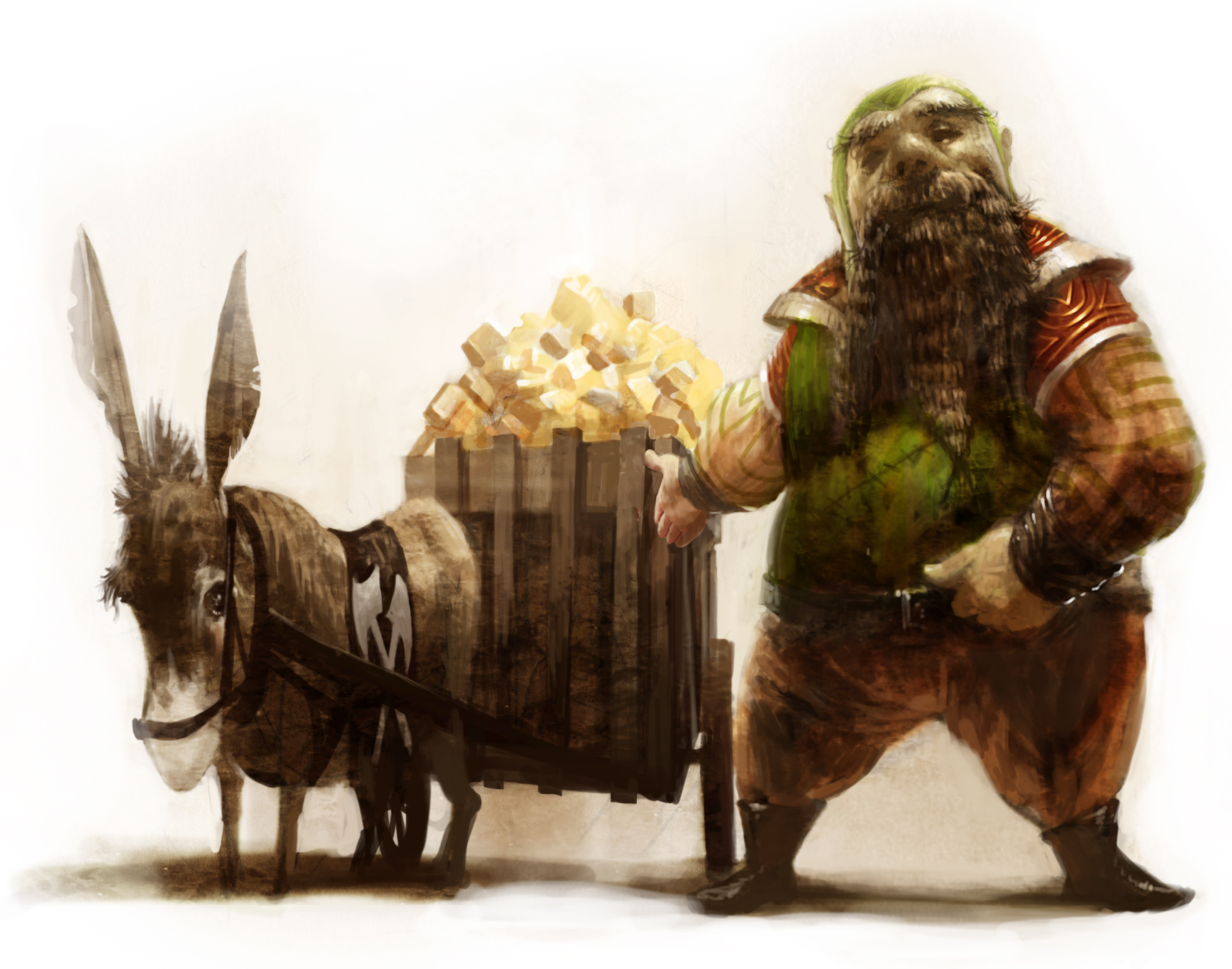
not gonna lie I included this mainly for that lovely cartoony donkey
If being ashort, wide, gruff, grizzled, no-nonsense human just isn't good enough, there are dwarves. They hail from the mountains of Mercia, and have long held a relationship with humans as a societal bedrock, where their long lives temper ambition from corrupting their tenets (at least on a human timescale) and dwarf society provides a constant backdrop to the roiling strife and eternal war of human society. Nigh-unassailable cavern fortresses, open to humanity in times of peace and locked implacably shut in times of war, retain vast stone libraries of information and hoards of goods and materials, the carefully curated and chosen contents offered out piecemeal to humans. There are two main pieces of tech the dwarves work to keep a monopoly on- clockwork, and gunpowder. Saresare, the perpetual rival of Mercia, has no dwarves, and as such Saresaren alchemists have developed gunpowder and dwarves have not been able to suppress the proliferation of the technology outside of Mercia.

Dwarves tend to be impatient with humans, and you must realize, from the point of view of a single dwarf(though not quite as immortal as elves, dwarves mostly just get rockier, not decrepit with age), humans are a gibbering horde of morons who undermine their own efforts constantly and are too short-lived to learn valuable lessons or ever truly master a profession. Unlike elves, who are typically isolationist and willfully ignorant of human society, a dwarf will see every step of their social engineering efforts wasted as crowns pass innumerable hands until they are sold as curios from a dead nation, a nation a dwarf probably outlived. Nonetheless, they soldier on, trying to forge the bad iron of humanity into a straight bar of steel, for the kingdoms of day are human-dominated, and for all their faults, humans are easier to get along with than the madness of the moonlands or the deep, dark earth. Some dwarves resent this simultaneously patronizing but servile role in relation to Mercian human society and leave, while dwarves who try to stay but do not conform to the rigid life in the underground are banished.

While humans surge and fall like the tide, dwarf society is crumbling from the bottom up, the darkness of the deep earth gnawing at their roots as it did their progenitors. Their subterranean cities tend to be half abandoned, with forgotten dangers in the lower levels that have been festering since the days when elves ruled the world. This is not well known to outsiders, but it is not a secret, it simply isn't talked about outside of grim and impossible quests to reclaim the lower levels from the dark. The dwarves are, so to speak, caught between a rock and a hard place when it comes to choosing whether to live above the ground or below it, unable to shape human society to their satisfaction but lacking the ability to stand against the deep dark forever.

Dwarves do not technically see in the dark. They love fire, and glowing bugs, and eerie phosphorescent mushrooms, but in the absence of these things, they learn to navigate like bats via echoes of clicking tongues or tapping picks, callused but exquisitely sensitive hands tracing the stone, and to fight like this, though they prefer to have flame. This does not work well except in enclosed spaces. Dwarves do not like weapons- a tool that can only be used to kill is a tool that is a waste of space and iron 99% of the time. Dwarves also do not like ranged weapons- their subterranean hunts are very different from chasing a deer through thickets in the wilderness, and in the close quarters of the underground, even throwing weapons are a risky business. What a dwarf does like is a good trap. Bear traps, deadfalls, nooses and snares, caltrops. All very easy to set up with a bit of time and an almost assured path the enemy must travel. They can even automate and time traps with their clockwork contraptions ticking away in the darkness. Dwarves name their gear that they've had for more than one session out of a combination of code-efficiency and sentimental hoarder attachment, and lose 1hp if they lose a named piece of equipment.
This is not a dwarf city. A dwarf city looks like the inside of a very cramped dungeon room with some dwarf-runes informing you whose house/workstation you're inside, because dwarves don't have empty space for the sake of empty space.
To a human visitor, a Dwarf city is cramped, smoky, undersized, and impossible to navigate naturally. They are often given lodgings in a large cavern to give them a break from the claustrophobia, and,are rarely told that caverns are weak points in dwarf defenses, bubbles of old chaos in the earth, at odds with an orderly and regimented maze of tunnels. The only thing a human visitor is likely to enjoy are the mysterious mechanisms(usually clockwork) that pump water, move elevators, and keep air circulating. These mechanisms are also commonly retrofitted into deadly traps if the fortress is compromised.

HALFLINGS-
The Beast Islands have little people living on them. They are the most like humans, simply shorter and more resistant to exotic ailments that are so common on the Beast Islands. Humans believe they shrunk to fit their small islands like the pygmy beasts and minimals so often found on the islands, while halflings believe it is humans who grew huge and clumsy when they found their way to the mainland from some lost island home in forgotten times. Some halflings adhering to this theory often call humans 'hugemans.' It is patently obvious to halflings and dwarves that they have nothing in common, though ignorant humans may confuse the two.
If you're playing as a human child, you may as well just use the halfling 'race.' The only difference is that you won't have any island-specific traits that a halfling would (low-light vision out to 30' being a common trait of Moonlander halflings).

Apart from a tendency towards individual halfling islands being a pastiche of whatever form of government I've read about most recently, I pretty much treat halflings as humans, just with frayed nerves from everything being bigger than they.

ALF
no, not this

True/High Elves, or Alfs, or Fey, have souls derived from the nameless and forgotten First Sun, self modified via the sorcerous Third Sun that begat the lesser Elves, then warped by exposure to a mote of True Darkness that brought about the end of their world-spanning civilization, combined with the revolt of the 'lesser bipeds.' Elven ruins scatter the moonlands, filled with bizarre wonders and terrors and things you recognize from legends only in how they aren't like the legends after all.
View post on imgur.com


You can think of them as Elves+, beautiful enough to make people go blind, more graceful than a cat, able to pick up a spell after seeing it cast once, with dance moves for combat and an unbridgeable cultural gap between them and mortal races. 99.9% of them are sealed away in the rusting hulk of the Iron Moon, where they plot escape and create new servitor races in the crumbling darkness. Each one is like elf Lex Luthor or something, hardly a unified species, just a bunch of immortal supervillains all nursing old, old grudges.

Unable to produce new elven souls after the Iron Moon debacle, they have swelled their ranks with the Fey, servitor creatures spun out of shadow and dream that are better suited for escaping the Moon. Fairies are actually spells. Goblins have no name, and their shapes are ill-defined save for being wretched, humanoid, and shadowy. If they can steal a name, they'll become much more real and human. Hmmm, best not to think too hard on that, eh? Moving on to Ogres, the muscle of the bunch, you get tough bastards who can turn into anything they've eaten, of a size of anything they've eaten. It's these 3 types of Fey you see most commonly in the trenches and ravines the massive chain of the Iron Moon digs into the earth as it wanders the sky, trying their dimwitted best to usurp the realms of men and usher back in the age of the Elves.

SVART
The original Dwarves, or Svarts, have souls indirectly derived from Yg-A, the undersun, and an accompanying greed that cements their true nature as dragon-kin. They are stone statues with bellies of fire, and must work constantly to balance the composition of their forms with the nature of the flame within, lest they hatch into a Dragon, or fade away into a lifeless statue (or more disturbingly for delvers in the Veins of the Earth, an almost lifeless and very hungry statue). They eat gems and gold and ore to gain experience, and flammable materials (especially alcohol) to fuel their inner flames. They also can devour light itself to fuel those flames, either from torches or souls. Their civilization is a thousand years broken, their deep ruins haunted by Grues and worse, their people lapsed into quiet dormancy. The last two great works of the Svarts were the Iron Moon, to contain the madness the Alfs fell to, and the Dwarves, who were instilled with soulfire of the 3rd sun, not the voracious 2nd Sun Yg-A, but not overcoming, their more fleshy sunlit forms. They fed upon light, but were consumed by darkness. Some are still born from the flaming wombs of the earth, stalactites dripping from the ceiling of magma chambers and forming a Svart instead of a Stalagmite. But they are born alone, and likely to succumb to the terrors of the deep earth before meeting another of their kind. Some Svarts live amongst Dwarves as semi-captive curios, each typically unaware of the other's true nature.

Preemptive link to Part II, in which I stop waffling on and on about ancient made up history and start waffling on and on about 'race as class' and possibly Ningen and Ghouls as well
Or maybe not, after all

Sunday, March 24, 2019

Meta-class: Secret Badass

This is not a 100% serious post. But it's not 100% unserious either. It is 100% a shallow exhortation to go watch Thunderbolt Fantasy though.

There's a trope in fiction of the god in disguise walking among mortals, or the ancient kung-fu master in disguise as a harmless janitor, or a witch who seems like a nice old lady but is also straight up Baba Yaga, or perhaps, on the lower power levels, simply an old military veteran slumming it with the rookies.. It's a fun trope, but at odds with the osr playstyle, definitely leaning more story-gamey. But perhaps it's not totally incompatible after all.

THE SECRET BADASS

 
me writing this metaclass and you reading it, probably

First, pick a regular class (or maybe like a monster like a vampire or werewolf or something). You start at level 1 just like everyone else, but for you, that's where you want to stay, ideally. Your experience works backwards. You *lose* xp while others gain it. You are hypothetically already at the levelcap of your campaign no matter how much XP  is written on your sheet, and your apparent xp level is how far you've been pushed and forced to reveal your true power, whereas gaining XP represents you spinning things to appear less impressive, blowing money to remind people you're just a useless drunk, people retconning their memories of your actions to fit your pushed narrative of not being anyone important, etc etc.
I call this OVEREXPERIENCED for shorthand reference


The most obvious way you can be pushed to reveal your true power is by running out of HP. You can instantly gain levels until your HP is positive again, and then say something like 'Tch, I guess I'll have to take this seriously..." or some such anime rot. You can also gain levels if you fail an attack or saving throw, gaining enough levels to hit or make the save instead, or instantly gain levels to use class abilities you'd get later- such as suddenly getting a few extra % points in Open Locks, or suddenly revealing that you can prepare Explosive Runes. The GM might require Hidden Powerlevel and  Stashed Hoard to declare you have specific spells+the spellbook for 'em, otherwise they may be randomly determined spells
I call this the HIDDEN POWERLEVEL.

Or on a more meta level, upon finding a fortress full of brigands, you could rocket up to level 9 fighter and be like 'At ease lads- they're with me' and then the rest of the party is all 'wtf Ol Barflozz is actually LORD Barflozz' and the brigands are all 'Ah yes Lord Barflozz, didn't recognize you in the fake beard sir, come on in.' Extra retainers and allies fall under this as well- you can gain a level to declare individuals are your retainers, pets, cowed past foes, satisfied former employers, etc etc.
I call this NAMELESS DOMAINLEVEL and if your GM's main objection to the class is the shared narrative control (that's storygames) this is the ability that should be cut first.


Another use is by revealing you have a magic spell, item, or ability that you've been sandbagging with. Like your waterflask is actually a Phial of Water Elementals, or your sword is actually the very same +5 Holy Avenger the church has been looking for. The GM must adjudicate the cost of this ability, but as a rough rule, each +1 or ability an item has is probably calling for a mandatory level-up. If you simply know where you stashed it instead of it being on your person, the GM may relent the multi-level gains required to use this ability and just throw it in a dungeon to be recovered unfair and square instead. It also works for monster abilities if you wanted to be a secret vampire or summat.
This is the STASHED HOARD

 Also, if you ever actually reach the level cap or are more than double the level of the lowest leveled party member, you get to finish up the scene you're in and then must walk into the sunset, never to be seen again, not even as an NPC. This is the FUCK OFF, ELMINSTER principle and assuming your players aren't trash you shouldn't really need this, but I also just read a forgotten realms sourcebook(0/10) and I really wanted to get that bold text out there.

And finally, there's the reason(s) you're lying so low. You probably have to roll a d20 each session and if you roll under your current level, your past shows up to bedevil you somehow.
  1. Pursued by 4+ Overt Badasses who are out to get you for whatever reason, each one being your equal and together being damn near unstoppable.
  2. Haunted by guilt over past failures and misdeeds. Unable to confront your past, if you lean too hard on your old tricks, the bad memories come back and you'll end up running away again, possibly all the way to hell this time.
  3. Curse stating you'll drop dead if anyone speaks your true name to your face. As you were super famous, you had to flee and adopt a new identity.
  4. Ancient prophecy about blah blah chosen ones, one of the other PCs fits the bill and you're caught in a balancing act of protecting them from the Dark Lord and calling down the Dark Lord's minions on everyone's head by your mere presence.
  5. Your power is stolen in some way, and the original owners are looking to collect. Deal with a devil, stolen goods, does it really matter?
  6. You just really hate domain level play and are trying to recapture the fun of being a low-level adventurer. If discovered, you'll have to slink back to your palace and go back to levying taxes and going to dinner parties where nobody even gets killed.
  7. Secret agenda you're pursuing. Has to remain very secret, lest rivals/enemies catch wind and shut you down, so you absolutely must avoid drawing attention to yourself.
  8. You're a gruff mentor figure with a dim suspicion that your role is to die after helping some young male take a few steps on the Hero's Journey, and so are doing your best to swerve the narrative into a different genre that's kinder to elderly people. Romantic Fantasy is probably too much to hope for, but Swords & Sorcery seems survivable enough so long as you avoid the lurking Survival Horror and Cosmic Horror on the edges.
just look at the detail on this puppet

Design Thoughts
This is pretty much the epitome of 'play it once to get it out of your system' design, allowing players to taste the high levels or play as a high HD monster and realize it's less of a big deal than they imagined. The trick, I think, with exotic oddball classes and so on is to scratch an itch a player might have, without making everyone else itchy in the process. Some oddball classes end up fitting into the world well enough, while others get quietly dropped after a while, and this is actively designed to fit into the latter category. Curiously enough, I think this class is actually less of a problem the lower the powerlevel of the game is. A level 20 BFRPG character honestly doesn't have all THAT much going for them in a vacuum- someone who organically reached that level would have all sorts of odds and ends, but shooting up to level 20 in an already bad situation might do nothing but buy you a few extra rounds to live... and since you CAN bloat your levels, you're more likely to try that instead of something sensible like hiding in a coffin, and so end up dying anyway. In later editions like 3e/pf, 4e, or 5e, it would be a whole nother story of course.
It also might be fun to run a semi-cooperative semi-competitive game where everyone is a secret badass with conflicting secret missions going through somewhere very lethal like Tomb of Horrors, but their true powerlevel is kept secret (true powerlevels being 10+1d10 I expect) so the idea is to suss out everyone's capabilities. And of course if you manage to stay at level 1, everyone else has to tread carefully lest they be banished by the Elminster Principle.

Monday, February 25, 2019

Fairies are the Elf Spell List

Fairies, as in the Tinkerbell variety (or the GDGD Fairy variety if you're weeblord like me),

and they said there was no good cgi anime
 are anthropomorphized spells. High Elves are behind this, of course. More on them later. That's why fairy personalities lean one note and its never really clear what their society is or what they do all day. Because what they do all day is whatever their creating elf mage told them to do, filtered through their dim-bulb artificial minds of rune-logic 2 suns out of date.

Elves have reasons for turning their spells into fairies beyond elvish weirdness, of course. For one thing, it allows them to delegate the casting of useful but low impact things to their fairies, and to adjust the purpose and scope of a spell via plain-elvish instructions rather than involved and expensive thaumaturgy. For another, it appeals to their vanity to have slavish minions. And non-elves are likely to interact with fairies as though they were people and not anthropomorphized spells, which gives Elves a vague advantage via the power of misinformation and deceit. (There's a reason all elves were sentenced to eternal imprisonment within the Iron Moon, after all- they're dicks. But worry not, 99% of the elves you meet aren't real elves).Anyway, fairies don't cast very powerful spells, but they can cast them at will, forever.
Fairies, and also the Elf Spell List (that is probs partially stolen from someone(s) but I initially wrote this list on the back of a scientific research paper I dug out of a university dumpster 6 months ago so don't expect any citations)
They tend to be encountered in groups of 1d8, have 1hp, AC as plate +3, and about can fly as fast as a horse, while others must slowly creep about like mice (and have AC as chain). They can use their own spell at the lowest power setting infinitely, or one step up if they work together in a group of 3 or more.

Lower numbers tend to all know different spells, while larger groups tend to all know the same spell. Use a d8 to determine which, the 9th and 10th spells were never mass-fairyfied.
Wizards can eat them to learn the spell, and swatting them with a rolled-up-newspaper equivalent causes them to revert to spell-form and turn into a scroll. Their cute appearance and desire to continue living may be nothing but elvish self-preservation rune-programming, but at the end of the day its up to you if you really want to be this guy.


  1. Glamour
  2. Mirror Image
  3. Eye Game
  4. Fairy Gold
  5. Elvish Override
  6. Slumber
  7. Jewel Wings 
  8. Elf Shot
  9. Elf Shield
  10. Fairify

+1
1. Glamour- Clothing and makeup becomes awe-inspiring, providing your choice of a bonus to reaction checks, friendly morale, or a penalty to enemy morale. +1 hour and bonus/malus per spell level/MD expended.

+2. Also go read dungeon meshi already jeez
+3, obviously in the 'intimidation' sense


at +4 things get kinda weird but it's all illusion don't worry about it
Glamour Fairies
These are basically the fashion police. If you don't accede to their demands to change out of your armor and into whatever garments they have on hand/are already making minutes after seeing you, they will be forced to go to increasingly extreme lengths to make you fabulous. Tricking you into a garbage pit and stealing your clothes while they're hung out to dry is plan A, after that things start to involve rust monsters, slandering your identity to local townsfolk by describing your clothes so you have to adopt a disguise, hiring mimics to turn into your clothes then leave you naked later, and if need be, stripping your corpse and dressing that up instead, possibly allying with a dread necromancer to make your newly adorned corpse walk down a fashion catwalk.
Or you could just put on the clothes. And the ones after that. And after that. And...

2-Mirror Image- Though the obvious combat use is creating a mirror image of yourself, you can create a mirror image of anything you can see. It is silent and insubstantial, but otherwise totally visually convincing... at least in terms of what you can see. If you copy a castle, the side you can't see and the interior will be nothing but fuzzy static. Once touched, the illusion pops like a soap bubble. Whip up up to 1d6 copies per dice/spell slot level.

Mirror Fairies- These replicate via mirrored surfaces, and don't tolerate the poor copies. Mirror fairies are frequently to be found hunting down choppy 'puddle fairies' that were reflected from a puddle, viewed from below, or 'grey bulge' fairies, reflected from overly shiny breast plates. They will go to any length to acquire quality mirrors, and are intelligent enough to extort adventurers for gold via neverending mirror tricks to bedevil them, or assist them only to demand payment later. Mirrors are expensive and heavy, after all, and fairies are poor and small, so it's up to you adventurers to secure them their perfect reflection. Subsequent generations of mirror fairies are invariably slightly dimmer and off-color than before, preventing infinite replication, but a few generations of difference from a good quality mirror are tolerated. A final quirk of behavior is that mirror fairies never admit that they are anything but an illusory reflection. No matter what.

3-Eye GamesSemi-permanent invisibility to a target, but with a random twist.
1-Only invisible so long as you hold your breath. So long as no one sees you doing it, you can take a break to breathe visibly, and then become invisible again by holding your breath.  
2-Clothing and equipment not made invisible. You become visible once you get the invisibility dust rubbed or washed off from the friction of movement and so on, in a day or so or if you put on clothes/get splashed by water.
3-Only invisible so long as you keep your eyes shut. If you can see through your eyelids for some reason this won't work- it's operating on the 'they can't see me if I can't see them' principle.
4- Piece of cloth, usually a cloak, is made into an invisibility cloak that is itself invisible as is anything beneath it. Ends once you drop it or somebody not under the cloak touches it.
5-Only invisible so long as you don't hurt anybody or break any laws.
6- While standing still, you're invisible.

No See Ums- Tiny people more often invisible than not. Get super shy and tongue-tied if their location is known and they know its known, otherwise cheeky devils. Incorrigible thieves, eavesdroppers, voyeurs, and gossips of course, but you already could have guessed that. Their favorite game is hide and seek, and they often have the assistance of a scary monster to raise the stakes of the games. They'll assist you with their magic, but if you aren't a good sport, they'll assist the monster instead.

4-Fairy Gold
A trick that turns leaves and acorns into coins and gems. The transformation only lasts until midnight and is ended prematurely by contact with iron or seawater, and the bigger your scam the bigger the ensuing fallout, of course.

Leprechauns
Typically working in tandem with other fairies, providing fake gold to tempt you into going along with various fairy shenanigans. Initially quite friendly, they will munificently buy you whatever you wish, with predictable results in a few days and one leprechaun that is just shocked and appalled at how cheap human gratitude is. They will hint at having great treasure hoards that they draw from rather than admitting their trickery, and will quickly go from friend to foe if their generosity is met with suspicion or greed. If their ruse is revealed, they will defend their actions as that of a freedom fighter, expanding upon the virtues of a gift economy and the vices of the marketplace.

5-Elvish OverrideCompels a group of fairies to perform a specific number of tasks for you. The exact number is irrelevant because if the fairy likes the task it won't keep track, and if it doesn't like you or the task, it will declare things like 'breathing is a task' and hold its breath until it falls over and passes out. They will also inevitably get bored and wander off after an hour of cleaning or carrying the lantern or whatever you set them to.

Unbeknownst to many, this works on any elf-created magical being with the proper safety overrides in place. Goblins, Ogres, guardian golems and of course any undead raised by an elvish necromancer. If they make their save vs spell they can never be affected by that copy of elvish override, but if they fail, they will immediately become nonhostile, and maybe even helpful.
Against humans, elves, and dwarves, this functions as charm person and charm person is in fact a misunderstood elvish override.
Unbeknownst even to True Elves, There is a Snake Override that works on Alfs and Svarts.


idk who this is but they came up when i searched 'pixie lord'


Fairy Lords- Inherently respected and obeyed by other fairies. Expect that respect to be found in all other living beings too, and will sic their fairy posse on those who do not show proper respect to the lord. They are inevitably found with some extra minions, and they work tirelessly to create warped imitations of royal life, demanding palaces, courts, royal balls, etc.
1- Goblins- nameless, shadowy, only able to own what they steal.
2- Ogre- Cruel, stupid, flesheating. Able to change into animals of equivalent HD they have eaten.
3-Impressionable Humans- Naive, gullible, easily overawed.
4- Cu Sidhe- Huge, intelligent green dogs with silky flowing hair. Also know an innate spell, but use them for hunting.
5- Assorted small animals, half-trained.
6-Roll twice/other

6- Slumber-  Max HD of target must be equal or less than [sum]. All allow a saving throw as usual.
If using vancian spell system, Dice=Spell Slot Level used and max HD affected is Spell Slot Level x4
1 Dice- Target falls asleep. Can be woken by shouting in ear, splashed water, slap upside the head, etc, but will be content to ignore the current sound level and mild jostling such as being carried or tied up.
2 dice- Target falls VERY asleep- will only awaken upon taking damage (from attempted murder or dehydration)
3+ dice- Target falls into enchanted slumber. Progression of aging, hunger, poison, disease, etc halted. May only be woken by a specific conditional, like the kiss of royalty or the crow of a hen.

Sleepmaid-These diminutive, moth-like fairies are used as guards, medics, assassins, and sleep aids in about equal measure. Their go-to response to an uncertain situation is to put everyone to sleep, rummage through belongings, then decide what to do from there. They do not kill unless specifically ordered to, as stab-happy fairies are likely to create more diplomatic incidents than they solve, but they will occasionally send people into sleep-stasis and await further orders from command (and command has probably been trapped in an iron moon for a few hundred years, so they may be waiting a while).


7-Jewel WingsTransforms the caster and up to 6 others into hummingbirds for a day, or into hummingbird moths for a night. Equipment is not transformed, and HP is 1 and AC is as Plate+3 in these speedy but fragile forms. It is unlikely spells can be cast in this form if gestures and incantations are required, but maybe you got lucky and had a spell that was originally developed in the squeaks of hummingbirds/moths, I don't know your spellbook.

Flitfey- The joy of flight is to be shared! Flitfey are forever trying to get people to fly with them, even if that means leaving out the details of what 'the gift of flight' will actually entail. While the spell only works on the willing, ignorance is no object. Any wingless fairies traveling with Flitfey companions will likely be transformed into hummingbirds or moths when encountered.
Their wings have worth as per gems if recovered, too, you fairy-eating monster
8-Elf Shot
This is magic missile by another name, dealing 1d4+1 damage and manifesting as a bow of light that fires unerring arrows of arcane energy that tweak their effects on the fly to harm anything with HP that is not explicitly protected from magic missile.


Killswarm-
There is a human cultural impression that elves are excellent archers and that elvish archery is the best on the planet. This has some truth- elves have good vision and lots of time to practice silly trick shots. In fact though, this impression comes from historically vague depictions of fairy killswarms, deployed in ancient times to hunt and kill anything that threatened the elvish empire. Killswarms(and the many, many variants of magic missile used by humans) are also anti-fairy countermeasures, instantly popping the hard to hit but easy to slay mobile spell platform that is a fairy. Killswarm fairies are angular, lean, and deadly paranoid- in their war, whoever is seen first by the enemy is dead. Whoever falls for bait and fires their Elf Bows at the wrong target, is also dead. As such, they are considerably less trigger-happy than you might expect, and will usually ask questions first and shoot later, and scatter for cover in a mad panic after focus-firing one unlucky target down- they're always expecting the counter-attack from a rival killswarm.

9-Elf Shield
This spell can be cast with a single exhalation of air, not even a full word. It is far from a perfect defense, but it is a VERY fast one, and it is pretty as well, a sort of opalescent shimmer, a rainbow seen only in peripheral vesion. It gives +4 AC to the caster or target, and does not stack with armor. This explains how elves can fight in such ridiculous getups and not die. Most importantly, it blocks Elf Shot, and indeed all variants of magic missile, and it falling into the hands of the Witch-Queens was a big part in the ultimate imprisonment of the high elves in the Iron Moon.


Shieldswarm- Shieldswarms were an attempted counterplay to killswarms that failed for obvious reasons- if the shieldswarm protects itself, a valuable target dies instead. If the shieldswarm protects the target, the shieldswarm is obliterated by elf shot and the shields drop. It was easier to bait out killswarm attacks with Mirror Image, or avoid them with Eye Games, or commandeer them with an Elvish Override. As such, Shieldswarm fairies are basically extinct.

10-FairifyThis spell removes a spell from a book (or whatever the permanent abode of the spellwisp is) and turns it into an adorable fairy that looks fondly upon its creator and can cast infinite uses of a spell. Unlimited power will soon be yours, right? Well...

One of the many downsidesis that the fairy is not particularly intelligent, is overly enthusiastic about using its spell incautiously, and must be treated fairly well (or constantly micromanaged with Elvish Override) to ensure its continued cooperation.
this is you trying to get out of paying your fairies
Treat it as a retainer in terms of getting half-shares of XP and treasure- the treasure goes towards keeping the Fairy happy(their tastes are exotic and varies based on the spell), and the XP is lost from the inevitable consequences of delegating adventuring instead of doing it yourself..

Fairies cast spells with 1 magic die that always rolls a 1/as a level 1 spellcaster with any variables also always rolling 1, and will almost certainly  be subject to many nerfs that the GM finds appropriate, such as Polymorph only affecting one limb at a time or Light manifesting as the fairy glowing as a candle.

Tuesday, February 19, 2019

Kings of The Jungle

The Lion and Tiger are both kings, but they are different sorts of kings.
They can speak to any living being, but rarely deign to do so. How often do you try negotiations with the flesh YOU eat?

YE  LION

You can challenge lions with manes to duels, and they will accept. Defeat them, and you will become the new leader of the pride. Lose, and you will either be eaten, or enslaved, or the latter first and the former later. 

After winning, if you are too in-tune with being a de facto lion, too happy with your killer lionesses, too pleased to devour red meat, then you yourself will become a lion some day. Every time you trust your life to the strength of the pride rather than your human(ish) fellow adventurers, every time you risk your life for the sake of the pride, perhaps by defending your claim against another challenging lion, or choosing to aid a lioness over Patsy the Torchbearer #3. The empty throne of a King of Beasts beckons your soul, and eventually, your soul will realize that it is not just acting like a lion, it is one.

If you are not in-tune enough, too happy to treat your lionesses like tame attack dogs, insistent on cooking your food and eating apart from the pride, then the pride will abandon you eventually, sooner or later. The lionesses will mock you for tolerating other males, and snarl at females(they frequently don't ID which is which correctly, and don't really care). They will eat the pack animals and call you a fool for not doing so yourself, if they even deign to address you. And then they will leave.

This dynamic is not what most people have to worry about. Most people have to worry about being eaten by lions, specifically lionesses.

Lionesses hunt in packs, and the maned lions are not invited on these hunts. They are usually content to slaughter a horse and leave you be, but lions eat a lot of meat. If your group proves easy prey, they will find you again and again, taking you down one at a time, and they do not fear fire or magic, they only respect the danger. They could use such things themselves, if they wanted to (they don't). They are beasts, true, but they can plan and scheme and speak if need be, activating rusty abstract thoughts from disused corners of their minds.

Sometimes lionesses take people alive and bring them to the maned lion. Lions ruled men, long ago, and sometimes they enjoy putting uppity humans back in their place and showing them how useless they are when stripped of their tools and social structures. They will not ransom prisoners, or negotiate hostage exchanges. If someone is taken, you have to take them back, and the lions will oppose you with unflinching violence. That word, Pride. Did you think it was chosen by coincidence?


So, there you have it. Lions are the Lawful kings of the jungle. What then, of

YE TIGER


The Lion is, ultimately, no longer king. Once unquestioned royalty, now less so, lawfully diminished and jealous of the dominance of uppity apes with spears and domestic animals. Tiger is a tyrant-king, usurper of thrones, that which spat in the eye of the sun. Tiger is the Chaotic King of the Jungle, King not because any serve Tiger, but because Tiger takes what Tiger wants and none have the power to say otherwise. Every tiger has two names, but they will not tell you either. Every tiger has a history as a housecat, a cat so cunning, ruthless, and iron-nerved that it killed 100 dogs, upsetting the natural order and becoming a Tiger. Everything a Lion has is inherited from their royal bloodline. Everything a Tiger has was earned. Tigers think often on how superior they are to Lions, but Lions rarely think of Tigers at all.

Tigers work alone. They prefer to strike from ambush, slaying in a single surprise round. They flee what they cannot kill, and prefer to kill humans. Tigers are not beasts, they are monsters. It is unclear whether the transformation from cat to tiger made them monsters, or if all cats are monsters to begin with. Tigers may speak with you if it amuses them to do so, or if they think it will give them advantage- unlike lions, they have no pride, and so nothing they do demeans them, and so there is nothing they cannot do.

Tigers swim, tigers climb, tigers sneak. Lions can see at night, but prefer to sleep through it. Tigers are the night. Their black stripes are marks of darkness and chaos, and their function as camouflage is incidental.

Cat-Lords, RakshashaTigers that eat 100 men violate the natural order still further. They can look like men, or tigers, or both at once. Mortal magic and steel cannot touch them, as mortals are yet bound to the natural order, and a Cat-Lord is not. A blessed crossbow bolt kills them instantly, a perfect, inexplicable confluence of the fading dominance of sunlit gods and torchlit civilization over these feline nightmares. They pick up the workings of magic easily, the chaos of their stripes now reaching their souls and letting them warp reality. Think of it as thusly- when a mortal shapes their hands just so, they might create a shadow vaguely resembling a duck or rabbit. When a Rakshasha shapes their hands just so, they create a duck entire.

Some cats are content to merely become tigers. Any cat mad enough to to become a Rakshasha will not stop. A Rakshasha's next goal is to devour 100 gods. What it will become should it succeed, none can say, for Dogs send champions to slay the beasts at any cost, a much delayed revenge for the prior slaughter of 100 of their brethren.

Tuesday, January 29, 2019

Sunset Realm Cosmology and Religion

I'm tying the last 4 campaigns I've won into an overarching setting, because that seems the best way to build a large setting up, really. Having some pictures to break up these walls o' text is definitely necessary but I can't lie, this post is more for me to organize some stuff to a single area than for anyone else.

First Sun
The First Sun gave light and warmth, of course. It  gave form and law to the Elements, who form the world in a covenant of cycling matter that returns warmth to the Sun, with interest, warmth and soul growing from what seemed dead and dark, with a seed of light to germinate within.

But the darkness was vast, and the Sun could not illuminate all things. The world was made, but outside the world, the darkness remained. From behind what was lit, shadows were cast, and they stretched to the very edge(but no further) of true darkness and there were seized by a ruinous nostalgia for unbeing, and so the Sun was torn asunder. But the Shadows were illuminated by the light of the sundered Sun, and they became glowing Moons, and their moonlight, pale as it was, sustained the world, though much of it became shadowed and chill, and the forgotten First Sun's world grew strange indeed in the light of roaming moons.
Yg-A incited to devour his fellow moons, shed Yg, and become Second Sun
Then Yg-A the Snake Moon fell prey to a hunger within, born of stolen and diffuse light, a hunger called Fire, sometimes called the Light Degenerate. Yg-A devoured many moons and, wonder of wonders, ignited into a Sun, the Second Sun, and Yg-A became the Dragon-Sun, scaled and fiery, and Yg the Mother of Serpents came to be from the shed snake-skin of Yg-A, and the world became as it once was, but different, dominated by the hunger of flame-bellied serpents, the dragons. Very few dragons nowadays trace lineages back to the Second Sun, but those that do are terrible indeed.
Yg-A Becomes the Undersun
Yg-A's hunger was bottomless, for Fire knows not satiety, and as the fellow Moons were nearby... The Moons fled before Yg-A through air, and some still shake in the distance, watching the world from the edge of darkness fearfully lest Yg-A return. You may know the Coward Moons as Stars, and this fear of cannibalism is why Moons only rarely share a sky with each other. Yg-A turned Fire-Hunger towards the Earth, and, jaws gnashing, sank into the earth in an attempt to consume it. Yg-A knew not of the covenant violated, and the Tamed Stone took Yg-A's heat and became Magma, who worked to undo the breach of the Covenant by returning heat to the Sea and Sky too via Volcano. Yg-A was weakened and forgotten, his light no longer supporting the surface dragon-kind, sunk to the depths of the dark earth just as the fearful stars fled to the heights of the dark sky. Then on the dying, sunless surface, bipeds of great cunning collected the scattering light and heat and bound it into a forged vessel, the Sorcerer Sun, the Alf-Star, the Rune-Light, the Third Sun.
Towers from left
High Elves, Svartalves, Ningen

And the world became as it once was, but different, dominated by elves, or so the serpents of Yg let them believe. The elves spun things of light and the tamed elements, until they tired of such things and spun stranger, more dangerous things from moonlight, until they too tired of that and began to spin things from shadows... and then, a single thing spun from Darkness itself. They could not understand what they had wrought,  and the elves forgot what they were, mind, body, and soul, and the Svartalves below and the human Witch-Queens above stole the light of the Sorcerer Sun and trapped the warped fey inside the dark structure, and cut its tethers, sending it to roam as the Iron Moon.The moons and darkness closed in, but the stolen light was released once more, weakening the Witch-Queens and leaving the Svartalves to be swallowed by the darkness beneath their mountains. The released light coalesced as a mirror of men's souls, and thus was Riikhus, the Fourth Sun
Big Head Gods- Riikhus, Mokkhus
Lil gods- Lady of Gardens, Murulu, Kispiritis, Jackal then Horse god of Yuba
Also the burning remnants of high elf/witch queen society beneath the Iron Moon
Riikhus did not know what he was, so he looked to Man as example, and saw they called things greater than themselves Gods. So Riikhus called himself God-Sun, and around Riikhus clustered many things that too called themselves Gods, and so the rule of heaven was much like the realms of man, now. Many Gods there were (and had always been, by other names), vying for the heat of the living, which they called 'soul,' and many who opposed Riikhus were cast down and enslaved. But some were his ally, like Mokkhus who called himself Brother of the Sun.

Moons Clockwise from left- Winter, Autumn, Spring, Skull
Gods counterclockwise from left- Dying Riikhus, Rejoicing M'shesh, appalled Lumar
Then came Sarkomand, who found the lost thing of Darkness and became all-powerful, or so it was dreamed, and the dream was maintained by Lumar, who remembers forgotten things and shivered in her mirror-realm as she played at being the one and only Moon. But the dream was a bridge between dark and light, and many gods were drawn there, and as Riikhus now sought to bring all gods beneath his yoke, he could not stay away. Upon that bridge, Proud Riikhus and Broken M'shesh contended for the second time, but a human, Townlocke, turned from Riikhus in favor of M'shesh, and she retrieved that which Sarkomand lost, and stripped Riikhus of much of his might for the sake of establishing the new coming of M'shesh. Weakened Riikhus left the dream, never knowing that Lumar's deception was a mantle of protection laid over him, and the covetous Moons descended and devoured Riikhus, and the proud Gods who contended against the ravening Moons learned that 'God' was only a word, but Moon was a thing. Of the devouring moons, five took the lion's share of Riikhus's corpse- the moons Skull, Winter, Spring, and Autumn, and Lumar, who was not a true moon, but only a dream, a reflection, an opportunist. Unable to long hold what she long cherished, the light reflected from her scalded arms and burst forth from the dream as the 5th Sun.
5th sun, assorted moons, cultist on a hill
The New Sun is a dream, a reflection. Men called it Heleos for it made its home in the sky above the ancient island academy of Heleologos, or Sol Triumphant, for the glutted moons were driven before it like wolves before a vengeful shepherd, and those more knowledgeable called it Sleepwalker, or those more heretical, False Dawn, but it did not respond to these names, whether called by men or by gods. It only crackled across the sky, swift as a chariot drawn by lightning, driving off the moons, and maintained the light of the world. It is a mindless thing, a child of Lumar's unrequited love and Riikhus's reflected glory, begat in dream, where perhaps it should have stayed. Now the edges of the world bleed sunset and the dark ice and ruins of past worlds edge closer as the False Dawn chases moons in circles round Heleologos.


Widespread Religious Understandings

If you're inside the black ring you're in the Noonlands and don't have to worry about Moons
The black ring encompassed Sarkomand's Faults a century or two ago because the 4th sun was brighter than the current one
Heleognosticism- The cult of Riikhus and the slave-pantheon is broken, but sun-worship survived. Their prayers fall upon the deaf ears of the False Dawn, but their arcane secrets are just as miraculous as faith, especially with what was wrested from the overseas colony/dream of Sarkomand's Fault. Knowledge is to be found from light, and any truth that dwells in darkness is suspect. Pyromancers collect shards of suns and embed them in their palms, pain enlightening them as they are consumed by flame. Other researchers contemplate matter, their understanding of the world composed of God-dogma and fragmentary understandings of the forgotten elemental covenant. Most spells come about via the study of the soul, the study of gods and fey and ghosts. Most noonland kings have a Heleognostic as court wizard, and most wizards of the noonlands trace their spell-lineage back to Heleologos. Heleognostics and those sharing their cultural influence are spiritually aloof, perhaps in imitation of the False Sun, and do not pay polytheistic homage to local gods, relying on their own enlightened intellect and the enlightening Sun and Flame to protect them from jealous godlings and moonspawn.
Worshipper Goals- Trust in the sun, spite the moons, shun the darkness. Knowledge is power, and what is unlit is unknown.
Death Expectations- Become one with the Sun, strengthening the light and opposing the darkness as a united, transcendent whole. Dream-realms and afterlives where souls maintain individuality are ignorant of their true potential as sparks of the divine sun.
tl;dr- Fedora-tipping nerd wizards scared of the dark

The Undersun- Yg-A lives and writhes, far below, shrouded in magma in the bowels of the earth. The convulsing ur-wyrm fans heat into the flame degenerate and consumes souls, or heat, in his endless hunger, but his flame is too his prison. Fire is an excellent servant but a poor master, and those serving the burning below have no guidance, only flame and more flame. The Undersun is rediscovered again and again, and misunderstood again and again, and so every new cult is different. Especially in the Moonlands, where the Sun does not shine, the reliable heat and flame from below draws human adulation in lands otherwise locked in chaos and darkness. All that burns is an offering to the Undersun.
Worshipper Goals- Variable. Death cults where people get thrown into volcanoes are just as common as people who simply use a volcano for heat and light in a frosty Moonland.
Death Expectations-Variable, but the ultimate end of those who align themselves (or rather, their elemental covenant) will find themselves transformed into beings of fire that dwell in the depths, drawn towards the Undersun but unable to bypass the maze of stone and lava. "Demon" is a popular term used for these flaming chthonic souls when discovered hundreds of years later by people with different moral outlooks.
tl;dr- volcano sacrifices
The players never did find their way into the warped mirror world variant of the first level of Sarkomand's Fault's megadungeon and so Lumar was p much toppest secret even though she was 'meant' to be a fairly big deal that campaign.
But I didn't force it and it was fine. Moral of the story, don't force the story.
Lumar- A mirror-goddess, a dream goddess, doppeldeity, taking all forms save her own, for she has none. Her female nature is ascribed to her by mortals as a perceived contrast with dead Riikhus rather than any self-ascribed nature. Perhaps she and her shadowy mirror-realm existed from one second after the first sun glinted off the face of the dark waters, but perhaps it took the humanity of Riikhus to make the reflection of a sun take on a mind as well as life. She keeps secrets of past solar ages, and as she consumes secrets to replace with lies, she weaves deception so complex it has become a sort of truth of its own. This is the dream-realm, the mirror-realm, a realm that looks like light, but is not, looks true, but is not, is, but is not. Fakes have many advantages over the real thing, after all.
Lumar is everywhere there is light to reflect from things, everywhere there are souls to dream, but she does not exist within the 'real' world, a secondhand existence of perception, not reality. Her servants are less of a cult and more of a conspiracy that infects existing cults and social structures, their actions tipped towards the obfuscation of knowledge. Riikhus opposed her and knew not why, and now the knowledge-loving Heleognostics do too.
Worshipper Goals & Death Expectations- Those who serve Lumar are typically unaware they are doing so, as Lumar can imitate anything. The mirror realms and dream realms that are her domain are open to the living, so perhaps the dead souls of Lumar continue their work anonymously.
tl;dr-Illuminati

Yg- Mother of serpents. She is older than elves, older than dragons, yea, older than the word "god," and certainly wiser than them all. A snake content to watch over snakes, the one god she opposes is Lumar, for Yg seeks to know all, and perhaps one day, swallow all. But for now, she tends to her snake daughters(Snake sons are hopeless, alas) and coils in the deep dark earth and the deep dark sea and the deep dark sky, encircling this world so much tinier than she remembers, and she waits. Stars blink more often than she. Yg is not a god of mammals, and they must shed their skins to become snakelike to gain access to her venerable knowledge, though wise humans do not meddle with snakes regardless, lest they draw Yg's ire. Unlike the torchbearing Heleognostics, Yg knows that darkness holds knowledge as well.
tl;dr- osr snakepeople

Moon Cultists The moons are ancient facts of life outside the Noonlands, and bring life and light, albeit in twisted form. There are a thousand moons, each with some moonlit cult out in the darkness. The 4 greatest ones, that ventured into the very Noonlands to devour Riikhus, have the most prominent cults.
i love this image for Skull so much
one day I'll find the source
one day...

Skull- A skull of a murdered god, resting in a moon shaped like a broken and empty shell, maimed long ago by Yg-A and still fearful of the touch of flame and sunlight. Undead, created not via a soul piloting a body in violation of the elemental covenant, but stolen bodies operating with the soulless light of Skull, the elemental covenant hijacked to steal the heat, life, and souls of other creatures and offer it to Skull. The undead of Skull are always human, but certainly not people, and know only hunger and violence. Skull cults (AKA Skults) slowly take the light of skull into their body to replace their souls in a bid for immortal undeath, and do so via the slaughter of the more 'traditionally alive' and self-mutilation. The end result, a Lich, has an artificial soul composed of Skull-light that behaves very differently to warm souls which continue life in various underworlds. Heleologians claim that Liches, like all skull undead, are not the same person as the lost soul, simply an evil copy, while Skulltists are certain that the continuous consciousness ensures it is a transfiguration of themselves, not a replacement.
tl;dr- these are the necromancers and undead you CAN'T play as

Spring and Autumn- The life of these moons at first appears quite similar to typical birds, plants, and bugs, but quickly become something else. Toxic, spined, perfumed. Autumn harvests the hard elements of the earth with bronze birds, iron butterflies, and steel magnolias, and Spring the cycle of life via delicious fruits, bugs, and birds as lures, and fruits bugs and birds that find you delicious. The cults of these twin moons range from experimental hippie types, to biologists-gone-wild, to ravenous maenads. The end result is all that matters- the thorn forests and flower jungles sprout up, and then the winged beings spawned from them return to the moons with all they have harvested from the world, adding themselves and all they have to the mass of the moons, which, on close inspection, appear to be scapes of petrified beings slowly consdensing into the bulk of the moon.
Worshipper Goals- Party hard. Follow the moons, whatever it takes. The drugged/poisoned fluids of the moonspawned lotus-jungles are without compare. Also you can get resurrected as a plant or bug mimic-clone in certain seedpods or cocoons, so you can party really hard.
tl;dr maenads and instant off-climate magic jungles
Winter- In the border Noonlands, winter is understood as chilly times when cold weather blows in from elsewhere. In the Moonlands, it is understood that Winter is a moon whose light is fearful enough while obscured by its frozen clouds, and should they ever part, the land below will be flash frozen into an ice age. Noonland "winter" is basically just a feeble, distant shockwave of these events. Winter is why the world out where there's not even reliable moonlight is an uninhabitable frozen wasteland of black glaciers grinding ancient forgotten civilizations to rubble and why you sometimes find animals that are 3 times bigger, hairer, and fangier than 'normal' animals.
Worshipper Goals- The worshippers of Winter are disgruntled doomsday preppers, essentially, certain that the world will, sooner or later, become a frozen wasteland where the strong eat the weak and pacts with vile spirits will have to be struck for survival as mortal civilization collapses, and after our so called "King" elected Sleeny Alazneer as Chancellor of Finance, the end of the world can't happen soon enough I tell you wot. Some of these nasty fellows even raid and pillage preemptively whenever the weather gets cold. These people, who adopt names like 'cold-eyes' or 'sons of winter' and so on, are not to be confused with 'bandits' who typically have more relatable reasons for being assholes.
tl;dr dire cave animals and instant off-climate ice age survival
LOCAL GODS-  If there is a local god in your vicinity, you are well advised to leave offerings at their shrine. This is less worship and more of a 'please don't mess up my face' fee and while it generally won't give you any divine favor, it may at least take certain angry spiritual-servitor-things, weather disasters, and so on off encounter tables and similar low-impact probability tweaking. There is no hard limit on the use of the word 'god,' here it pretty much means 'any being powerful enough that it's basically a faction all on its own.' What's a faction? Well, that's a matter of scale, innit? What might be a 'God' to a village might barely quantify as 'big monster' to an empire. 
The whole island is the corpse of the dragon-turned-god Ebeth, you see
Ebeth- Dragons know not the difference between Need and Want, but one dragon knew Pity as well, and sacrificed itself to feed a pitiable race of insects. Ebeth became a corpse island of golden dragon-flesh, and his will lives on, in the giant insects and awestruck humans alike. He is not dead so long as altruism lives on, but his church is fractured between humans who want to improve their lives by looting his corpse, and of the original insect-people who view the humans as greedy interlopers taking more than their fair share, and the original message is muddled.
Arrkohn- But the brightest lights cast the deepest shadows, and Ebeth had a shadow too. Preaching self interest, not generosity, the dragon-cults of Arrkohn the Black serve themselves and themselves alone. They believe even the altruism of Ebeth was just a self-serving act to satisfy Ebeth's golden ego, and will prove to the world that true altruism does not exist, only things that people Want and Need. It's not 100% clear if Arrkohn is an actual thing or just something that dragons co-opt to jumpstart dragon-cults as a gold-gaining scheme.

These two dragon-gods are a player-suggested contribution, not my OC.

The moonlands are more ruin than civilization. Without the order-imposing light of a sun, the chaotic forces of moonlight and darkness quickly erode the stability of mortal civilization.
Saint Bridget- Awesome nautical adventuress-saint. Outside of her local worship in the weird little village of Bridget as a protector and guide to those lost on the waves of fate, her opposition to the piratical god Kispiritis who was part of the Riikhus slave-pantheon back in the day makes her an anti-authoritarian figure in the eyes of the Mercian-descended inhabitants of the region.
Worshipper Goals- Follow your dreams, protect those you love.
Death Expectations- As a 'mere' human the afterlife she sustains is relatively small- a ship, captained by herself, and crewed by all her adherents, sailing the seas of the world.
Kispiritis-Though it was confirmed he escaped the god-devouring moons that ate Riikhus aboard a ship called Sea Serpent, property of a snakeman called Shukra, Kispiritis was never seen again, presumably having run afoul of a sea-entity greater than himself in the chaos of the Riikhite pantheon collapse. However, worship of him still persists in the form of offerings to the sea, made by pirates to find prey and by merchants to escape piracy. Some say that these offerings simply go to the Ningen, but whose to say those giant sea-people don't appreciate it, eh, eh?

Lord of Calamities- Titanic half-buried half-alive demon-god who grants mutations as a sign of favor and natural disasters and plague as a sign of disfavor, with some overlap. Lives out in the Wurderlands around a dark city best described as "permanently Halloween." This calamitous lord is actually the Goddess Murulu, once a slave of Riikhus and one who found beauty in all things, even things like deformities, scars, and so on.
Worshipper Goals-Find the beauty in all things. And in yourself, awwww. Honestly there's no great ideology going on here, Murulu offers freaky mutations and acceptance for the weird of the world, smites people who spurn her blessings, and slowly shapes the world to be more to her unusual aesthetic preferences.
Death Goals- Reincarnate as a freaky monster. Or at least as yourself +1 mutation if you're a square.
Campaign #2, Wolf Moons
Lady of Gardens- Endemic to Queen's Coast, Kings' Point, and Prince's Spit. Once a slave of the Riikhite Pantheon, now back to fussing over the management of good breeding of people, domesticated animals, and crops, and demanding the extermination of chaotic monsters. It would be a simplification to write off the region as a low-key religious war between her orderly human societies and the freaky hybrid wackiness of the Lord of Calamities in the nearby Wurderlands, but it would not be an inaccurate simplification, at least.
Worshipper Goals- Live orderly lives where everything is in its place, functioning smoothly. Social mobility is not encouraged, and her realms are heavily feudal.
Death Goals- Carry on with social niceties, but in a properly tended necropolis-afterlife mirroring the real world.
Isfrix has only one facial expression
Isfrix- God(Often called Demon-Lord due to low bad public relations) of Hate. Hatred is powerful and common, and it coalesces into Isfrix. Isfrix is both totally unrelatable as whole (only a God of Hate could hate everything) but is totally relatable in small doses. If you hate something, Isfrix got you, it doesn't matter why or how. Isfrix is too mercurial to ever really be considered a permanent ally to anyone, but is easily called upon for the sake of cursing and bedeviling people, and occasionally you get a frankly cartoonish villain who seeks to unmake reality that Isfrix will totally get behind.
Worshipper Goals- stick it to (hated person, group, or thing).
Death Expectations- Suffer in the hell of Isfrix until you get kicked out(Isfrix hates company more than being alone, usually, because there's more to hate about something than there is to hate about nothing). As far as Hells go, by all accounts Isfrix's isn't so bad. As he hates everything, there's not much there save for a few dickish spirits (collectively known as Hatecubi due to an absolute bastardization of linguistics) and maybe some extremely inoffensive terrain that has nonetheless been blasted with hate-lasers and reduced to a cratered waste. Yeah, while Isfrix does subtle curses like Dead Man's Pennies, which trash your saves and attract disease spirits and can't be gotten rid of except by slipping them to someone you hate, Isfrix also just tries to hate things to death directly via eye-lasers.
A somewhat more indirect player contribution, this one. Pretty much everything but the name was me, but all the same.

Ibn Haur- Headless head-swapping god of Saresare. Treated as weird combination of folk hero and celebrity more than a being of worship because Saresare is a place more concerned about The Law, but Ibn Haur is a sort of antiquated animal-man hybrid-trickster figure that used to be a big deal back before Saresare had their agricultural revolution. That was like, 3rd sun times. It's a miracle the old boy is still kicking.

The Law, an offshoot of Heliognosticism endemic to Saresare, longtime rival of Mercia and joint plunderer of Yuba, that focuses more on the order of the world (and society) than the Heliognostic sun exaltation. Go read The Nightmares Underneath for the sort of implied overview of this, I ain't getting into it here.

Janus- Two-faced god of blood and gold and transmutation between the two via secret sacrifices, svartalf(dwarf) origins and human adoption as the undermen vanished into the deep dark of the earth.  Currently an autocratic industrial prison-complex in Oroboro, but falling from favor due to player efforts. They started in this post and a player fleshed them out some in the current campaign into something more concrete. Their priests are Incarceratrix, or Incarcerii, and they battle criminals with intent to capture, not kill, favoring nets, mancatchers, blunt bar maces, bolas, and nets.
Worshipper Goals- Get super rich via sacrificing blood to gold and super tough by sacrificing gold for blood, use your physical and financial power to get even MORE rich before it's time to build your tomb in the Golden Sepulchre (a mighty tomb-complex), have a palace stocked with slaves waiting for you in the Hell of Janus
Death Goals- Enjoy your opulent slave palace in the Hell of Janus, don't end up a slave yourself in post-death power struggles with already established hell-lords, something that conveniently went  unmentioned in church teachings.
Another player contribution, this guy.
Ebeth is off to the right, and that area to the left is Lungfungus' Fassulia that I stuck on there to playtest. It's a good intermediate zone between Oroboro and Saresare.
Oroboro- Rather than trust in the fickle gods, the people of Oroboro, once a colony of Mercia but now an independent city-state, decided their afterlife would be a reflection of the city, a netherworld necropolis sustained by the collective will of the living and the dead who called themselves citizens. As in life, so in death, such is the dead city of ororborO. Of course, some people (rich nobles who don't want to mingle with the hoi polloi of the citizens, mostly) build themselves family tombs, whose netherworld equivalents are then sustained by their bloodline and funerary arrangements. Again, that's why there's so many opulent tomb-dungeons filled with angry dead- the dead want their afterlives to be as they built them, and when a tomb is defiled, so too is the afterlife equivalent.

The Jackal God of Yuba-Once a slave of Riikhus, now empowered by faithful for the second coming of the Sorcerer Kingdom of Yuba. Yuba eats the hearts of her enemies and the blood of invaders warms the feet of the Yubans, and the Unchained Jackal howls at the moon for the loss of their friendly rival the Horse God. Yuban priests are polytheistic and pay tribute to a lot of lesser local gods (slandered as 'demons' by the foreign nations of Mercia and Saresare), but the Jackal God is their goodest boy and they give him priority.
Worshipper Goals- Be nice to dogs. Teach dogs to be nice to you. Eat the hearts of your enemies so they are reincarnated as dogs to assist you in your next life. Also, #freeyuba
Death Expectations- Dogs that are good get reincarnated as people, and vice versa.
tl;dr-anubis but as the sole survivor of his pantheon. The other member was

The Horse God of Yuba- Once a slave of Riikhus, devoured along with him. A god of friendship and peace, now a hole in Yuba's pantheon that the Jackal God is at a loss to fill.
tl;dr- they dead. But as an aside I found amusing, a player of mine who adopted aspects of my campaign for their own had a player who took the Horse God as their deity of choice to hang their bronyism upon. In retrospect, the horse+friendship should've been obvious, but still that's a funny interpretation and if players have a misunderstanding about a god I think you should encourage rather than correct it, and just have there be offshoot branches and so on.

T'liki- Trickster chaos gambling god, sealed away in Lumar's dream-realm that cloaks Sarkomand's Fault, stand-in for the RNG of the game itself, mentioned before here and here (but those posts kinda suck so whatever)
But one night I was working on prep in the roll20 game room and his image showed up somehow, but overlaying the horizontal scrollbar!
Just look at that smug bastard in the bottom left, overlapping the scrollbar and not even being a part of the image
how the heck even
That was when I decided he was trying to escape the confines of Sarkomand's Fault and make it into Crownless Lands via depletion of the deck of many things. So far, unsuccessful, and yet sealed within the dream.

Mokkhus-Once Riikhus's cold brother, of death but not undeath, an accountant in aspect and a taskmaster to the enslaved gods. Mokkhus was thought lost in the War In The Sky, and current Mokkhites are now a clammy, aging cult with ghost-powered clockwork golems seeking to recover the sundered pieces of Riikhus from the Moonlands so that a ressurrected Riikhus can heal/find Mokkhus and re-enslave all these upstart godlings into a unified pantheon again.
tl;dr- emo steampunk
Worshipper Goals- Reignite the good old days with the good old sun
Demand obeisance and servitude from any so called 'god'
Death Expectations- Wander the earth as spirits until they can get a new body since the afterlife of Mokkhus and Riikhus collapsed 100 years ago.  Alternately build a nice tomb to spend their afterlife in.
They do not know that their clockwork contraptions are but an idle experiment by an imposter older than this 5-sun drama and Mokkhus himself is long slain, his skull adorning an ancient Moon.
M'shesh- Mother of the undead, seeking to undo Death itself, to end pain and suffering forever. She does not understand the Elemental Covenant (though lets be fair, no one has really understood it since Second Sun) and is preoccupied by trying to minimize suffering as she shoves her faithful souls into unsuitable, damaged bodies. She is unwittingly sequestered away in Lumar's Dream where her second attempt at an undead-society can operate unbothered by the real world, but her whispering black wind slips through to other dreams in other lands and so M'shesh worship exists in isolated pockets. As she still has a bad rap from the bad portrayal pushed by the Riikhus-crusades a century or two ago and association with Skull makes people leery of undead, peaceful M'sheshan undead keep to themselves.
Worshipper Goals- Kill nothing, cause no pain to any creature, shamelessly abandon vows of pacifism in self-defense of your life because those who deal death are welcome to it
Death Goals- Re-inhabit bodies to continue a blameless life. If no bodies are available, one will be dragged around in M'shesh's arms like so many rag dollies as she treads the grey nether realm between worlds.
tl;dr- these are necromancers and undead you CAN play as.

Monday, January 21, 2019

Hexcrawling In Fassulia And Beyond

So I'm playtesting Lungfungus's Fassulia and it's going well so far, but I'd like to talk about some things I do with hexcrawls (or rather that I do NOW after dissatisfaction with the vast, barren expanse of simultaneously boring and dangerous wilderness that passed for a hexcrawl in Sarkomand's Fault).
Some of this is reinventing wheels other people have invented, mind you.

Improv & Connections Here's some (rewritten) hex keys

1-Plains- Road from Kabuli to Phavea
Blocked by floral maw and 1hd sproutspawn


4-Plains-Kabuli Village, Near the desert there is a cave hiding a crashed ship with a magic scimitar
Feuding Family of Gharib and Jasim, gharib the taxmen, Jasim the singers, rebels, contest for singing


7- Hills-Pillar monastery. Isolated and bored nuns. One has 18cha in terms of singing voice

3-Swamp-A vast tar pit bubbles before you, it's stench  unmistakable

As the players investigated, I turned things into a blood feud where Gharib blamed Jasim for a missing son and slew one of Jasim's sons, causing the outraged Jasim family to in turn slay one of Gharib's sons. Jasim claims Gharib's first missing son got drunk and wandered into the nearby tarpit at night, Gharib's son claims Jasim slew the son rather than hand over a goat for tax purposes. In truth, the Floral Maw was the responsible culprit because a player guessed that was the case and that seemed reasonable to me. The players decided to reconcile the familes via marriage because a wizard character claimed to have read at the academy that was the best way to resolve such things (again, reasonable enough sounding and so declared canonical) and so the hunt for an eligible pair from the families was on. Since Kabuli has singing contests and the nearby nunnery had a nun with a good singer, it seemed reasonable that she could be the daughter of the rich (and suspected corrupt by the players on account of the rest of the village being poor as dirt) Gharib, so the plan was to retrieve her and convince her and a son of Jasim to marry to end the blood feud. The Floral Maw was in the way and had to be destroyed, revealing the ring of the devoured missing son and providing further incentive to end things peacefully, and things wrapped up handily, with the reason the daughter being sent away that she fancied a brother of Jasim anyway but Gharib didn't care for his daughter to marry into a family of lower economic status. But now love finds a way, blah blah, blood feud ended and tiny podunk village saved from both themselves and nearby monsters.


So big whoop, a GM used improv and player input to spin together a session, what's my point?

Well! On the one hand, it is important for hex crawl features to have connections to each other. So the players are encouraged to walk back and forth through the hex-crawl and discover context that makes the layout meaningful. If hex fillings are totally self-contained and not actively grinding against each other, well, it's a sterile and noninteractive land the players have found, isn't it? That would be the dungeon equivalent of a delve where monsters stayed in their rooms and had no knowledge of anything outside their 20x20 boxing ring and every room was spaced in a predictable grid where you could go in any direction whenever you wanted and backtracking to old rooms was never necessary because they could all be handled and written off after the first time entering.

But on the other hand, when you're designing/running a hex-crawl, you have to realize you're not designing/running an adventure module, either. The goal is not to guide the players along particular paths and events, its to let them bumble about exploring and to have something emerge from play. So while I spun the above plot from a few minimalist hex fills and it worked well, it would not necessarily be an "improvement" for a hex crawl to write out that pseudo-romeo-and-juliet blood feud drama word for word as a hex fill, because then a hex crawl becomes like 5 different interconnected modules that you won't be able to remember anyway. Hex crawls are meant to work well on the fly, and that means improv and random content, not heavily prepped super-dense pre-made content. Which brings me to the next point.

Gameable Content
Each hex is often 6 miles across which is a lot of space. If a hex has only one content fill, it better be something both cool and easy to stumble across. Something the players want to interact with, will inform their decision making, something they'll return to again and again with different ideas, or otherwise the content is quite likely to fade from memory and relevance and you'll have an 'empty' hex on your hands.
Here are some things that I think are good fills, and how to make them better still.
  1. Civilized Settlements- This is an easy player attraction- a place to rest a resupply without having to fight off like a random encounter per day. It's also easy to improv for- you know on an intuitive level(probably) what people are like and what conflicts may mar otherwise enjoyable stays at a settlement. The easiest thing to do is probably just settlement+random encounter menacing settlement, and you can also just introduce any NPC you like in a settlement without raising too many eyebrows too. They're a good combination of stable but flexible in what hooks for adventure can emerge from them.
  2. Monster Lairs- This is different from a dungeon, in that it's not a kooky collection of tricks, traps, terrors, and treasures, it's just where some local wandering monsters hang out. A bandit camp or dragon lair or bear cave. It's more of a way for players to 'hunt down' particular menaces and strike them from the wandering encounter tables for that hex, and maybe get some loot/accolades than a true adventure site. I don't think it's at all unreasonable to have a monster lair of every wandering monster in the region hidden away in hexes- 6 mile hexes are big and this allows a sort of metric for 'how much work does it take to slaughter everything in a hex so I can build a castle/hire miners to dig up the crystal mountains unmolested'
  3. Dungeon- Minidungeons are fun to scatter throughout the land, but are also a fair bit of work and their contents tend to be somewhat aloof and separate from my earlier advice to keep things connected. Overreliance on dungeon as hex contents turns hexcrawls into pointcrawls, where the points are dungeons that are interesting and travel is largely an annoying wandering monster tax between dungeons (at least that's how my Sarkomand's Fault was). To differentiate them from monster lairs though, you should have them repopulate with wandering monsters or specialized dungeon monsters very quickly. Dungeons are constant features that should reward return visits to a certain extent, especially if they have weird features like statues that shrink you or other fun tricks. What you don't want to have a dungeon be is a one shot visit, clear, and never return because that hex is now boring thing. It's fine if the players decide not to ever return, but that should be because they have other things on their plate, not 'the dungeon has been cleared.' Dungeons aren't mastered until you've deconstructed the walls and built a fortress out of them. One of my favorite things a player did back in Sarkomand's Fault was use their flying ship to loot the stone of The Gelatinous Dome and another minidungeon of my own construction to build their temple a over a third ancient ruin. In returning to the dungeons, they made extra use out of those places and managed to find things they missed the first time.
  4. Terrain- Mountains and swamps, the roughest things to cross, can get glossed over pretty easily according to a lot of wilderness procedures. They just cut down travel time by x1/3 or something. If you've ever been in mountains, and not even fantasy-sized everest mountains, that's a vast understatement of how totally confusing and impassable harsh terrain can be. Those places should have extra chances to get lost, chances to have to turn back due to impassable mires/cliff faces blocking the way, multiple paths 'through' the hex that well send you east instead of north because there's no known route north, and extra secret hex content fills that, if you stick to the known mountain passes/dry land through the swamp, you won't ever see.
    An opposite issue comes from roads- you find a road, you follow it, it goes somewhere, hooray. But there's reasons roads are where they are, and so there should be off-road hex contents that, again, you won't find unless you look for them (though if a road was built to avoid them, you may wish you hadn't after all).
    The short version of this is to have obvious hex contents, and hidden hex contents, and to make terrain relevant in finding and reaching those contents. Harsh terrain where it's hard to see and unwise to linger leans more towards lots of hidden hex contents, while nice, flat, well-populated farmlands lean towards obvious hex contents. Think mountaintop temples and hidden valleys and secret caves and forbidden groves for hex fills that won't be stumbled across when travel is the only goal- they might be found when the players are lost, fleeing in a blind panic, or following instructions via guide or treasure map.
  5. Treasures, Tricks, and Traps- Lungfungus and I talked about hexcrawling having a parallel to dungeon rooms. If all a dungeon has is monsters, exploration is punished severely. Similarly, for exploring to be valuable in a hex crawl, there has to be nice things to find, not just different encounter tables by terrain. Healing springs, unmined gem deposits, friendly dryads. But for exploring to be interesting, there needs to be ambiguous things too, where weal or woe comes more from player decision than anything. Mysterious mystical merchants, glowing runed monoliths, localized weather conditions, sketchy mushrooms. And then there can be explicitly dangerous things, like sagging snow on mountainsides, quicksand, crumbling sandstone ravines. It's up to players to really exploit these features, but unless they exist, the wilderness might find itself shunned as a purely negative experience.
  6. Weird Shit- This arguably falls into the above category, but having some truly outrageous, fantastical stuff can really pique the player's interests and give you blank checks to expand on later. Things I've done in this category are portals that spew out sand in a water(sand)fall 100' feet up in thin air, a mountain made of water, rifts in the sky that are always night, deserts of glass shards, tree stumps 6 miles across, shattered mountains with the shards hanging mid-air, and so on. Naturally you don't want to overuse these things (unless your game is like Adventure Time in which case please invite me to your games) but they add some serious fantasy and mystery to fantasy games, which I think have a tendency to slump into stale genre conventions if you go 'no that'd be too crazy' too often.