Showing posts with label Monsters. Show all posts

Thursday, August 11, 2022

Giant Lynx, Mammoth, Manticore, Masher, Mastodon

 AD&D Giant Lynx


don't sue me TSR games I own the monster manual and can show it to people if I want...!

AD&D Mammoth, Mastodon
These nearly identical entries (Mammoth has 13 HD instead of 12, does 3d6 instead of 2d8, and has AC 5 instead of 6) take up a good half of a page and are largely redundant with the Elephant entry earlier. More and more evidence for the existence of someone very interested in finicky details of the pleistocene being involved with early D&D.

AD&D Masher
Probably among the most forgettable monsters of all time, these are 8HD 'worm-like' fish, dealing 5d4 damage and being covered in poisonous dorsal spines that mean it must be attacked from the front or below, lest the spines fend off attackers who must either abort their melee attack or save vs poison or die. They eat coral but are prone to attacking if surprised or threatened in "self-defense." It's not a bad concept for a monster, though it being underwater and just a fish limits the need to engage with them.

One might expect them to be popular sources of poison spears by the underwater races of Sahuagin and so on, but I see no mention of interaction with other sea creatures. In fact, apart from a lonely 2e wiki entry and a mention of dwelling in the waters of Raven's Bluff in Toril, they do not appear to have any internet presence.

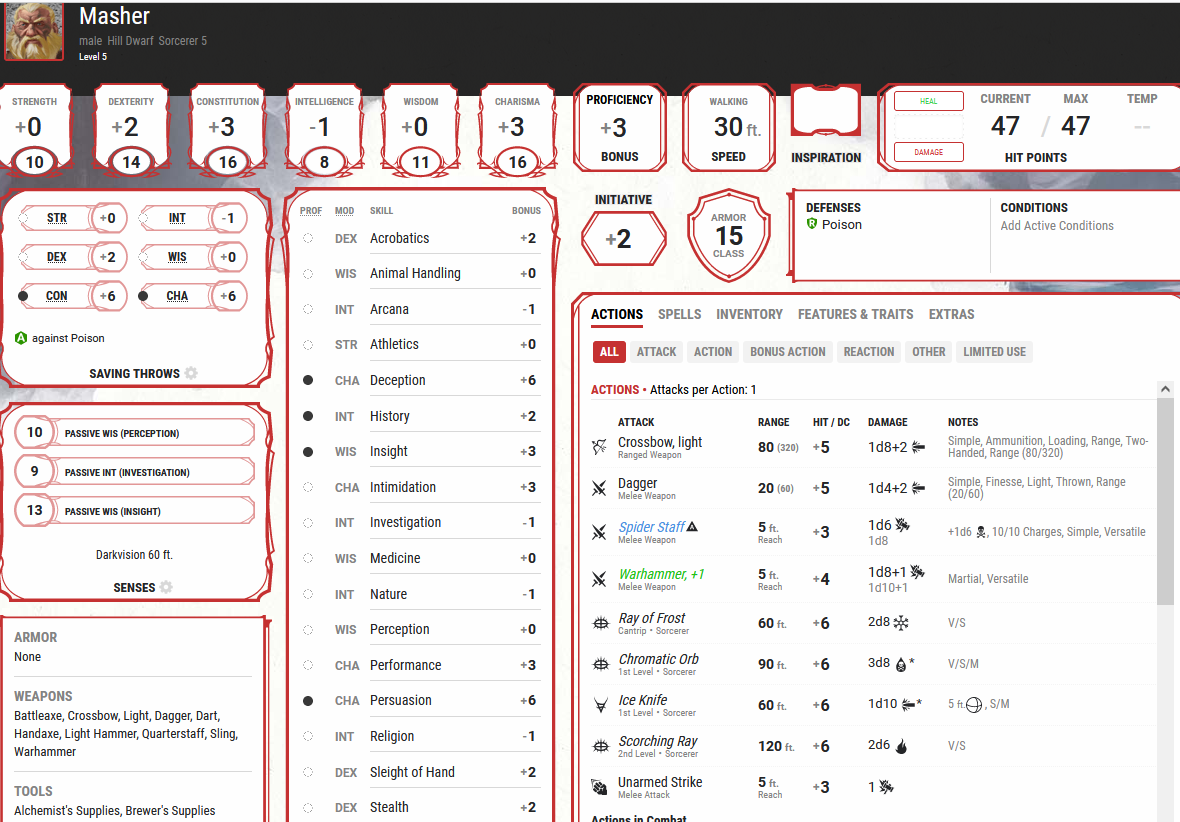
Some random 5e character named Masher has about the same online presence as this fish on search engines


AD&D Manticore
An interesting creature, it can fire 4 volleys of 6 spikes, dealing 1d6 damage each at the range of a light crossbow. As they can fly, one assumes they soften up or slay foes at range, then close in to finish off whatever remains with their unimpressive melee (a regular ol lizard man is about equivalent if you ignore the HD difference) Their treasure type E is typically unimpressive- there is a chance of something good, but it is a low chance indeed. If nothing else, their iron tail spikes can no doubt double as iron spikes to shut doors with.

Manticores are an interesting tactical problem for low to-mid level parties- one must survive the volleys of fairly accurate (+6) spikes, then be able to defeat the creature before it flies away to end its aerial reign of terror, or find a way to track a flying beast back to its lair for treasure. They are of low intelligence but are 'Lawful Evil' which might imply deals can be struck with them, though it is unclear if they speak despite having human heads.

Sunset Realm Giant Lynx
Like most giant animals, the answer is 'sure, why not, there are many ways to become gigantic.'

nasty man

Sunset Realm Mammoth/Mastodon
See the Elephant entry. Most of them are found in the frozen lands of Fomoria south of the fault, driven ever further south by Deadliege expeditions to steal their bones and make necromantic war-constructs from them, just as what was done to their less-hairy elephant brethren in the warm north jungles.

Lungfungus had an interesting approach for these beasts statblock wise that I think I'll steal- failing a melee attack against one incurs 1d8 damage from trampling, as an automated way to make unskilled hunters better off on ranged duty and account for the bulk of the beast simply trampling people.

Sunset Realm Manticore
Goblinpunch already did a pretty great take which I am mostly stealing from.

Manticores are Nightmare creatures, born of dreams of spite and grudge. As Nightmare is closest to the waking world in Saresare, they are known to be residents of that desert sultanate, though they are often hunted and driven into Yuba, Fassulia, and Mercia, cursing all the way. Their faces are that of the host of the nightmare that made them.

They eat hard things, breaking their teeth and bleeding their gums, and incorporate those things as their tail spikes. Shards of bone, stone, and metal compose the quills of a manticores tail. Vomiting forth unsuccessful consumption leads to their lairs being foul smelling and messy, and frequently haunted by unclean spirits of disease. Harpies and manticores do not get along well, but are frequently found together regardless. They fear sphinx.

Manticores are generally unreasonable, growing more resentful of everything you have that they don't but can be satiated temporarily with slander and general nastiness. Politeness and care only pisses them off more. Aiding them with whatever grudge they are nursing is the only way to be allied with one.
If a manticore cannot kill you, it will follow you, harassing your friends, scaring off game, leading enemies to you, and worse if it can manage it.

If you are hit by a manticore tail spike, it embeds in you and you become poisoned by hatred. You cannot aid other people, and can only laugh at their misfortune, mocking them, listing out all your grievances and resentments towards them. Pulling out a spike deals 1 extra point of damage per spike, and you can pull out any number within a round as a full-round action, but someone with a spike in them certainly can't pull spikes out of someone else. Those who die, not from the manticore itself, but from the side-effects of this poison, will spawn a Nightmare incursion upon death which in turn will spawn manticores with their face. Manticores try to engineer these scenarios, knocking people off cliffs and then poisoning their friends and similar so they let them fall.

This poison is nightmarish in nature and only takes effect when the manticore hurls spikes, it can only be collected by things that can collect dreams or emotions.
Similarly, only their spikes are real- upon being slain, the manticore collapses and turns to nothing. Manticores do not have biology or ecology, and could indeed sit in a dungeon room for 100 years doing nothing but hoping to eat the next person they saw.


Monday, May 16, 2022

Lycanthropes

AD&D  Lycanthropes


Werewhatevers are pretty decent foes, though they are accursed with the problem of 'why can't lycanthropy be used as a power-boost for my character' that has plagued GMs since their inclusion. The excuse of becoming evil even while not in wereform does not dissuade some characters, is sorta suspect in general, and doesn't even apply in all cases since werebears are chaotic good, and wereboars and tigers are at least neutral.

The curse is simultaneously easy to get (taking 50% of HP damage or more from a lycanthrope) difficult to remove (requiring either a 1/4 chance of belladonna curing it but poisoning the character for 1d4 days with a 1% chance of death) or a level 12 cleric to cast cure disease within 3 days of infection. So the question of what to do if a player is infected is a common one.

As far as the different varieties go, Werebears can cure disease and are probably a reference to Beorn of Lotr, perhaps combined with the figure of Bödvar Bjarki. They also work with brown bears, which seems less likely than working with other infected but whatever.

Wereboars are the most inexplicable to me. They are neutral but foul tempered and likely to attack, and I am not at all sure what they might be a reference to mythologically.

Wererats are suprisingly tough with 3HD and are almost certainly a reference to Hisvet and her ratty friends from the Fritz Lieber books of Lankhmar, and are a staple of the urban sewercrawl.

Weretigers being 'most often female'  makes me think they're likely a reference to a specific character rather than a mythological category. Hantu Belian are a malaysian possibility of origin inspiration, but it seems less likely. Or maybe the artist just really wanted to draw tiger teats in the art, idk.

Finally, werewolves are obviously derived from mythology and hammer horror films (as I guess from the artwork) and are most divergent in that they are quite pack-oriented as opposed to the lone accursed fellow-3d6 werewolves being the average number-appearing, rivaled only by the 4d6 wererats.

All in all, there is a disconnect from the desire to have lycanthropy be an alienating, isolating curse, and the apparent small gangs of these creatures getting up to a wide variety of alignment-appropriate activities and social interaction. They're plenty dangerous to adventuring parties with multi-attacks and a tenacious curse. One wonders if slings loaded with the incredibly numerous silver coins would provide ample defense even to peasantry against such threats- even in a copper standard, where money is 100 times more dear than the gold standard, silver is not some exotic metal to be carefully sought after and hoarded, it's just something you could presumably get from the coffers of any business, so their weakness doesn't hold the same problem as the modern werewolf film.

All in all, I think 'the curse of the werewolf' idea doesn't hold up well in a D&D universe in terms of logistics or implied setting... it's either a known problem with known solutions and is thus free of any supposed horror, or too easy to manage and suddenly it's a supersoldier serum, or it's a campaign ending blight akin to a zombie apocalypse.

Sunset Realm Lycanthropy


Clockwise from top left- 6th age superhero squad of Yuban Cynocephali, yuban weretiger or
possibly grumpy were striped-cat, horrid bear-scourged Blood Beast,
6th age rat-descended PASCC agent, slaughterhouse pig-spirit possessed butcher.
Not pictured- me having any motivation to draw

There are several types of shape-changing beast-folk in the realm

Firstly are those of inhuman ancestry, manifesting not as the more typical permanent hybrid form, but as having multiple forms + a 'best of' combination. The 'immunity' to weapons comes from the ability to heal wounds by transforming to some degree- limbs may not regrow, but wounds will close. Wounds inflicted by silver may carry over between forms, the lawful metal refusing chaotic undoing of its deeds, or serious injuries or bindings of silver may prevent transformation all together until healed/removed.
This form of beastliness is not contagious, but it is heritable. Transformation is typically based on stress or focused will.


The second form, that of Curse, occurs thanks to possession of a human body by an animal spirit. The transformation is hideous here, as one form is distorted, broken, then 'healed' into another by the unnatural vigor of two souls within one body.
Horrible crimes against animals may cause vengeful beast spirits to possess the offender, turning them against humanity as vengeance-by-proxy. This is quite unlawful, which is why silver is effective. The other main source would be being cursed by the gods- Our Lady of Gardens inflicts this curse against those who completely defile and disregard her society, granting them an unsightly form to match their behavior, and allowing others to hunt them as they please. This curse is not given lightly- Our Lady must cooperate with her rival Murulu, who is lord of such corruption and transformations, or with Lumar, who can mimic Murulu's powers, and explains the association with the moon such beast curses have. Lumar may inflict this curse whilst mimicking Our Lady as well, though the mysterious goddess likely does so with ulterior motives like the beast accidentally burning down a library or slaying those who know secrets when the moon arrives. Either way, the beast-soul assigned to torment the accursed is assigned as punishment, so attempts at harnessing the beasts powers are doomed to failure as the beast will thwart the accursed in every way possible. Typically, this curse is not contagious when god-granted, unless the punishment is meant to spread to the allies of the accursed as well. However, especially in the case of punishment by beast-souls, the soul may splinter itself into nightmare fragments to propagate and may well be a contagion.
Either way, the curse can only be lifted by mollifying the gods or the angry animal spirits, so there is no one-size-fits-all cure besides death by silver.

The third form, that of Blood, is a disease, of sorts, a contamination borne of the combining of Moon Blood and the blood of beasts, then introduced to the human form via injury or improper blood transfustions not sanctioned by the Sanguine Church of Vint-Savoth. This form taints the mind with bloodlust, and deforms the body with foul mutations that are related to the animal blood in question, but are ultimately alien in origin due to the source being the Blood Moon. If full transformation occurs, there is no going back- that person's soul is gone at best, or trapped within a raging monster of the Blood Moon at worst, hoping to save its comrades if it can wrest back control for even a second.
Such beasts are best slain by fire, silver, or massive bloodletting to drain the corrupted blood from its host.

As far as location of the 'standard' werebeasts goes...

5th age Oroboro had the first form of Werewolves in the hills, a clan sworn to oppose the villainous wizard who lives in those parts. They may date back to the 4th intersolar period, where humans seeking to survive the sunless darkness mixed bloodlines with wolves. It is unknown if they survived the Enlarge Wars, but they likely would have been forced to become more urban.

4th Age Phillipston was initially human, but was overrun by wererats of the accursed sort after the power of the Riikhites and Mokkhites was broken. These wererats date back to accursed experiments by Sarkomand early 4th age. By the 5th age though, the curse had weakened such that the ratty population was essentially the non-dangerous 1st variant, though prejudice lingered for generations, leading Phillipston to be fairly insular. The 6th age Phillipston Anomalous Subsurface Control Committee, or PASCC, was also known as the Rat Race due to high numbers of rat-folk signing up for the dungeon control and exploration teams.

4th age Yuban "werewolves," actually weredogs known as Cynocephali, were sacred, rather than accursed warriors of Yuba who fought back against Riikhite Mercia, and were demonized for it. In the 5th age imperialism had diminished, but Cynocephali still had enemies in the form of the Cat Lords or Rakshasa, who created accursed weretigers to serve as a counterforce in bloody internecine conflicts as Yuba tried to reunify after being broken in the 4th age. By the more peaceful 6th age, werebeasts had receded into being more of the first variety than the supernatural variety, with those who engaged in battle frequently forming public color-coded super teams.

While Vint-Savoth was scourged by the Blood Moon even before it had a name or was settled, and as such has every variant of the 3rd type of werebeast and more, it may be worth noting that even in the 6th age after the Blood Moon was felled and largely contained, werepigs of the 'angry beast soul' variety rose up against factory farming as horrible chainsaw-wielding pig-men until, as happened in Prince's Spit with the Three Tusk revolts, the inhumane practice was ended for good.


Actual Rules I use for Lycanthropy
If forced to roll on the Death and Dismemberment table by a contagious-type werebeast, lycanthropy is contracted on a failed save. If killed, one may choose to contract lycanthropy instead to save ones own life, though it cannot be cured save by magics comparable to that of raising the dead in that case.

Ancestry Type-
This type would be run as a 'race-as-class,' perhaps multiclassed with a more standard class. The Spook from Esoteric Enterprises would probably work, with Grit HP regenerating quickly due to transformations clearing wounds, and Flesh HP being struck directly by silver weapons.

Curse-Type

Transformation occurs upon the curse's trigger- moonlight, witnessing appropriate animals being eaten by humans, etc etc, and upon periods of great stress, physical or mental- failing a save vs fear or being reduced to low HP, for instance, likely trigger a transformation into the appropriate statblock, healing all non-silvered damage and, bursting out of armor, backpacks, clothes, etc and destroying them.

Characters with equal or fewer HD than their beast-form cannot control it or remember what they did in any detail. The beast is typically unnaturally violent.

Characters with more levels/HD than their beast form can control themselves to some degree and can make saving throws to prevent themselves from attacking allies while transformed, and can act with some direction beyond 'accursed rampage.'

Characters with at least double the levels/HD of their beast form are, against all odds, able to go beastmode at will and can control themselves, though the transformation lasts until next dawn. Essentially, it is only a weird superpower at this point.

Magic items meant to aid in control, or perhaps unusual mental stat modifiers, may count as bonus or malus HD for purposes of controlling oneself. Each year survived with the curse probably adds a 'virtual' HD for purposes of controlling oneself as well.

Blood-Type

This is more of a corruption track, as once transformation occurs, the soul either leaves, or stays within the body, able only to take control for a total of 1 round per level ever before control is lost forever.

Every time corruption is gained and corruption > level, a save vs scourge must be made the next time great stress is felt, mental or physical. Failure indicates transformation into a beast of HD=Level+Scourge.

Scourge Track- The stages roughly corresponds to what percentage of blood is pure moonblood, as opposed to what percentage is corrupt beast blood.
0- Unsullied- No exposure to the scourge
1- Acceptable levels. Scourge never goes below 1 after initial infection barring incredible magics or mad science.
2-4- Hunter-Acceptable Levels- Scourge Level provides various advantages if the right techniques are utilized. The Church issues tags confirming blood status to sanctioned hunters.
5+- Public Menace Levels- Berserk bloodlust clouds judgement. Must make a saving throw to not consume blood or stop attacking targets in melee. Mild physical transformation such as elongated hair, teeth, nails, eye color changes, mucular growth, etc. It is not unheard of for very skilled hunters to lapse into this state on particularly long or horrible hunts, and rumors abound of secret church forces who have tags sanctioning blood corruption of 5% and higher.


Common Scourge Sources
+1 Skin contact with scourged blood. First-time only.
+2 Internal contact (ingestion, wound contamination, transfusion) with scourged blood of higher HD source/Scourge level than your own.
+1 Making a Death and Dismemberment roll. Only applies if you have at least 1 Scourge. Counts as 'great stress' so immediately check if a possible transformation is in order.
-1 Monitored bloodletting and transfusion by the Sanguine Church over the course of a week. Counts as 'great stress' for potential transformation, though the Church typically euthanizes transforming unfortunates before they get out of hand.

Monday, February 21, 2022

Lion, Lizard, Lizard Man, Locathah, Lurker Above

AD&D Lions
While everyone is familiar with cats and claw/claw/bite routines by now, a lesser known feature of lions might be their bonus hind leg rake for an additional two attacks at 1d6+1 which occurs if both main paws hit. Basically, if you don't have good AC, fighting lions in melee will shred you.
Presumably because of their manes, male lions have +1 AC from frontal attacks.

The statblock includes mountain lions and spotted lions, which are smaller cougars and and larger Pleistocene cave lions, respectively.

AD&D Lizards
A bizarre entry far more fantastical than one might assume.

Fire Lizards are also called 'false dragons' and indeed are like a weaker sort of red dragon, with 10HD< AC as plate, a claw claw bite routine of 1d8/1d8/2d8, and an unimpressive small flame puff for 2d6 save for half. They themselves are immune to fire attacks. They sleep for long periods, hunt once a week from their subterranean lairs, and like shiny things.

Though not possessing the great hoard of a dragon, they do have treasure tybe B, Qx10 for many gems, and a 10% chance of having 1d4 eggs worth 5000 gold each. Unlike dragons, they are only animals.

One might assume this is a sort of 'fakeout' monster, where peasants are harassed by a 'dragon' and the party finds these things instead. They have a sort of appeal as alternate guard beast or mount that's dragon-like but not all too troublesome, but I can't imagine they are anyone's favorite monster.

Giant Lizards, ironically, are the smallest lizard in the lizard entry. While 15' long, they only have 3HD and a single 1d8 bite (2d8 on a nat 20 due to getting a good bite in) so they're kinda a 'whatever' monster.

Minotaur lizards are huge 8HD, 40' long beasts that deal massive damage(2d6/2d6/3d6 claw/claw/bite) and, on nat 20s, can hold people in their mouths- not a swallow hole, but a similar sort of auto-grapple. They are slow, but good at ambushing, and are usually found in their lairs with a scattering of loot from their victims. I don't know why they're called Minotaur lizards... maybe because they lurk in a lair as the minotaur did? Later editions give them horns, which makes sense, but no mention of horns is made in the AD&D entry. With numbers appearing of 1d8 they mostly seem like just a big beefy threat for deep dungeons

Subterranean Lizards seem to be some form of giant gecko, as they can run on ceilings and walls. Apart from the double damage nat 20 lizard bite, they aren't very interesting, but at least they could potentially get up to shenanigans in certain dungeon layouts compared to the Giant Lizard.

AD&D Lizard Man
A fairly uninspired entry about 2HD humanoids whose main claim to fame is being slowish on land but fastish in water, and having a claw-claw-bite routine with 1d2 claws. Also having pretty good art.

The entry mostly just goes on and on about how 'primitive' 'crude' 'tribal' etc they are and says some 'evolved' to a 'higher state' of using huts, shields, throwing weapons, and clubs, the better to eat people with. Gygaxian baloney instead of any actual lore, basically.

While I'm sure people have done better with lizard-men since then, the default entry might as well just be giant lizards.

AD&D Locathah
Ah yes, another 'underwater fishperson.' They ride giant eels and are 'nomads' who also live in a castle that has a 50% chance of a portuguese man-o-war trap, and have provisions for leader types who have no difference save for increasing HP.

I had forgotten these creatures existed, compared to Kuo-Toa and Sahuagin, and expect will forget them again soon enough after this post.

AD&D Lurker Above
Now THIS is a monster. "What if the ceiling was actually a giant manta ray monster that fell on you and smothered you to death."
They are very tough and non-intelligent, not even animal intelligence, fighting to the death against whatever they drop down upon. With mediocre AC but a fat 10HD, and a 1d4+1 round time limit before those trapped beneath are 'smothered.' An entire party can probably chop one up in time barring bad luck or all the fighters being trapped beneath with weapons too awkward to shank it with in hand (honestly with the number of such monsters in D&D, there is probably something to be said for walking around with an offhand dagger instead of a shield.)

Some interesting things are the good odds lurkers have fat stacks of gold coins as treasure, perhaps as incidental bait in the rooms they overlook. They also have neutral buoyancy thanks to a produced gas in their bodies, allowing them to fly despite being more like a manta ray than a bird.

All in all, a classic 'check the roof' monster of the upper levels, once the players have grown weary of green slime and piercers.

Sunset Realm Lions

Sunset Realm Lizards

So in the age of the 2nd sun, Yg-A, the world was very hot, the ice of the moonlands being driven far back by fiery dragons. It was a good time to be a reptile.

However, Yg, the cast-off skin of Yg-A the dragon sun, had other ideas beyond sitting in the sun and licking your eyeballs. Those reptiles who traded their legs to the snake-goddess Yg were granted wisdom in return, and so arose the Serpent Empire. The Reptile Kings, Frogs, Eels, etc all resisted, but were eventually subjugated by the big brained schemes of the serpents, adopting serpent tech but always being one step behind.. Lizardfolk were, according to ancient murals, equally comfortable on all fours or bipedal, with different tail positions for balance, and favored strength and rigidity, as a conscious opposition to the subtlety and flexibility of the snakes. Though the Serpents conquered them for the sin of 'keeping their legs' the reptiles were not wiped out by the serpents, but by the intersolar period after Yg-A became trapped in the earth. Free of the Serpent Empire the Reptile Rebellion's splinter-kingdom of fire and magma kept the ice and darkness at bay for a while. But by the time the Elves, Ningen, and Svart created the 3rd sun, it was too late for the lizard-folk. If, by chance, their fires continue to burn to keep the lizards warm anywhere, it is in the Beyond, a thawed circle of waning fire in a lightless expanse of gnashing glaciers beyond the reach of the daylit world. Even their ruins are rare to find in the current solar eras- there is one on the Fault, from which a resurrected mummified Reptile King failed to reach the Orb before Townlocke did, but most have been swallowed by the dark of the moonlands. Sometimes one might find 'lizard people' but they are the product of mad alchemy or divine miracles, not descendants of the forgotten rebels of ages past.

Locathah- Nah

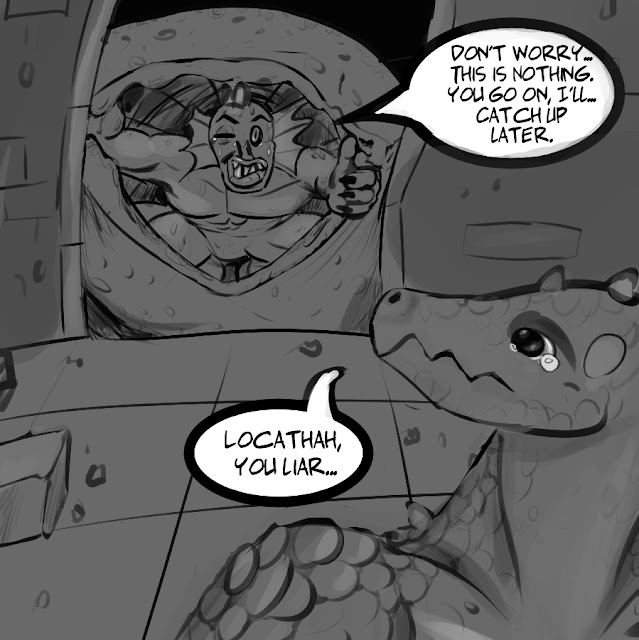
now get outta my encounter tables you black-lagoon lookin discount sahuagin


Lurker Above- Simply, these are a type of giant wilderness killer mimic adapted more to caves, gobbling sabre-toothed tigers, hibernating cave bears and so on. Trappers, the floor version, are not a different species, but simply lying on the floor, perhaps after dropping from the ceiling to eat something earlier. Choice of ceiling or floor may be these creature's gender expression, and it is theorized that a Lurker and a Trapper will mate with each other when attempting to eat the same adventurer, who will presumably be smothered by the undulating Trapper/Lurker sandwich and used to feed offspring afterwards.

As mimics, they can change their texture and patterning to match ceilings or floors, but are more specialized than smaller mimics and become less and less convincing as the terrain becomes more advanced than a cavern. As such, while they could potentially infest a stone castle, certainly mines and dungeons, perhaps even external cobbled/brick roads, wooden domiciles are typically safe from Lurker/Trappers.

Unlike mimics, Lurker/Trappers are not intelligent enough to train, but they can be lured to key locations and kept there with a high rate of success if fed consistently and so used as guardians. They may wander in order to seek mates, however, so this tactic is used only by mad dungeon wizards rather than respectable members of society.


Friday, February 18, 2022

Lich

 AD&D Lich

The Lich is one of the quintessential Big Bads of fantasy literature and ttrpgs alike. Fictionally, they tend to appear more as 'immortal wizard' than 'immortal skeleton wizard' but whatever, Voldemort is basically a lich, Koschei is basically a lich. Official D&D has more liches than you can shake a stick at.

Liches have AC as plate +3, and a oddly worded immunity to mundane attacks from beings of under 6HD, though this is fairly pointless as creatures of 5HD or under flee in fear with no save anyway. They may touch enemies for 1d10 cold damage+ a save or paralysis effect. Their laundry list of undead immunities is somewhat expanded- Charm, Sleep, enfeeblement, polymorph, cold, electricity, insanity, and death spells/symbols.

Apart from some text describing that they are indeed converted magic-users, no provision for their spell lists is given. Using the spell lists for monster abilities largely misses the point of a monster manual in my mind, for a monster that says "oh just have a bunch of rarely seen high level spells memorized, thoughtfully put together, and used to terrible optimization" doesn't help me much.

Liches are fine villains. I seem to recall reading that while the dragon is the active tyrant of greed, the despot king, the earth-ravaging billionaire, the lich is the soul-crushing villainy of a hidebound and restrictive society. It has a head start in terms of power, influence, and knowledge, so it's nearly impossible to catch up. It turns people who would be your allies into your enemies via the power of necromancy or enchantment (a metaphor for cultural hegemony). It can kill you, but you can't really kill it, it just comes back if it loses a fight, just as killing a single leader doesn't end a country. The quest to find and destroy the phylactery is symbolic of the work required to break a system. You can sorta reason with a Lich, but ultimately it's just the preserved bad takes of some dead guy so you know it's always going to cycle back to the same old awfulness, sooner or later. And it is usually a guy, isn't it? Go figure.

They might also be symbolic of the inability to accept death turned ruinous and destructive, but I digress. While fine as a crafted villain, as far as an entry in a monster manual goes they just kinda suck because you can't actually open up the monster manual and use one, you gotta create a huge spell list, think of strategies to use it, maybe some magic items, probably spend the monetary parts of the treasure on a base or mercenaries or something, or it'll fall flat and just be a spooky skeleton.


Sunset Realm Lich
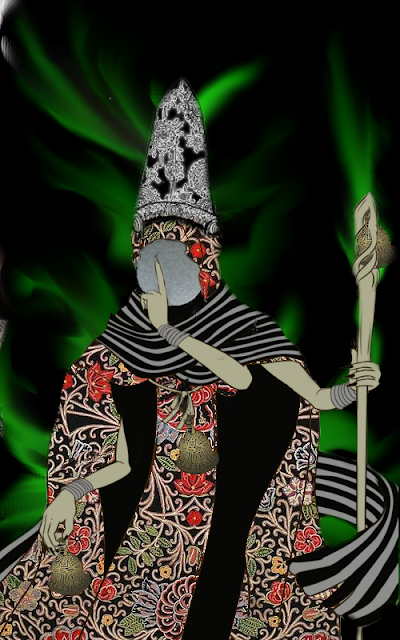
An old photobash of the Green Necromancer
The defining characteristic of a lich is that their soul is anchored to an item that regenerates a body for them to inhabit, one way or another. But... It's not even that hard to come back from the dead in this setting, so Liches are not necessarily all that impressive, honestly. They're more just... disturbing. They had such conviction in an idea that they bound themselves to the world in a way that they'd come back no matter what, heedless of how everything they knew would crumble away in time, all to pursue something. This conviction is usually deeply uncompelling to people 50 years, a hundred years, a thousand years later, and so liches end up doing their mad schemes in forgotten ruins alone or with hanger-ons at best. Sensible people who come back as undead join the city council as Necropolis Representative, or become a child of M'shesh to return as undead in exchange for pacifism and cult membership, or sign up for the Skeleton War. But not liches, oh no. They have to come back on their own terms, their own power, independent of anything else. It's a form of vanity, in a way.

The most notable Lich in the sunset realms is Magister Verdurus, aka the Green Necromancer. Born in the City of Bells to a noble family, he travelled the world learning magic as his hobby until his money dried up, came home to find out that elvish politicking had usurped his family's claim. He threw a fit and tried to kill everyone involved with dread sorcery, was defeated after leaving a combination grey-goo/zombie plague biohazard known as the Blight, tried to ruin another country to gain political power to come back for round 2, and ended up going mad with forbidden knowledge and seeking 'true' immortality via memorability, perhaps as a cope for his original desired noble position no longer existing. His apprentices, having learned enough for their own goals and recognizing megalomania when they saw it, abandoned him, leaving only his omnicidal cult, which was eventually defeated. He would return several more times, ironically becoming less of a threat each time as the world moved on without him and he lost the thread of how things worked. Being a manifestation of a player setting suggestion, he was always doomed to descend down this road of evil and madness to suit that player's whims, so one can't be too hard on him. He is a plague on the city of Oroboro that resurrects every so often as cackling villain, and believes himself to be the one who will end the last sun and bring about the Age of the Dead, where no life exists and even the planet itself is considered dead, and his death cult thinks this is the age where they can finally live as glorious undead kings of the world. One can sort of see what that world looks like in the M'shesh controlled Fault (5th age onwards) and no one is all too impressed, and so most everyone wishes he'd just try to do something with his unlife over there instead of trying to ruin everything for everyone over here in Oroboro for the 15th time.

The contents of the Green Necromancer's Spellbook in the reign of Samuel Goffnagoff were as follows

1-Floating Disc, Shield, Read Languages
For saving Telekinesis slot, general defense, and general info-gathering

 2-Levitate, Web, Locate Object
For saving your flight slot, capturing people nonlethally, and finding macguffins

3- Flight, Darkvision, Fireball, Lightning Bolt, Blight Curse (A useless spell with the blight contained, otherwise basically infecting someone with a zombie plague)
While 'fly high and rain damage from above' isn't rocket science, it is pretty effective.

4-Ice Storm, Massmorph- Elemental AoE coverage, and a good 'ambush someone with camouflaged undead' spell.

5-Animate Dead, Cloudkill, Telekinesis. Telekinesis to do heavy lifting if the minions were gone or for air transport, animate dead because no lich without it can be respected, and cloudkill to get intact corpses for animate dead.

6-Death Of 100 Pits- Reverses gravity off and off in 10' cube forever. 1d6 fall damage each round. Hard to escape without assistance.This was the signature spell, powerful in its own way, needlessly cruel, leaves a lasting impression as the corpse bounces forever, able to create dungeon power sources.

7-Reaper's Haste- Take one action whenever an enemy takes an action. Age 1 year each time. Drawback less penalizing for the immortal. A general 'action economy compensator' spell.

8-Mind Blank-Gotta have this as a defensive option I guess

 9-Forbidden Moon Gate- Opens a gate and draws forth a Moon, bringing the chaos of the Moonlands to the Daylands. A broad spectrum doomsday threat spell. Was ripped out and cast as a scroll so is mostly lost to time.

So the Green Necromancer was basically air support for undead ground troops.

The two apprentices mentioned were Felgraft, who focused on the 'evocation blasty casty' side of Verdurus spellbook and disappeared into the Bowels of the Earth in search of treasure, leaving only Felgraft's Flames as his legacy, a green fireball that comes from the ground up and only burns the living. His spell list was Sleep, Fly, Felgrafts Flames, Dimension Door, and the players rescued him from being walled up in a dungeon sauna once. He had a bodyguard, Loran, hired for purely mercenary goals.

The other was Veiled Kirasu, a very short woman who had a tower in a lake that sought to drill deep into the earth as well but was abandoned due to darkspawn monsters coming up the mineshaft. Her legacy was longer lived, as she continued magical research after parting ways from Verdurus and was the elder student- Spell list was
1- Floating Disc, Shield, Read Langages
2- Levitate, Web, Locate Object
3-Flight, Protection From Normal Missiles
4- Ice Storm, Massmorph
5- Animate Dead, Cloudkill
And she waged a brief war against the hill giants of what is now Fort Fortenfort, before returning to her true goal of defeating the dragon of Mantlehearth that killed her family. She became Necroqueen of Mantlehearth and ruled the island for a time, though necromancy gone wrong led to her losing her necromantic minions to undead whale siren song.

His soul anchor is a black sword, granted to him by a being from Beyond to lead him down the role prescribed by player-suggested campaign suggestion. Like most such things, it can be destroyed only in one way- by the flame of the 7th sun (son?) though it will destroy that in turn, at least according to prophecy. For the most part tho, the black sword is just a +1 longsword that deals its damage as level drain and raises undead from those it kills, eventually resurrecting the Necromancer with enough life force drained. He does not particularly hide the sword, instead letting whatever adventurer find it continue to use it and letting it fall where it may.

His cult uses simple tactics- find a ghul, let it make more ghuls, focus fire unparalyzed targets with Magic Missiles taught to all the novice necromancers. The Blight can be used to infect populations or corrupt wilderness in a scorched earth zombie apocalypse way, and though it answers only to Verdurus, there is also the Red Queen, an extra-invincible stone golem which can grow a body for every soul exposed to its gas, constantly regenerate and mutate those bodies with gas to adapt to what killed them (the life it gives is oft considered a fate worse than death mind you), and control those bodies if need be. He has a few wicked Ifrit that would like to see humanity exterminated as well, bound in Fassulia and forgotten, but sometimes unearthed to seek to further his goals.
His efforts, and that of his cult, are a large part of why Oroboro and Fassulia feud, as Fassulia, ravaged by his efforts, sees him as an Oroboron problem, while Oroboro sees it as a collective calamity they are not responsible for. Politics!

Here's a Lungfungus Dungeon I reskinned into an old lair of the Green Necromancer, an ancient ifrit-operated ghoul-plague missile silo that was never fired, and over the years has been invaded by plant creatures, sickle-clawed giant lizards, bandits, and at some point, a dragon-cult of Arrkohn (another player suggestion)

You gotta click on 'open in a new window' to get a readable version I am sure.

 But all this took a long time to come up with- the Green Necromancer was created to fit the setting suggestion of the Blight and Blight Necromancers a  player called Shin came up with back when Oroboro was created from player suggestions. But Verdurus had three campaigns total to make appearances in, have dungeons created to serve as his old hideouts, have connections drawn between factions, develop counter-measures against threats he faced. Three campaigns is a lot to ask to grant a lich narrative weight, and that's why casually introduced liches are a bit rough to run on the fly-without time to develop their presence, they're just a skeleton with hastily rolled up spells the GM doesn't have time to consider the long-term implications of.

Liches are good- just not as a monster manual entry.
Thursday, November 18, 2021

Leech, Leopard, Leprechaun, Leucrotta

 AD&D Giant Leech
Sneaky creatures that suck blood with an anaesthetic bite, with only  1% chance of detection until the afflicted is reduced to half HP, slowly sucking blood at the rate of 1HP per HD of the leech (HD ranging from 1-4). They are very slow, so if they fail to attach via initial attack they are unlikely to pose much threat.They can be killed with salt, and attack people camping near leech infested waters at night. Unlike real life leeches, they also spread disease.

I like the idea of warding off leeches with a circle of salt while camping at night in wet areas, or carrying bags to kill the big 4HD varieties, adding procedures to check each other for leeches, etc etc. Similar to green slime adding a 'check the ceiling' for adventuring procedure, I think leeches are a similarly excellent complication to sodden areas.

AD&D Leopard
The endless slight variation in the claw/claw/bite routine, # appearing, and HD of the big cats, each with their own entry, continues to confound me. Various other highly similar creatures got lumped together in a single statblock (Horses, beetles, etc) so I don't know why the big cats didn't get the same treatment.

AD&D Leprechaun
These creatures are fragile fey that will attempt to steal valuables 75% of the time, with a 75% success rate, then flee, with a 25% chance to drop the item if closely pursued. With treasure type F, they are likely to have decent treasure themeselves, so if the players can get around an advanced movespeed, invisibility, non-living objects polymorphed into other inamiate objects, illusions, and ventriloquism (as well as an immunity to being surprised due to good hearing and 80% magic resistance), perhaps by the noted 'fondness for wine,' stealing a leprechaun's pot of gold, so to speak, could be a much safer endeavor than dragon-hunting, but a similarly lucrative one.

While rather more derived with twee Irish tourist trappings (and possibly nasty 19th century stereotypes) than any solid mythological source material, they are a pretty good challenge I think, requiring creative problem solving to both learn the location of the treasure and avoid being tricked by the monster. Better yet, they are often active antagonists who will steal something from those they encounter  with no reason beyond that of mischief, which makes the question of 'is it ethical to rob leprechauns of their treasure' likely to be a clear cut case of retrieving stolen goods from a supernatural trickster spirit, rather than extortion and robbery of an innocent person, and can jumpstart the players into action.

AD&D Leucrotta
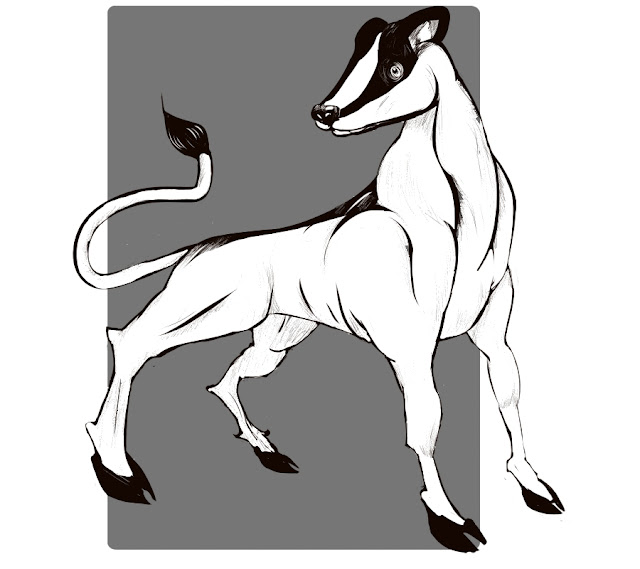
While supposedly so ugly that other creatures cannot bear the sight of it, I always thought the art and description didn't really live up to this. A stag body, a lion tail, and a badger head? Just another furry animal, really. Later editions tried to uglify them up by making them more monstrous

It can imitate the voice of people, to lure them into bite range, but I don't think this adds up. It lives in 'deserted and desolate places' and runs almost as fast as a horse, and has a 3d6 bite attack, so it is perfectly capable of running down humans who don't have a speedy horse and devouring them without the need for subterfuge. It also gets 2 1d6 kick attacks when it flees, perfect for 'hit and run' rather than ambushing. So why the need for a lure?

The Forgotten Realms wiki mentions various tactics used by them, some of which were 'neat' but didn't address my basic concern that the statblock suggest a hit-and-run pursuit predator, while the described tactics and mimicry suggest a trap or ambush predator. From all this, I think the best way to 'solve' the problem is to put them not in desolate wastelands, but near humans, lairing in ruins (which may have mechanical traps to lure humans into), along roads (luring humans off the path to devour so as to leave less trace of the struggle) perhaps by rivers (where disarming and dismounting is likely), and certainly near hunting grounds (where their footprints, indistinguishable from that of stags, will draw hunters to them).  Additional explanation for their behavior could be that they do not have particularly good senses- no keen sight to spy prey across open plains, no strong nose to follow trails, and hearing good enough to imitate speech but not good enough to hear prey attempting to be stealthy. As such, it becomes important to lure humans near, ideally dismounting from any horses, and lead them into areas where there are no easy escape routes or places to hide.

Sunset Realm Leeches
Giant leeches come about when a leech sucks the blood of a giant, naturally enough, growing larger and more of a threat. As becoming larger is common worldwide, so too are the threats of giant leeches in wet places.

Frog-witches of the Bog of the Canal know that leeches are good for drawing out magic through the blood. A leech that feeds on someone with a potion effect will gain it for themselves, and various disease spirits and poisons can be drawn out of the body via the application of leeches to key points as a healing method. While some find it disgusting, potions-leeches, to be consumed later, are a form of alchemical reclamation and recycling far more available in the bog than fancy glass alembics and such.

In Vint-Savoth, leeches are used to draw out corruption of the blood from the Blood Moon by the Sanguinaries of the Sanguine Church. Such corrupt leeches are disposed of, but those that survive may grow into horrible sewer beasts that squirm through the blood-gutters, consuming the fetid flow of disposed blood that trickles down to them. While such monsters may help control the population of blood-corrupted rats, they are ranked highly for disposal, as new strains of the Moon Scourge may develop rapidly in their churning, blood-filled guts due to their indiscriminate feeding.

Sunset Realm Leopard/Jaguar
Jaguars/Leopards are the big cats of Yuba, thought to be the reincarnated souls of Yubans of questionably morality who ALSO didn't really like dogs, and so returned as cats instead. It is said that the spots are sins that prevent the soul from moving on, and upon death the soul splits, the spots left by past misdeeds falling off, and the clean parts reforming into the original soul, now free of wickedness and able to join a peaceful afterlife and leave the world behind. As for the spots, they combine into stripes and slither around, seeking to attach themselves to wicked cats that are becoming tigers. Unlike the prides of lions or the solitary tigers, the spotted big cats work in pairs, pairs being assigned such that their spot/unspotted skin ratio comes out to 50-50 when accounting for both of them.

Sunset realm cat taxonomy is rather different than real life, caring only whether they be striped, spotted, or solidly colored.

Sunset Realm Leprechaun
While touched on somewhat here, this variant of Fairy, an artificial spell-construct is not only in charge of fake gold. Some leprechauns, serving long-vanished alf-creators who tasked them with collecting taxes and managing treasure vaults, still function, attempting to retrieve treasure from humans dwelling in lands that, long ago, were part of the elvish empire. While largely harmless alone, they will invariably be working with other fairies or shadow-goblins to aid in guarding and enriching the stale hoards of their masters. Since said masters, having been locked up in the Iron Moon or vanished into the dreams of ice or trees, will not be coming back, the risk of serious retributive action from the fey is low and raiding leprechaun treasure ranges from 'archaeological expedition' to 'yearly sport' depending on location and relation.

Sunset Realm Leucrotta
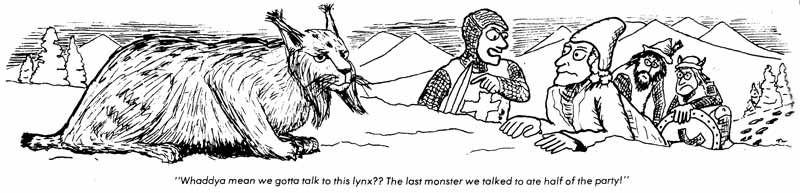
I think the same can be accomplished by any animal that learns Commonid and chooses to be villainous, so I will instead utilize ventriloquist goats that lure people to cliff edges ("Is anyone there? Help me up! I can't hold on much longer!") and butt them off when they go to investigate the cliff edge.


I don't know about your players, but mine are likely to think weird human noises in suspicious places are a trap. If they see a beastie like this though they'd probably walk right up to give it pets and snacks.


Friday, November 12, 2021

Lamia, Lammasu, Lamprey, Larva

 AD&D Lamia
Lamia are bulky, leonine, centauroid creatures with 9HD and armor as plate, who drain 1 point of wisdom permanently on hit, and have a handful of spells- charm person, mirror image, suggestion, and illusion. Characters drained to 3 or less wisdom do as the lamia says, but as no mention of lamia keeping such simps around is made, it seems like they only become food rather than slaves. It is also unclear if the wisdom drain works on everything, or just on prey species.

While it has the usual idea of 'if you are alone and fail a save you die,' it has potential to use the environment against players via its high movement speed, illusion to cover hazards, so a sort of determined 'hit and run' monster causing permanent character damage could make for a good mix of infuriating and terrifying. Still, I think it would think it would have more potential to be an interesting encounter with bewitched people and monsters assisting it.

AD&D Lammasu
Another force of good derived from assyrian myth and clumsily jammed into D&D cosmology. Statwise, it's the usual uninspired mash the forces of good have- 8th level cleric casting, it's a flying lion, invisibility, dimension door, aura of protection from evil, better healing, 1/10 chance to be able to speak a Holy Word, some magic resist. A likely strategy for them to employ would be hit and run in surprise invisibility attacks, then flying or teleporting away to heal each others wounds efficiently before returning. Add in some debilitating effects like Hold Person or reversed spells and I think they'd be quite effective at whittling down the forces of evil, and despite my dislike of the lack of original flavor, it could actually be quite an interesting tactical problem to deal with a pack of these creatures, and they'd make excellent support for other beings as well.

One thing I dislike about this entry is that their common spell-list is not provided as it is in, say, 3.5, making them a bit annoying to use on the spot, as one must whip up a 8th level clerics spell list. One also wonders at the disparity between Good and Evil in which infernal Evils can only be hit by magical weapons, but many Good celestial beings can be brought low by an ambush of bandits with slings and a surprise round.

AD&D Lamprey
Self explanatory really- simply more giant than real world counterparts, they suck blood. I enjoy their method of attack differs from the norm- they first attach for a small amount of damage, then drain a fixed rate of HP each round thereafter- 2 for the 1+2 HD variants, and 10 for the 5 HD massive variants. That makes it so the players can prioritize removing attached lampreys and defend each other, and provides a simple, obvious threat and counterplay.

AD&D Larva
While mechanically they are nothing more than demonically themed 1HD cannon-fodder, the lore of these creatures is pretty good. 'The most selfishly Evil' souls becoming human-faced worms, which are then turned to Quasits or Imps, or used as a form of barter by liches and night hags is quite flavorful.

Sunset Realm Lamia
Yg, mother of serpents, offers wisdom and snakeliness to those who sacrifice their legs to her and become a serpent. Lamia are the first stage of Serious Devotion to Yg, humans whose legs have been replaced by the tail of a snake, or the offspring thereof. The next stage of serpentine enlightenment is the Naga, a snake with a human head, after which there's nothing left but to become a full snake, though the combination of grueling divine trials of worthiness and the appeal of having thumbs means that most Yg-cults plateau at the Lamia stage. Medusa are a different set of requirements entirely, though there is theoretically nothing stopping a nagadusa or a snakedusa from being a thing. It could be the honor of being a repository of forbidden knowledge also contains secrets that mean medusa do not strive to become more snakelike, or more complete snakes are spared the burden of this knowledge.

In any case, rather than mysterious monsters like medusa, Lamia are a fairly common kind of person to be found at the intersection of Yg serpent cults and human society. Though they do tend towards occult wisdom and bookishness on account of the pact with their god, the immense strength of a snake tail that big makes them rather good wrestlers and swimmers as well. Subsequent generations will tend towards the human part becoming snakier as well- scales, fangs, venom, forked tongues, slit eyes, cobra hoods instead of hair, eggs instead of live birth, etc etc, as Yg slowly warms up to them and blessings accumulate over generations.

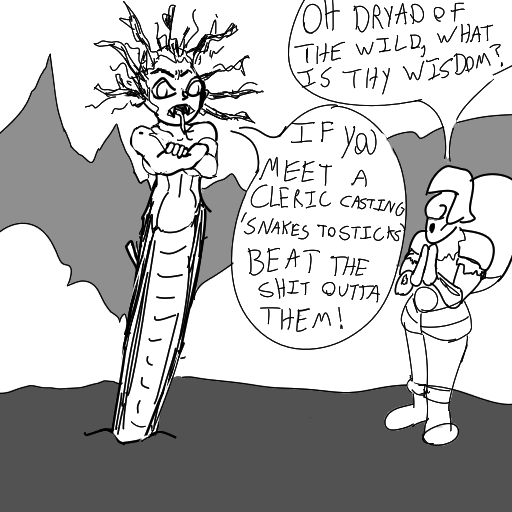
being lignified by the Lumarian curse "Snakes to Sticks" results in a non-zero amount of lamia trapped in awkward locales with the upper torso of a human and the lower half of a large vaguely serpentine log. Such are the perils in being involved in a divine war of knowledge (Yg) vs secrecy (Lumar)


Sunset Realm Lammasu
Nah, though 'winged beast with a human face' is a fairly common motif among divine servitors.

Source unknown


Sunset Realm Lamprey
Though no fault of the fish, lamprey are most known not for their own form, but for the Oartia bloodline of vampires. Originally a kind of curse derived from lamprey souls used in mad experiments beneath the sea in the laboratories of the Ningen, the giant Ningen lamprey-vampires spread it to humans somehow or another. Such vampires are smooth, flexible, amphibious, and faceless, typically concealing their terrifying toothy maw beneath masks, long hair, or giant hats. Like most animal-type vampires (as opposed to undead ones) the Oartia bloodline is found most frequently in Vint-Savoth, as the accumulation of accursed moon-blood through hemophagy grants monstrous powers. While the Oartia may have originally been merely afflicted humans who could have lived on donated blood, the creeping corruption accumulated through years of bloodsucking has surely switched their categorization to that of monsters, driven from the cities but still ruling in secluded coastal or swamp castles, their curse spreading to other animals as well in cases of long-turn habitation.

Sunset Realm Larva
Rather too specific to D&D cosmology

Monday, October 25, 2021

Jackals, Jackalweres, Jaguars, Ki-Rin, Kobold

 AD&D Jackal
Included because of the Bag of Tricks, these are essentially just lesser wild dogs.

AD&D Jackalwere
An odd inclusion, I assume these are similar to wolfweres, ie, a wolf that can assume human form. With low numbers appearing, a sleep gaze that only works on the unsuspecting (not once combat has started, specfically mentioned) and a vulnerability to iron weapons as well as magic, they cannot engage in incautious melee as lycanthropes might, as while steel is preferred over iron, the odds of being incidentally bludgeoned by some pig-iron craftsmanship would be much more likely than humans trying to use silver lying around. Being mistaken for a werewolf would be of great help to a Jackalwere, so they would probably try to spread false rumors so that they could both face harmless silver, and loot it afterwards.

Still, against anything but the most novice of adventuring parties, they are likely to triumph only by stealth and subterfuge. In my opinion, this makes them a sort of questionable encounter for engaging gameplay, as 'being murdered one by one in your sleep' is both a terrible way to TPK the party, and the most likely outcome of being bamboozled successfully by a jackwere or group thereof.

AD&D Jaguar
While the differences between big cats may be of interest IRL, in D&D they are essentially just smaller lions/tigers, a south-american styled palette swap, so there's not much to say.

AD&D Ki-Rin
Similar to the Coautl, this chinese-inspired entity is given a great grab-bag of magic-user spells, psionic abilities, none of which are specified or detailed in the entry here, making it largely useless for the purpose of 'opening the monster manual to run a monster without needing further prep.' Apart from a nod to having 'double strength' for anything sky-involved, the creature has little to no identity of its own, so it comes off as a rather shallow entity, a flying quadruped wizard thingy that might show up to fight the forces of Evil.

While I normally am contemptuous of later edition adaptations that only focus on monsters insofar as how they may apply tactical maths at the player party, in this case the treatment of Ki-Rin is much improved. Their benevolent protection is described as affecting 3 miles (or a hex lol) around their lairs with various effects such as the purification of water, winds saving good creatures from falls and preventing evil creatures flying, which makes for an interesting sounding region, and their role in the cosmology becomes more distinct.


AD&D Kobolds
Like many other 'evil' demihumans, Kobolds have been redeemed and popularized as a player race in many games, and have leaned more reptilian/draconic in the USA, while the word came to mean a sort of dog-person over in the Japanese RPG scene. Mythologically speaking, Kobolds have much in common with the gnomes, sprites, brownies, and pixies that D&D set them in opposition to, so I find the more friendly depiction of them as rogues and tricksters one that is more in line of the spirit of things, even if the form has been warped.

Modern reclamation aside, Kobolds are essentially just the feeblest form of vaguely goblinoid creature, having 1d4 HP and not even having significant 'leader' types. They lay eggs, occasionally train boars or weasels, 'hate most other life and delight in killing and torture' and are especially hateful towards the 'brownies pixies sprites and gnomes' which seems to cement them as the villains of the 'fey folk' of the sylvan wood.

They commonly wield clubs, axes and javelins, with short swords and spears being, I assume, the 'superior weapons' used by their leader types and guards. Since it's mentioned that their shields are made of wood or wicker, I assume some of their AC comes from that and perhaps dexterity and/or leather armor. Unlike goblins, they are not good miners (ironic, given that mythological kobolds had a strong association with mines) and all in all they seem less well-equipped than their other demihuman counterparts. With that in mind, 'Tucker's Kobolds' were a significant departure from the standard issue kobold found in the AD&D DMG, though that's not to say I disapprove, not at all. It seems even back in the 80's people were not content to leave Kobolds as merely 'lesser goblins.'

Sunset Realm Jackals
Despite his focus on dogs, he is called the Jackal God of Yuba, not the Dog God. This curious incongruity of the god is suspected by some to mean the Jackal God is some manner of ascended Jackal that forsook its own kind in favor of the company of humans and dogs, though if true, this event is so ancient that it does not even have religious tales of its occurrence.

Jackals are treated as dogs in Yuban religion, forbidding mistreatment of them but allowing reprimands if they act wickedly, but they remain undomesticated. Yet, their wildness is not the same as the moonlit chaos of the Wolf, but simply a dry and dusty indifference. Some sects of the religion say the distance between human and jackal is to be taken as a lesson- if humans were meant to know about jackals, the Jackal God would tell us, but he does not, therefore there are secrets of the kingdom of beasts that are not meant to be known.

Sunset Realm Jackalwere
Though any poor beast could become a whateverwere, the curse of being tainted with humanity does not make for a specific species, but an individual accursed monster, and such creatures are usually more of a blight on their host animal populations than on humans, just as werewolves are a menace to humans moreso than to wolves.

Sunset Realm Ki-Rin
Nope

This post took forever solely because I couldn't come up with a kobold image til now


Sunset Realm Kobold
In the ancient days of the wars between the Serpent Empire and the Reptile Kingdoms, through strange reptile sorcery, an unfertilized egg could be hatched into a small homunculus servant- a Kobold. Appearing similar to the lizard that donated blood to the ritual, these mini-mes were used as assistants and sometimes infiltrators. However, after the Reptile Kingdoms fell, their secrets were scavenged by the rest of the world. Elves would alter the ritual to create goblins from animal-shadows, and Dragons would use the ritual to create servile cults to attend to their needs.

Like goblins though, kobolds could ascend from 'conjured servitor' to 'independent life form,' and that is precisely what they did over the years. Those who were descended from abandoned reptile king servitors would often forget their origins across thousands of years, and believe themselves to be the same people who built the ruins around them (albeit somehow shrunken). Those who were descended from dragons who were slain or otherwise left their servitors behind often believed themselves to be the descendants of that dragon, and often sought to transcend their small forms either by biomancy or pyromancy.

These isolated cults of bygone lizards aside, the most common kobolds are the source of the word, from Cobalt or Blue. These are the kobolds of the Dragon-Empire of Bai-Szue, a tremendous and ancient blue dragon of the Fault, and interbreeding with remnant goblins, lizardfolk, and other Fault residents have given rise to a population of kobolds of varying levels of roundness of feature, coloration, cold or warm-bloodedness, vivi or oviparity and other assorted additional or missing features from the 'baseline model.' Due to the highly variable background, there are kobolds who are destitute thieves and kobolds who are exalted bureaucrats alike, and they make up at least a third of the population of this realm in all social strata, even the very top, which is of course reserved for the bloodline of Bai-Szue.

Second in size (both numbers and stature) are the red kobolds of Mantlehearth, a volcanic isle near Oroboro long ruled by the red Dragon Anyash Surtor, who left half dragon everythings behind, and the dragon blood, when mixed with the little people of the isle, resulted in a significant kobold populace. Efforts to ascend to full dragonhood by medical science or theurgic pyromantic investigations into the Undersun are both common.

Third are the green kobolds, also of the Fault, descended from the extensive green dragon family of the northwest. These kobolds are recent, and thus, are conjured goblinoid-type shadow-entities, who, not being truly alive, can be destroyed without incident on the Fault (where otherwise nothing properly dies, thanks to the efforts of Townlocke, Prophet of M'shesh the Mother of Undeath). These entities are merely manifestations of the will of green dragon sorcerors sending forth small minions to plunder the ancient dwarf-cities... but history shows this is unlikely to remain the extent of their existence for long, especially with the blue kobolds as a nearby model.

Fourthly are the Black Kobolds, derived from not the Reptile Kings or the Serpent Empire, but from the Froglords of Zaba, or more precisely, the acidic black dragons born of the Froglord wartime experiments, who in turn crafted Kobolds as servants after the dragons declared themselves the masters after the froglords were defeated. These are the source of the aforementioned 'ruin dweller' type kobolds, who, though an ancient people of the Wurderlands in their own right, are overly obsessed with the works of the bygone Froglords, in ironic contrast to the modern bipedal frogfolk who have forsaken both human and frog heritage in favor of simply living as best suits them.

White kobolds, like white dragons, are likely some manner of Winter Moon corruption of extant creatures rather than their own thing, or simply albinos. If any exist, the Auroral Reaches or the Moonlands would be likely locales.

Monday, September 13, 2021

Imp, Intellect Devourer, Invisible Stalker, Irish Deer, Ixitxachitl

 AD&D Imp
Similar to the homunculus of last post, the Imp is a potential familiar for Lawful Evil magic users, though there are so many caveats on rolling special familiars as opposed to birds, cats, toads, etc that they mostly seem like set dressing for NPC magic users. Though they could be very effective assassins with disguising polymorphs, a save or die stinger, invisibility, and flight, they are 90% likely to not fight for their masters.

Their presence does offer a variety of bonuses like a sensory link between the imp and it's master, 25% magic resistance if the imp is right there, +1 level, and 6 questions per week as per a commune spell. But if the imp dies, the 'master' loses 4 levels of experience, and any silver or magic weapon could do the trick, so all in all an Imp familiar may prove more of a liability against informed foes despite its usefulness as a resilient, sneaky monster and the magical advantages.

I think they would be more interesting if they would offer to enter a familiar pact with any willing wizard, with the goal of corrupting them to the service of hell. They also make for an interesting weakness of villainous wizards.

AD&D Intellect Devourer
As the lore of these creatures became more developed (as bodysnatching minions of mind flayers) they departed somewhat from their origin, which well deserves its description as "one of the most feared of monsters."

There appears to be either a flaw in my own understanding of AD&D Psionics, or in the description of Intellect Devourers, because, apart from the four dagger-like claws used to multiattack, these creatures do not appear to have any ability to attack non-psionic targets, for their attack modes of C and E correspond to Ego Whip and Psychic Crush, while the text mentions Ego Whip and Id Insinuation, but no psionic attack mode save for Psionic Blast actually functions vs non-psionics.

Ignoring this however, for a giant brain on legs (as the AD&D variant is medium sized, rather than brain sized, a possible typo given that they were even then meant to 'house themselves in the mindless body'.) they have an inexplicable form of invulnerability. They are immune to normal weapons and 'most spells' and +3 or higher magic weapons  do only 1 point of damage- better even than the fabled demon lords. Fireballs only count as 'bright light'  and lightning bolts deal only 1 damage per die. Death spells have only a 1/4 chance of success, and power word kill slays them. No explanation is given for this, alas.

Bright light and protection from evil drive them off or keep them at bay, which are some fairly accessible weaknesses that at least make up a little for their nigh-invulnerability.

All in all, the idea of brain-eating (and replacing) monsters seems good, but runs into a similar problem as the succubus, where there are implied potential situations of subterfuge and deception, which are then somewhat ruined by the lack of a true need to engage in those situations in that way, due to the complete lack of danger that situation poses to the would-be deceiver.

AD&D Invisible Stalker

A creature I think has a serious case of overlap with Aerial Servants, despite being significantly different. Both invisible, both servants summoned from the plane of air. Stalkers seem to be physical, intelligent, and stealthy, while an Aerial Servant is essentially an Air Elemental. Stalkers seek to subvert commands occasionally, while Servants just go berserk if thwarted. They are discussed almost entirely in terms of how they serve their masters, rather than what they 'are'.  It is even mentioned that stalkers can be seen dimly on certain planes of existence, but not what they actually look like. These creatures are talked about more as of a spell effect with no associated spell than an actual being.

AD&D Irish Deer
These fall within the provenance of  'herd animals' and I assume their inclusion is to appeal to the pleistocene enthusiasts of the early D&D crowd.

AD&D Ixitxachitl
A bizarre combination of 'evil clerics' and 'manta rays,' with some of them being level draining vampiric variants. Though no doubt one of my internet friends will be displeased to see me once again scorning the aquatic inhabitants of D&D, I cannot say I understand the appeal of these entities.


Sunset Realm So and So's

Imps were already discussed in the demons post, and while I am not opposed to a killer body-snatching brain, I don't think my implementation of such an entity would have anything in common with an Intellect Devourer. And as for the rest, no, I think not.

I haven't decided how such a brain would enter the cranium yet though, so perhaps this Yuban apprentice screams in horror at the questionable perspective rather than the brain


Saturday, September 4, 2021

Hobgoblin, Homonculous, Horse, Hydra, Hyena

 AD&D Hobgoblin
While inexplicably garbed in samurai armor in the illustration, hobgoblins do not have any actual correspondence to japanese mythology that I am aware of. Instead, they seem to be the D&D variant of the Uruk-Hai from lord of the rings, being superior to goblins in terms of being able to fight in sunlight or darkness, as well as having many siege engines in their lairs. Contrary to what you might expect given the general increase in depiction of orcs as the beefiest demihuman, hobgoblins are actually more powerful and larger than orcs, which is what makes me think they may have originally been Uruk-Hai with the name filed off, much as halflings were once hobbits.

Of some note is Koalinths, marine hobgoblins with gills. I do wonder at the fairly pointless oceanic palette swaps of some monsters, when ocean-specific entities liek Kuo-toa and Sahuagin fill that niche with more flavor for sure.

AD&D Homonculous
Compared to the other forms of artificial servitor in AD&D, which often require Limited Wish, these little creatures are quite reasonable to manufacture, requiring a hired alchemist, Mending, Mirror Image, and Wizard Eye, 1 pint of the casters blood, 500-2000GP, and 1d4 weeks. For a creature with 2HD, a sleep-causing bite, flight, and a telepathic link, that's a pretty good deal, apart from the 2d10 feedback damage sustained if it dies.

They are rather similar to Imps in the form of a diminutive, flying, and poisonous mini-me, but without the demonic traits. They seem a flavor monster above all else, a way to spice up NPC wizards, but I do wonder if they were ever commonly manufactured by players.

AD&D Horse
A horse is a horse, of course of course. But there are some horse-mechanics that may have been lost over the years- firstly, horses are said to panic 90% of the time when confronted with... well, basically any adventuring hazard, really. Warhorses panic only 10% of the time, and do not fight on the first round of melee, kicking and biting only on round 2 and beyond.


AD&D Hydra
Tactically, a pretty good monster in that you can take its heads off rather than just abstractly attack its HP bar. Only 4 heads can gang up on a target at once, making them reasonably 'fair' to engage in melee with. Most do not actually regrow heads, which is fine in my book as everyone has seen Hercules, so the task to burn the stumps is less of a puzzle and more tedious busywork at this point.

Pyro and Cryohydra are of course more dangerous, having miniature breath weapons that can bypass armor and attack HP via saving throws instead.

AD&D Hyena-
3HD dog, with 5HD prehistoric version. Though interesting animals in real life, there's not much going for them in the game world.

Sunset Realm Hobgoblin-
Hob is merely a prefix meaning house, so a 'House goblin' is a goblin ready to serve as a house servant for their alvish masters, having been granted a name and a shadow to distinguish them from the nameless, interchangeable hordes of shadow-goblins servants. As time marched on and the shadowy-type died out without alves to replace them, basically all goblins became Hobgoblins, people rather than monsters, so the term became pointless and they were just referred to as goblins. Refer to the goblin-post for more details.

Sunset Realm Homunculus
Artificial children of biomancy and/or alchemy, Homunculi are traditionally grown in glass jars. They appear as a mixture of whatever blood was offered in their creation. While Chimerae may be grown via similar methods, Homunculi refers to creations that have human blood, even if their appearance does not end up humanoid. They are sometimes made as noble heirs, and may be referred to as 'clones' if grown from only a single donor's blood.

Notable historical/fictional homunculi include
-Barnabas O'Jar, companion to Queen Astrid of Del'Narith on her early adventures, including the chaining of Anathemant, later court sage and librarian. A homunculus grown by a wizard of a lost age who left Barnabas in a jar for years until the Queen and her companions rescued him.
-Seven-Veils, a toadlike little magical prodigy who made a pact with the Great Raven, threatened and saved Fassulia from the Forbidden Moon Gate, defeated Finzu the Egregrious during the Eclipse, and became the lead of the Tower of Cul'Khuwa in Phavea after a long and lawful history of defending the peace.


Sunset Realm Horse- Two gods compete over claiming responsibility for the domestication of the horse- the Horse-God of Yuba, and Our Lady of Gardens. While the Horse-God had a stronger claim in the 3rd and 4th ages, on account of having a horse's head, Our Lady's story became more popular in the 5th age onward, due to the death of the Horse God in the 4th intersolar period. Either way, horses are as part of human society as dogs, being a workforce, mode of transportation, and companion all in one.

horse hydra


Sunset Realm Hydra- A stolen idea I got from one of my players is Hydra-as-template to apply to anything whose heads or limbs are notable. This is a jolly good idea, and so the Sunset Realms has Hydraitis, a rare disease that causes ravenous hunger to fuel regeneration and replication of heads, limbs, or both. It most commonly affects snakes and lizards on the Fault, that being the homeland of the disease spirit, but captured Hydra have spread the disease across the world.

The source of Hydraitis is an ancient gene-modding retrovirus from the days of Yg and the Serpent Empire, originally meant for the creation of medusa, but persisting in a fragmented, free-roaming form due to the various magical catastrophes wrought by wielders of the Orb of Omnipotence. This is why most hydra are reptilian (reptiles save with disadvantage against contracting hydraitis). Eating hydra flesh or blood forces a save vs poison/disease, and it is a potential result of the Death and Dismemberment chart if forced to roll upon it by an infected creature. New heads will retain about half the memories of the original, and so those afflicted become increasingly bestial and instinct-driven until they become a monster eating constantly to sate each head's hunger.

Sunset Realm Hyena
Also known as 'False Dogs' these animals dwell in the north deserts of the Fault and the deserts of Saresare. Cats and Dogs view them with unease, and although they rarely attack humans, (and can be distracted by jokes if they do) they are dangerous vectors of the grinning-plague, ghul fever, or whatever you want to call it, so are regarded as dirty menaces to society and are driven into the wilderness by most human societies. Some lion prides have hyena jesters, though such jesters typically are there as prisoners, rather than by choice, and would happily join anyone who could rescue them, at least until an opportunity to rejoin their own society presents itself.

In the 4th age, they were used extensively by the Korozong, that demon-cult of ghuls, and so it is not unheard of of -zong societies to still use them in the role of dogs, though that is mostly the domain of criminals and people overcompensating for something.

In Saresare, they have a friendly rivalry with Vulch with regards to fighting over corpses, and due to the ancient antics of the head-swapping Ibn Haur, saresaren society has a fair few hyena-headed folk known as Gnolls.

Saturday, August 7, 2021

Hell Hound, Herd Animal, Hippocampus and Hippogriff

 AD&D  Hell Hound
A pack of big, angry firebreathing demon dogs is kind of self explanatory.
They are not explicitly demonic, but aren't from around here either. With good surprise chances, high HD, decent AC, and 1d10 bites that also deal an automatic fire damage equal to HD (4-7) with a save for half, they're threatening to both armored and unarmored people, and can locate hidden or invisible creatures 50% of the time. This is due to exceptional eyesight and hearing, rather than smell as you may have guessed, but honestly it makes sense they aren't bloodhounds if they've got fire shooting out their nostrils.

All in all, they fulfill much the same roll as other guard dogs, just on a higher 'power level.' The bandits have regular dogs, the goblins have wolves, presumably someone in the increased HD demihuman pool has wargs, the fire giants have hell hounds.


AD&D Herd Animal
Barely an entry and more of a suggestion that you can give animals 1-5 HD, a damaging attack, and a note that "Humans or humanoids of about man-size or less will be trampled to death if caught in the path of a stampede" which I have always thought sounded ripe for some rules-lawyer to buy a bunch of cattle and drive them before the party to trample Elminster or something.

AD&D Hippopotamus
They're big, they're tough, they're amphibious, they come in numbers, but there is not much else to say.

AD&D Hippocampus
The classic horse with flippers and fish-tail hindquarters, that tritons often have. Did you know they apparently talk in their own language and can learn more, so you can have a talking fish horse? I didn't know that. They are also chaotic good because reasons.

AD&D Hippogriff
Being half bird half horse as opposed to half bird half lion, Hippogriffs seem to me to be a much lamer sort of Griffon, and their statblock does little to disabuse me of this notion, essentially being half a griffon in HD and price of their young and eggs on the open market. They are slightly faster, and are omnivores, in comparison to carnivorous griffons and herbivorous pegasi.


Sunset Realm Hell Hound
The punishment for Bad Dogs (and humans) who repay kindness with viciousness, as prescribed by the Jackal God of Yuba, is to become a hell hound. Their sense of smell choked by smoke, their burning breath spoiling any attempt at kindly interaction, their spiritual existence is an exaggerated mirror of their violence in life, sicc'd on the enemies of Yuba. Those hell hounds who come to miss kindness and repent their own wickedness after a few years of this afterlife can be reborn as dogs or humans once again to try to do better next time, while those who revel in the hunt will forever be demons set to torment the enemies of Yuba, so their bloodthirst might at least be put to good use. Some slip their leashes and run rogue, at which point Very Good Dogs will be assigned to fetch the hellhounds soul back to the Jackal. As in life, they come in all breeds and sizes, but they are blackened by soot and ash and glow from the fires within.

Sunset Realm Hippogriff
Rather than an independent species, Hippogriffs are chimerae, artificial hybrids of bird and horse made by designer Beast Breeders and given a unifying name for marketing purposes (those purposes being a Griffon that can trot, mostly). Unlike Griffon-patterns, Hippogriffs did not escape and thrive in the wild and exist only as domestic populations, primarily in the Beast Islands and Mercia. They are seen as 'budget gryphons' and despite(or perhaps on account of) being considerably more affordable, they never became superbly popular among the nobility. 


From the medieval tome of 'things that didn't happen'

In Mercia, a Hippogriff is a term used for a lower-class person who puts on airs in order to try to interact with the nobility as equals, as some nouveau riche would purchase Hippogriffs in order to keep up (literally and socially) with Gryphon-riding Mercian nobles. As many of these people were lowborn but successful military commanders who amassed Hippogriff squads as budget Gryphon-Knights and held considerable military power despite their lack of titles, and wanted recognition, there is an undertone to the word that insinuates a 'Hippogriff' is someone who might be dangerous to the status quo as well.

In the Beast Islands "Hippogriff" also has derogatory connotations, but in a different sense, indicating something is a cheap knockoff, a product with corners cut rather than a piece of art, etc etc, due to hippogriffs being just that with regards to Gryphons.

Like Gryphons, they were almost entirely phased out by Oroboron Gwyverns by the 6th age, as the value of flying mounts turned more towards speed and efficiency, as claws and fangs were eclipsed by firearms wielded by the rider.

Sunset Realm Hippocampus
Like Hippogriffs, Hippocampi are also artificial Chimera, but unlike the Hippogriffs, Hippocampi were created by the Ningen, the huge fish-people of the sea, as something to trade with land-dwellers-2nd age elves in particular. As such, Hippocampi have a bit of feyness to them compared to the monstrous wild gryphon or the domestic Hippogriff. While all animals can potentially speak, hippocampi had to keep up with the linguistic whimsy of elvish companions, and as such are quite clever in ways one would not expect, not to mention rather independent. They choose their riders and will not abide being tied to a dock-post like a donkey left outside the local inn, but if their independence is respected they can be loyal to humans, but more as a 'friend you visit and can give you a ride' than a beast of burden.

Ironically, the Ningen do not treat Hippocampi with the respect land-walkers afford these sea-steeds. The Ningen created the hippocampi as bargaining chips, steeds for landwalkers, but the Ningen, being larger by far and perfectly capable of swimming on their own, view Hippocampi as a fun species to hunt and prey upon, the taste of horseflesh without the bother of interacting with the land. As such, Hippocampi live in moderate terror of their own creators, which may explain some of their eagerness to ally with landwalkers.

Sunset Realm Hippopotamus
If ever there were any, they are surely gobbled up by now.

Wednesday, July 21, 2021

Harpies

AD&D Harpies-
Derived from the grecian myths, AD&D harpies have an alluring song that allows them to slaughter all who fail their save vs magic and are lured to it. As usually, the entire adventuring party will not fail their save, the question becomes how to save the entranced party members from 2d6 flying monsters with 3HD and 3 minor attacks... though this is rather complicated by an additional, deeper 'charm' effect that takes place on touch, a rather rude surprise to adventurers who stuffed their ears with wax to dodge the song.

Honestly, charm spam into being 'attacked, tortured, and devoured' by a bunch of bird women reeks of a TPK with little player agency or counterplay if the encounter is sprung upon you without forewarning. This post goes into the variation by edition and even suggests some potential countermeasures to this ignominious character death, mentioning that, at least in the AD&D version, the text does not state the song is a charm as the touch is, merely that it requires one to move towards the harpy, which could allow the character to sling arrows and spells as they walked towards the harpy. Since later editions specify that the entranced characters 'take no actions but to defend themselves' and proceed directly to the harpy, regardless of cliffs or dangerous terrain, this suggested strategem seems likely to be against the spirit of the rules, though later editions also tend to remove the charm on touch ability, giving entranced characters at least a single round to defend themselves after the song stops and, one presumes, the harpy flock goes for the kill.

All in all, a bit suspect as far as good monster design goes, but I'm not the biggest fan of any effect that means the player isn't playing. If it was just problemsolving to avoid hearing the song/disrupt the hearing of the entranced, that would be decent. But the squad of 3HD feathery maulers kind of puts a damper on that. Mythologically, they were abductors and befoulers (and conflated with Sirens) so focusing on them attacking supplies if denied their entranced thralls would be better, as 'how can we get these awful birds to stop shitting on us' is a more interesting problem than 'fight flying monsters that swoop down for a claw/claw/bite + charm spam.'

From Top: Vulch, Bat-harpy, true Harpy


SUNSET REALM HARPIES
The word harpies refers to three beings primarily- the Bat-people of the fault, the Vulch of Saresare, and the monsters of the name.

Bat People, or House Desmodia
Despite having supersonic vocalizations to daze most vertebrates, anaesthetic saliva, a diet of mammalian blood, and better than average odds of being bi disasters, the bat people of the cavernous earth of the Fault are not actually vampires.

all sorts, according to science

Birds do not, as a rule, live underground, so these batty creatures mainly exist because it made more sense to have bat-harpies in the subterranean tomb caverns of my megadungeon than birdly ones. After all, dungeons have a lot of opportunities to make walking towards an enemy a dangerous prospect, so underground harpies have a lot of potential. A pack of them charmed a character who was separated from the rest of the party by a fear effect from a headless horseman, but then rolled very low on the con damage from bloodsucking, allowing the player to survive. From this I reasonably assumed that, as flying creatures, these bat-harpies do not drink all that much blood in one sitting, which makes sense. You wouldn't want to be so bloated you couldn't fly, after all. And from this, it followed that, once the whole megadungeon thing calmed down, they would likely integrate into the already rather furry society of Phillipstown (dominated by wererats as it was) as a superior source of blood than the troll they had been feeding on before. And from there, they'd likely prove valuable as night scouts and mass-manipulators during the intersolar period, which would then give them the clout required to secure exits from the Fault once the 5th age began, escaping the curse/blessing of undeath. And in the more human-dominated lands beyond the Fault, they may have shaved their fuzzy faces and hidden their wings beneath cloaks while in human society and, with their foreign wealth, gotten into advantageous positions, extracted modest blood taxes far more amenable than taxes of silver, and so became the Desmodia family, with the branches extending to Queen's Coast, where they lived as sanctioned beings of Our Lady after initial tragic misunderstandings, and Vint Savoth, where imbibing corrupted blood did indeed make them more vampiric, tarnishing the reputations of those dwelling in Queen's Coast, whose dalliance in the military, the market, and the nobility were honest enough.

But those are just one family. There are doubtless more of the bat-folk in the caverns of the world, unfettered by the social structures of the Desmodia, winging through dungeons in search of blood.

Bat-Harpy
No Appearing 1d6
HD- 1
AC- as chain due to dextrous flight, unarmored if not flying.
Move- twice human flying, half-human crawling on the ground or walls.
Treasure Type C- All will be very light objects
Morale- 4
Echolocation- Provided they can click and squeak, they can tell where physical objects are within their hearing.

Supersonic Song- Bat-harpies singing while stationary causes a chosen species (humans, typically) whether asleep or awake within 300', regardless of walls, to save vs spell or proceed towards the Bat-Harpy at maximum speed, not needing light to navigate and dropping any encumbering packs and items to move faster. They may defend themselves, but not from the harpies. There is a +1 to the save per 10 years of age(assuming human lifespan), as the higher registers are harder for the elderly to hear. The harpy chooses whether the entranced victim will fall into traps or off ledges or wade into water, or take circuitous but safe routes, depending on if they wish for a living victim or a corpse. Upon reaching the harpy, entranced victims are sonically sedated and stripped to expose veins, bitten (the bite causes no damage, being a minor incision from which blood is lapped) and have 1d4 points of constitution drained from them per feeding harpy, feeding taking 1 turn per harpy.
Surviving victims are then abandoned and the harpies flee, taking any lightweight objects they find interesting with them.

Directed Squeak- The subtle effects of supersonic vibrations on the brain can cause other effects when screeched/whispered directly at a target within melee distance, forcing a save vs Sleep or Confusion with the same +1 per 10 years of age to the save. Sleeping victims do not wake if fed upon.

Bat-Harpies must feed once per day or begin starving. They may feed more than once per day, draining another 1d4 points of constitution, but must space out these meals 6 hours apart or become bloated and unable to fly until 6 hours of digestion pass. They do not favor open conflict and will prefer to lure targets and attack sleepers, and corpses are of little use to them so they only kill those who attempt to kill them.


The other winged beings one might call a harpy goes by many names. Mercians called them Vulch, for Vulture-Harpy, Saresarens call them Ibn Nasir, Yubans called them the Yazata. They are long necked and bald, hairless in fact, and hold to a pacifistic, scavenger faith where they do no violence, and take nothing but what has been abandoned, subsisting on trash and carrion in their ascetic lifestyles. They were the first necromancers, though they sang to the restless dead to show them to their dreaming afterlives, and consumed them so their remains may return to the earth. The bell exorcists crafted their instruments from the tones of Vulch-humming, and the earlier, kinder portions of the Necronomicon were penned in part due to apprenticeship under one of them. Their song is for the dead though, not the living, and are able to live among humans as mendicant mystics in Saresare, quelling certain disturbances in the netherworld that go unnoticed or unmanaged by established funerary services.


And lastly, for the monsters that truly bear the name 'Harpy.'

The true harpies of the Fault are birds said to have the heads and torsos of women, though this is a misapprehension. Their 'breasts' are pectoral muscles for flight, their hair, downy feathers, their eyes the far-ranging, wide-open glare of an eagle, not a wide-eyed maiden. Their young are fed flesh, not milk, and they are not birds, despite the eggs and the feathers. They are monsters, creatures that descended upon ill winds from Beyond and now infest the jungles of the Fault and the Beast Islands. They speak your language in the fashion of birds, part cunning comprehension, half thoughtless mimicry. And they speak that which you most wished to hear, the words carrying on the wind and rousing you from sleep, drawing you off the paths with promises of knowledge. Do harpies truly know the secrets and answers, half-heard, or is it merely some monstrous trick? Either way, they are not particularly dangerous in melee combat, having sharp talons and teeth. They roost atop trees and cliffs, and knock the entranced climbers to their doom, or live near larger, more terrible beasts that kill those they lure, leaving the scraps for the harpies. They like shiny things, and so their nests are another sort of glittering lure, promising the treasures of dead heroes when in fact it is mostly fools gold and broken glass. They do befoul things they fear to attack directly with their excrement, ruining rations and marking the shat-upon with a smell that indicates to other creatures that here, here is man-flesh for the taking.

True Harpy

No Appearing 2d6
HD- 1
AC- as leather
Attack- 1d3 claws swoop, save or fall if climbing/precariously situated, fall prone if battered on unremarkable terrain. They may attack at any point during their movement.
Move- twice human flying, half-human crawling on the ground or walls.
Treasure Type C
Morale-9

Swooping Menaces- Harpies cannot be hit in melee by people they are tormenting, as they attack from behind, cause distractions to cover each other, and may well have some supernatural power to torment and victimize those who are alone. Targets the harpy is not targeting in a round may attack them as they fly by as normal.

Nest- Harpy nests glitter enticingly with potential treasures and sparkle from miles away. Harpies sing when they spot prey animals coming, their song reaching about 3 miles (ie, covering a 6 mile hex).
1d6 Nest Location-
1- 40'-90' tall tree (or higher!). Harpies begin attacking once creatures climb to 20' tall, hoping the fall will slay them.
2-50-100' tall cliff or waterfall. The nest will be situated halfway up, and harpies attack once prey are within 20' of the nest.
3- Rock island on raging river, deep lake, or sucking swamp.  Attacks begin once victims are swimming, pushed underwater on failed saves on hits
4- Ruins- highest point of ruin exterior, likely contains dungeon.
5- Bramble Patch- Very slow movement through patch, 1 damage to unarmored AC, harpies viciously harass as soon as the target enters the bramble.
6-Monster Lair- Harpies hope monster will kill entranced targets, less used to personal combat. Roll up a monster lair, Harpy morale reduced to 6.


Secret Song- Players may tell the GM what hinted-at secrets or mimicked voices would  lure them away on a failed save that lures them to the harpies, if the GM wishes to convey truths, half-truths, lies, or nonsense on that topic. Those without DEEP CHARACTER MOTIVES could be given rumors of treasure or simply be lured by the beautiful song. Affected players are not deeply hypnotized, just tempted, and may justify their actions to their allies and will defend themselves even from the harpies, who usually lurk in their nest out of direct line of fire until the time comes to dash the victim onto the rocks. Their goal is to listen to the fragmented information of the harpies, though the harpies themselves invariably foil this goal.

Excrement- Harpies can befoul targets with their droppings from above, with the usual to-hit roll, befouling 1 random inventory item and the target themselves. Though no damage is caused, the reeking smell makes stealth impossible until the character is washed with soap, and items are forever stained, smelly, and (in the case of consumables) ruined, though magic items get a save vs poison or similar.
The smell also attracts wandering monsters at double the normal rate, and the character must save vs a random disease unless they discard the befouled item and clean themselves within an hour or so.

As true monsters rather than simply carnivorous beings, spells such as Protection from Evil ward off harpies, and their very presence brings ill luck and ruin to the waking world.