Friday, June 11, 2021

Griffon, Gryphon, Groaning Spirit (Banshee)

AD&D Griffon

I rather like griffons as an encounter, because they are, statwise, essentially flying lions with AC as plate that come in unmanageable numbers of 2d6, but mostly care about eating your horses. A great calamity/opportunity to befall adventurers of any level venturing into the wilderness, really. Young griffons sell for 5000 gold and eggs for 2000, which is more reliable than the rarely-impressive treasure type C, but griffon adults, while fierce enough as is, fight to the death to protect their young.

AD&D Groaning Spirit (Banshee)
The spirit of an 'evil female elf' is, in the original monster manual, specifically called out as a 'very rare thing indeed.' With the later development of the drow, one might wonder if the underdark is absolutely infested with banshees. They are less menacing than spectres, dealing only 1d8 damage instead of level drain, but can do the famous death wail once per day, interestingly only being able to wail in darkness, and the death effect having a short range. Their appearance causes a save vs fear, so one could imagine them being a monster that appears, forces a party split due to saves vs fear causing fleeing, then the scream being used against whichever part of the party fled without light, with their impressive AC of 0 (20), typical immunity to nonmagic weapons, 50% magic resistance and 7 HD  keeping them safe from quick destruction (save for the Exorcism, a 4th level cleric spell) and allowing them to mop up survivors.

Mythologically, it's interesting to note the origin entity (Bean Sidhe) was more of a lamenting spirit mourning the passing of families who were "true" irish, the Milesians, as opposed to english or norse or whoever else was about on the isle. Initially I assumed this degeneration from fairy-bestowed honor1 into an evil deathbringer spirit might be the usual christian demonization of local legends, but the idea of Milesians themselves come from christian pseudohistory, so this is probably just a case of muddled correlation into causation leading the myth to drift from warning of death, to being the cause of it.


Sunset Realm Griffon or Gryphon


a Fault Griffon or Pelicat

The noble gryphon is a chimeric hybrid the result of a political marriage between the King of Beasts, the Lion, and the King of Birds, the Eagle, the resulting beast a nearly unparalleled predator sure to sit at the top of nearly every food chain. Slightly more historically, they are the mounts of Mercian kings and noble knights, which gives them a certain appeal in some ages and places, and a certain symbolism of the rapaciousness of imperialism in others (especially Yuba, whose troop losses to wyverns in the Yuban crusades was the origin of the 'griffons love eating horses idea). As a very rough overview, Griffons were known in the late second age (once Elves rose up from the ashes of the Serpent Empire), were popularized in the 3rd age by elvish warriors and ensuing Witch-Knights, remained popular (though their numbers were reduced) through the 4th age, and were viewed more as just another monstrous animal in the 5th age, and one that was supplanted as the 'flying mount' of choice by Oroboron Goose Wyverns (or Gyverns) which, while equally vicious, were at least vegetarian.

However, in the height of the 4th age, the popularity of griffon mounts far exceeded the population endemic to mercia, and so the Beast Breeders of the Beast Battler circuit (of the Beast Islands, naturally) saw an opportunity, and so began the era of designer griffons. While the variety is too great to provide an exhaustive list,


some of the most notable were the Night Gryphons, owl/panther combos favored by assassin cults such as the Esoteric Order of Neuph, the Palace Gryphons, Parrot/Ocelot combos favored as gifts for bratty nobles who wanted gryphons suitable for admiring and entertainment moreso than warbeasts, and the Fault Griffon or Pelicat, a Pelican/Tiger combo that escaped and bred in the Fault after a shipwreck on the coast and was an absolute horror of a beast prone to swallowing people and young donkeys whole, and able to subsist of of sea-fishing in otherwise uninhabitable coastal areas and be just enough of a hassle to dragons that the two species preferred to avoid each other rather than battle for territory.

Sunset Realm Banshee
Elves are immortal in several ways, both biologically, and via reincarnation. However, this reincarnation requires a certain magical construct found at the heart of their cities, and of course, within the Iron Moon. If the soul is banned from returning to any city and able to resist the pull of the Iron Moon (typically thanks to death occurring well within the perimeter of the Daylands), it may linger just as any other soul might, and become a ghost. Given that being banned from reincarnating from EVERY available city means that one must be very near irredeemably unpleasant to be around, these spirits are often quite ill-tempered and dangerous. The theory that the name comes from a translated elvish court record that states '...from reincarnation, the council bans she who would slay without cause the mortal races for sport' could explain where the term came from.

The common misconception is that it is the scream of the banshee which kills, when in fact, it is simply the killing-spell the dead elf uses (typically at screaming volume) which kills. As such, there are banshees which use fireball to burn down any domicile built near the grave, banshees which strike people dead with lightning strikes, banshees that cause the heart to stop, and so on, depending on the favored spell the elf uses. As such, a proper silencing spell is good preparation, but plugging ones ears and going 'lallala' is not.

Cold iron may disrupt their form in death as it did in life, and serve as the DIY exorcism tool in a pinch, but the soul will almost certainly reform after disruption or escape rusted bondage sooner or later if destroyed via such generic means. Proper exorcism requires either petitioning an elvish settlement to open their reincarnation queue to the lost soul, or performing a ritual to banish the soul to the Iron Moon, or Elfland. Related note, no banshee will ever pass through an intersolar period without being collected by the Iron Moon unless located deep underground, so while the surface of Alvish ruins are typically free of this variety of restless dead, their depths, if any, do not have the same guarantee.

Banshees are not technically bound to the place of their death, but as they live under threat of being drawn into the Iron Moon, they typically stay nearby, only gradually expanding their area of influence over years of haunting and confirmation of lunar cycles, and typically staying nearest at night, when the Iron Moon could potentially draw nearer.

Tuesday, May 11, 2021

Gorgon, Grey Ooze, Green Slime

 AD&D Gorgon
In what cursory research suggests orginates from The Historie of Foure-Footed Beastes + accounts of grecian Khalkotauroi, the AD&D gorgon is a 'bull like creature' that breathes out a short cone of petrifying vapors, an attack they prefer to do over their 2d6 attack, presumably a gore/trample. Like many other petrifying creatures, they perceive into the astral and ethereal planes, and their petrifying effects extend to there.

There is not too much to say about them, save that a favorable stratagem, once their breath limit was realized, would be to force them into combat with something other than the party, then slay them once their petrifying abilities were exhausted.

AD&D Grey Ooze
This ooze is roughly in the middle of the deadly jelly-monsters of AD&D. Slow and easily dispatched by melee or ranged, its main defense is appearing as damp stone. It eats metal at the same rate as a black pudding, meaning dispatching it may leave the party unarmed and unarmored against later threats. It is immune to spells save lightning, and is also 'impervious to heat or cold' which notably removes burning oil as a solution and may waste a magic missile or the like. All in all, it strikes me as a creature intended to encourage versatility, backup weapons, and scavenging, but lacking the single-minded charm of the rust monster.

As a final note, some exceptionally large grey oozes attempt to psychically crush any psionics who dare to use this much maligned subsystem around them. While this seems to be more Gygaxian psionic-bullying, the idea of a monster whose size correlates with intelligence isn't bad, and were it applied to oozes that could split and combine this could be very interesting.

AD&D Green Slime
A properly horrific threat, green slimes are technically plants, and are indeed sessile apart from their 'drop from the ceiling' on people attack. Those who it attaches to turn into green slimes in 1d4 melee rounds, a transformation probably variable in whether or not the slime hits the bloodstream, disperses through the body, and devours the unlucky target from within in a flash. Plate armor adds 3 melee rounds before it is eaten through, and wood is very slowly eaten.

Removing attached green slime required scraping, excision, freezing, or burning. Cure disease kills it, but other forms of attack do it no harm (Though it may be reasonable to think plant-affecting spells would affect it as normal.) I thought sunlight killed it as well, but perhaps that was a later conceit made by GMs to assure green slime released into the wild would not consume the world.

It is barely a monster, more of an environmental threat, but it is a memorable one, and a reminder to players with Darkvision that having fire at hand is advantageous for reasons beyond light.

As usual, Goblin Punch has had some jolly good ideas on green slime, including their use as illegal bioweapon thrown in opaque flasks to nigh-instantly kill just about anything.

Perhaps the horror of the green slime is a reflection of the horror of death and decay
A corpse at least has a face, burial rites
someone eaten by slime is just gone in a flash, once a person with hopes and dreams
Now faceless slime, contamination


Sunset Realm Gorgon

I see no great reason to have this creature exist, as there is 'standard lore' for Petrification with regards to it being a sort of byproduct of Yg-based cognitohazards most of the time, and muddying the waters seems unnecessary.
The word, however, may exist in a more grecian/Sunset Realm terminology. Gorgon is the title/rank of a medusa who has forsaken scholarly pursuits, donned arms and armor, and gone to war for the Serpent Empire. So unless a campaign is to be set in the 2nd age when the Serpent Empire was still around, Gorgon is a term of historical note only.

As far as 'killer cow monster' goes I would still use my pandora's ox as a bull that wanders through a dungeon grazing on all manner of normally inedible, abstract things and gaining their powers for itself, and releasing a flood of corrupting energy if slain. The design goal of this creature being to
1- Be different every time, but thematically appropriate based on what it has eaten
2- Be a question of whether to let it roam and collect powers, risking it becoming too dangerous, or to kill it and unleash its corruption to make the rest of the dungeon more dangerous.

Sunset Realm Grey Ooze
As is, the grey ooze has no place, but I am inspired by the bigger=brainier idea, plus the depiction of slime intelligence from the manga Heterogeneous Linguistics, which is all about language and thought from 'monsters.'

Thinker Slimes
While most slimes are unintelligent, ravenous maws of consumption, the Thinker Slime is different. It is unknown what causes an oozelike monster to gain intelligence, but it probably has to do with either eating books, or brains. Any slime can probably become a thinker slime, so this is not a specific 'type' of slime, but more like a template to apply to other slime monsters.

At human size, it has about human intelligence, stronger in pure memory and computational power, but lacking experience and context. It can learn social norms and speech much faster than a baby, but must learn them still. Each halving or doubling of HP roughly halves or doubles its intelligence, though it will often split into more slimes rather rather than seek the abstract heights of braininess unless it has a goal better served by a gigantic thinking jello.

It may split willingly, creating duplicates of itself, just smaller. Small duplicates of 1-4HP size are used as scouts which explore, then return and merge with the original to share information, or as an escape method in which the original sends out as many small versions to escape as it can, increasing the odds that at least 1 will survive and prosper.

If it is split unwillingly (typically by being struck by a bladed weapon) its intelligence and self is not evenly distributed among each part. If split in half, each half has a 50% chance of retaining any given knowledge the original had, with the other having that knowledge if this half doesn't. They may also reroll reactions, as they are essentially new beings, as might multiple slimes that re-merged back into a whole. Merging or splitting takes but a single round, but requires the round to be 'spent' by all involved parties.

They grow rapidly when fed, but require more feedings hence or will be forced to shrink under hunger's yoke. As a rough estimate, 100pounds of organic material(and/or whatever inorganic material this slime may dissolve) grants them 1d8HP after a dungeon turn of digestion.

Sunset Realm Green Slime
This menace is not a natural being, but rather, a nightmare vision of Life, mindlessly self-replicating, perfectly efficient, without any constraints on the simple eat-replicate cycle. It is, perhaps, a vision, a collective nightmare of Fauna imagining a plague-predator Flora. There are prophecies where the entire world drowns in slime, ancient ruins beneath the earth with no inhabitants save a single slimy colony of the stuff. Things have gone wrong with the Slime before, and will again. It is most common in Vint-Savoth, leading some to believe it is algae corrupted by the Blood Moon, or perhaps a variant form of Blood of that moon, but, deep enough in the bowels of the earth, it can be anywhere, dripping down through a thousand miles of hairline cracks and subterranean waters..

Taking this stuff into the sunlit world is a capital offense everywhere. Fools who seek to weaponize it invariably fall victim to it with the dramatic inevitability of a horror movie- it's not just dangerous, it's downright cursed. Political bodies that legalize its use in warfare are declared Dark Lords and crusaded against, much like what happens if some warlord has the bright idea to weaponize Moonspawn and other existential threats to humanity.

Still, fools rush in and all that, so with regards to adventurers, they should know that larger beasts take longer to be devoured- if a human takes 1d4 rounds, each doubling of mass adds +1 round to total conversion as the exponential flesh-to-slime conversion takes effect. Unlike a human being consumed, a monster or beast is likely to flail around as it is consumed, infecting all it collides with in its death throes.

The undead are unaffected by green slime, or at least, digested at a slow enough rate that a zombie leaking green slime is not a sight unheard of. Green slime that attains intelligence typically manifests as a Sludge Vampire (see goblinpunch posts above) and oft mimic real vampire behavior in an attempt to get people to waste their time with ineffective countermeasures. The Sanguine Church is aware of these creatures and suspects at least one vampiric lineage in Vint-Savoth is actually this type of blood drinking slime, as opposed to accursed human.

Thursday, April 29, 2021

Four More Campaign Worlds And Retrospective Lessons


Three years ago I made this moderately popular post about past campaign worlds, and I think it's about time I updated it with what I've run since then and perhaps what was learned.

CASTLE NOWHERE

A drawing of the most active characters- Leah the thief and her goblin minions, Blix and her fairy and spider sidekicks, Aten Bast the mighty wizard (Later replaced by the also mighty Thirbaek Merrymace after Aten's many deaths cheapened his life in the players eyes), Olaf the wicked old usurper of the Sheriff position, Leo and Pilgrim/Lily the Witch, character and decoy replacement character after some party PKing, and finally Ambrose Noure, the sociopathic but easy to work with Gothic Villain and his pigman retainer Lump. There were other important characters such as Erhard De Vend as well, but such is the nature of open table games that there is no snapshot of the party that is perfectly comprehensive.


After the politicking of Crownless Lands, I wanted to return to ye dungeoncrawling, and an individual sense of struggle and survival rather than faction jockeying. At this time I had been playing quite a bit of Enter the Gungeon and Darkest Dungeon and had belatedly gotten into the lore of Undertale, so I had a notion of looping time where each adventure would go through similar areas, with increasing familiarity allowing easy bypassing, knowledge of where the plate armor was to upgrade the frontliner, and so on. Additionally, death would be irrelevant, a time loop ensuring a way to keep characters constant but threat level high, even easier than even widespread Raise Dead. To keep the focus on individual treasures rather than gold hoards, I used a copper standard without changing rulebook prices. 1 copper piece was worth 1 xp, making lanterns and other mundane items valuable treasures, and a suit of plate stolen from Castle Noure's armory racks

Not much of this design sentiment survived the early drafts, as I think it would have required a singular carefully crafted megadungeon to work, but I did not have that sort of prep time available. So the focus of the campaign was a single small village beneath the eponymous Castle Noure
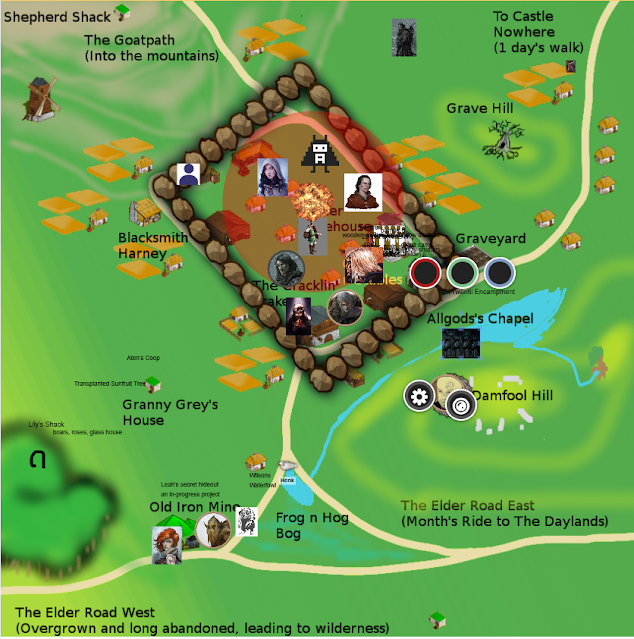
A quick view of the village map. Upgrading the village wasn't the focus of the game, but was a satisfying part


With a very small hex map in case the players got cabin fever and wished to wander, though this campaign was set in the Moonlands, a place where the sun was a rare occurrence and the lights of alien moons warped reality and spawned monsters. It was no place for mortals to go wandering about narratively, and on the meta level, this was not a hex crawl campaign.


With the dire outside established, the focus then turned to the accursed, time-looped estate which was composed of 3 modules- Ynn, Castle Gargantua, and Maze of the Blue Medusa, with Ynn as the ever-changing grounds of the estate that must be crossed, Castle Gargantua as filling for the towers and 'minidungeons' that might be found from entering buildings that were not Noure proper, and MotBM as the 'Final Area' within which were contained the secrets of the decadent nobles and mad experimentation that caused this loop. All were warped to suit the campaign setting rather than used as is, but Ynn was praised, MotBM disappointed, and Castle Gargantua was mostly ignored, but I feel like, with some tweaking, could be worth trying again.

Another sleeper hit was a tweaked version of the Meal of Oreshegaal, (which I still can't spell) which in my warped version had the Tuskmen as once-human peasants subjected to famine that Oresh turned to pig-people so that they could survive via cannibalism rather than become ghouls. As some of the more ghastly elements of the manor were removed, Oresh became everyone's favorite creepy wizard uncle and the party allied with him against the entity responsible for the time loop (which in a twist, was not a time loop at all, but a manual reset using clockwork machinery, cloning facilities, which then gave everyone a bit of an identity crisis upon the revelation that many of them were clones made to play out assigned roles).

Player attendance became wobbly near the end, but a final epic conclusion or three were achieved, and a combination of retirement and new recruitment was set out for the next portion of the campaign.

Things I learned from Castle Noure
1. Having the players be desperately poor is fun, but can wear thin in the long run- I am more likely to switch to 'barter only, coin isn't real' than go full on copper standard but silver/gold book prices again.
2. Making death a non-issue has mixed results depending on playgroup. Some players had more fun not having to worry about permadeath, and/or learned the value of permadeath by seeing the effects of hanging on to a character who had outstayed their welcome. While others used it as a crutch to support existing over investment and loss-aversion and were led astray, perhaps. I think future games of mine will have to pick a path, so to speak, either making death more menacing, or leaning harder into the 'fantasy soulpunk' idea I have for the setting, where death is just deportation to the netherworld and human consciousness in artificial bodies is the new transhumanism mood.
3. An absolutely hostile wilderness less fantasy wilds and more 'cosmic horror' is very fun, but again can wear thin in the long run. I am greatly amused by my veteran players who survived the Moonlands chuckling to each other when newbies ask about the Moonlands or naively assume that they couldn't be that bad out loud.
4. Reliable 'crafting systems' for potions and the like have a sort of appeal, but I think are doomed for a variety of reasons. Most importantly, I think potion ingredients must be confined to things that cannot be farmed safely, or you run the risk of having to run Magical Industrial Revolution with potions/magic items. Which could be fun if that's the premise of the game, but if it's just one player wanting to set up basilisk and mandrake factory farming, you probably get a pacing/tone/balance issue.
5. Having a premise to do 'one thing' in a campaign is great and good and has always been more successful than keeping things strictly 'get in ye dungeon and get rich and figure out what you REALLY want along the way". "Break the Curse of House Noure or Get Rich Trying" was the initial goal of the campaign, it fragmented into other goals, and finally, when the campaign was over, some characters retired, but some had formed a proper adventuring party forged from the unity of their common goal.

If there was a theme to the 54 sessions or so of Castle Noure, it was something about leaving past trauma behind and focusing on found friendships and family. But of course, it was not to last, for call no PC happy till they are safely retired offscreen...

IRON-CROWNED OROBORO
Map lacks some player added portions

After the party finished with Castle Noure, their next goal was to take their 60-foot tall clockwork fighting robot and walk it out of the hellish moonlands to sanity and sunlit lands, for a variety of reasons. Thirbaek Merrymace, cleric of dead gods, had properly put one of his gods to rest, and now sought to find the sunshard fragments of Riikhus and reassemble him. Blix wanted to honor the wishes of some bugfolk and bury them on the isle of Ebetheron, and also go on a honeymoon with their protein polymorph gf. But mostly, people just wanted to keep playing and get out of the moonlands, and Oroboro was a part of the setting that was well-fleshed out due to the past Crownless Lands campaign, so it made for a good destination.

Oroboro was supposed to be a city crawl+megadungeon, and I had a vision for the megadungeon, with rooms that would fill and empty with seawater, making timing very important, and equipment more important yet, as armor protected from monsters, but not drowning. A hell of undead and fishy monstrosities, a corrupt sore at the heart of the city that had formed from the unfinished business of Oroboro.

After the very positive experience with Ynn, I did not prep the Sunken Sepulchre megadungeon,but instead filled it on the go with random tables. I think dungeons benefit from building in advance so parts coincide, but I think the enemy composition between sea creatures, outlaws, and undead was a memorable mix as they required different tactics to approach and the players rarely rushed in, rather scouting, then returning to 'lair' areas with preparation.


Looming threats were the cult of Janus, cthonic demon god of blood and gold, their temple a crater filling with seawater, and the dread Ningen King, a giant merman made into immortal monster by the artifact Topaz, and his rivalry with King Samuel Goffnagoff, an old PC who had become king, as well as the machinations of the ancient serpent rulers of the city, a necromancer cult which outlived the loss of its head, a giant wasp-queen Happy who was raised by humans but whose offspring lacked morality and hungered for brains, and the neighboring country of Fassulia in a magical cold war with Oroboro.

The players were no mere murderhobos delving with rusty spoonshivs now, however- levels started at about 3-5, and reached 6-7. Waterbreathing and light were spells that trivialized some of the mundane threats of the dungeon, which was slightly disappointing, but the players found the place disgusting and dangerous enough that they probably would not have been willing to delve it without these magical tools. A fine balance is required to make dungeon delving at higher levels still feel dangerous, and I think it was barely met here, but, especially once teleportation and flight became available, it surely felt like the players were outgrowing many of the problemsolving parts of dungeon delving.

However, their heightened power, especially mobility-wise opened them up to the wonders of hexcrawling and domain building, and I soon found myself in need of prep far beyond the Sepulchre.


They fought (and lost against) blue dragons in the deserts relying on their metal clockwork battle bot (but came back with a plan and grapple ballista and a small army and won), delved a ghoul-missile silo in Fassulia and uncovered the machinations of the lich Magister Verdurus (villain of Crownless Lands), riddled with terrible ifrits who could only be tricked and outwitted, not beaten, visited the islands of the realm and other city-states like Phavea and the accursed City of the Emerald (within which a kiss-spread curse made all appear as the lost Queen of that city), met the Knights of the realm in their castles, accidentally assassinated Oroboron Queen Buckley at the machinations of a player from Crownless Lands picking up an old character, igniting mroe Fassulian-Oroboron intrigue (tho necromancers were behind it all) and made war Against the GiantsSaga of the Giants™ and defeated and claimed the hill giant section of that module to dip their toes into that hazy theoretical realm of 'domain play, ' which really came into full force after the players defeated the Heart of the Kingen (and betrothed the High Incarceratrix of Janus) removing the two main sources of evil at the heart of Oroboro, only to be confronted with a choice- both the King of Oroboro, Samuel Goffnagoff, and the Serpent Queen Tinnea, giant platinum medusa (one of three medusa) offered payment for the monstrous-immortality granting Topaz, but each was vying for rulership of the city. Tinnea got it in the end, simply because she could pay the ONE MILLION SILVER bounty upfront, while King Samuel offered a payment plan.

Apologies for that doozy of a runon, have an image of Blix, Erhard, and Thierbaek, as well as retainers Serenity the hatecubus/Erhard's Sword, and Kitadatapa, moral compass spider cleric.


Samuel was petrified and overthrown, which led to what would later be known as the Oroboron Civil War, in which some supported the legitimate claim of the Serpent Queens, while others supported the human Goffnagoff family who refused political marriage and opted for revolt (Princess Evalyn being the Rebel leader). I rolled reactions amongst Samuel's knights to see who would join the rising serpent queen and who would rebel, and was surprised to see that most rebelled (save for the most mercenary of them). More surprising still was the split of player loyalty to different sides of the civil war. Each side was largely identical in politics, so it really was down to character moments- Some valued their feudal oaths to the knights, or had sinister mirror-cult conspiracies at play, or simply sided with their best friends or just were double-agent lesbians
hey, a motive's a motive


Anyway, each side was given private channels to communicate in, and they plotted and schemed, drawing allies from local factions they met in more standard play to aid them, employed counter-measures and counter-countermeasures via spying and double agents and intelligence work, and I as GM was just the neutral arbiter of all this. Though some people felt betrayed, for the most part this was very enjoyable to everyone, as playing against other players with GM as arbiter lead to lots of problem solving. In the end people died, players retired, and the Serpent Queens were cast into prison or the pocket dimension from which they came (or beheaded by KAN for inscrutable purposes), the Lumarian conspiracy was revealed and [REDACTED] (he sold his name to a bugbear) the Mirror-Pope fled to the mirror realm, and the party's ties were now shooketh and everyone resolved to sail away from this political squabbling on a boat to become pirates instead.

What did I learn from this 65 session campaign? Well, one thing was what D&D in the 5-7 range really starts to look like. I would not go so far as to say this was 'true' domain play as we did not get deep into the nitty gritty of how many pikemen can guard a 5' wide breach in a player-build castle wall, there were mercenary troops hired, there were night raids on war camps, there was A player castle built on the ruins of the reclaimed Hill Giant Steading, there were religious conspiracies and marriage angles, it was all pretty great. With regards to 'domain play' I think there needs to be a goal- idly upgrading and sleeping at Fort Fortenfort (said player castle) was briefly fun, then ignored, but the goal of the Civil War galvanized players into 'domain level' actions. The trick might be setting- you need it to be wilderness enough that the players have room to grow, but also have nearby factions of all types so the players aren't just clearing hexes of direwolves or whatever.

According to one player, the theme of this campaign was 'Loyalty' not just to fellow party members and maximising loot, but to ideological goals. While fun, the Civil War took a lot out of people and they resolved to go on a piratical boat adventure with no complicated politics, just a desire to escape Oroboron politics and stop a prophesy that said the fled wasp-princess might bring about the end of the world via domination of brain-eating wasps.


VOYAGE OF THE THIEFBOAT


Things seemed to start off well- the party scrying the wasp-princess, robbing a tower of an archmage of its goodies (even learning the Wish spell, albeit a Glogified one), dealing with plague rats on the ship and pressganging pirates into joining. Then came Cycladea, a Lungfungus created island module meant to emulate bronze-age greek mythology.

In and out, talk to the wasp-princess out of causing the apocalypse, and definitely don't get caught up in Iliad/Gigantomachia shenanigans, 20 minute adventure

Bouncing around Cycladea started low-impact, looting some dungeons, helping villagers, meeting wizards. But these were not fresh characters. They had strings on them. Arsem's madness and Firstborn(the forsaken homunculous 'daughter' of Blix)'s pact with the Great Raven led them to piss off a terrible wizard who was cursed by the gods after their initial friendly meeting. Animated skeletons (and covert vampires who snuck on in Oroboro) caused a mutiny on the ship, and Finzu, the Pyromancer, lit a city aflame with everburning fire with some magical shenanigans. The party sided with the king who had imperialist dreams, and vowed to defeat the goddesses of Cycladea who were admittedly jerks in the greek pantheon way. The temples of the goddesses were burnt and pillaged, the kings forced to bow. Those of the party who enjoyed the chaos revelled, those with morals left the boat behind, Kithri the halfling slipping off to garden and raise sabre-toothed tigers elsewhere, Firstborn teleporting back to Fassulia to atone and work on the side of law, mourning the lost friendships the Civil War had ruined, Thirbaek and his wife the High Incarceratrix used a sunshard and miracles to have a vampire-dwarf-sunchild and started a new pantheon and went on to rule Stonefast 2 in other lands, Grift died and joined said pantheon as a new incarnation of Kispiritis, and so on. The islands fought back, but frankly, Lungfungus's world was not meant to deal with level 7-8 adventurers with a wide variety of spells and multiple spellcasting systems, especially when supported by arguably the most powerful faction there.

However, the victory-drunk party did not heed the hint that they may be succumbing to hubris when the previously pissed off wizard got a good lightning bolt off, and did not correlate characters leaving them to their capabilities weakening. After the final temple was burned and the Cyclops were freed, they sailed to the forbidden Isle of the gods, slapped around some fantasy creatures, then picked a fight with 13 lions lazing under a tree.

After round 3 arrived and half the party was dead,
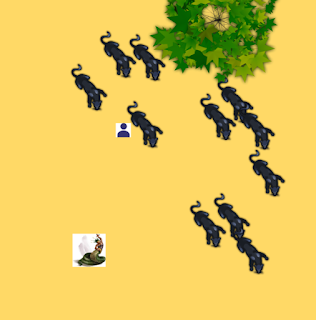
This is how a high (for OSR) level campaign ends- hubris, and cats

The survivors retrieved a teleport scroll from a corpse, and tried to teleport out. The teleport landed on the 100 result, the dreaded 1% chance to teleport yourself into rock and die (though we left it open to interpretation that they ended up in the Veins or another plane of existence) and so ended the campaign, on a wild but somewhat anticlimactic note Those players who had quit while they were ahead got happy endings at least.

I was gladdened to hear feedback that the 22 sessions of Thiefboat were satisfying to players though. It was not a glorious story, it was a tragedy of the corruption of power, hubris, and how fractures in interpersonal relationships go deep. What did I learn from Thiefboat?

1. High level play is strange, with its teleportations and flight and so on. Verisimilitude-wise, GMs must think of how cities and rival wizards will defend themselves from obscure methods of attack like, say, 2000-foot long dragon turtle shells being dropped from the sky, or magical arson. But things are still dangerous, and reliance on the big obvious tools can leave the players blind to the fact that they have 23 HP and that can go away from 3 dudes with arrows in one round.
2. Boat travel can be hard to make interesting without succumbing to the temptation of  shipwrecks and krakens. One of the more interesting things was the homicidal Captain Arsem secretly engineering a mutiny as an excuse to kill the 3 crew his madness demanded die to save the future from the prophecy, only to have that mutiny coopted by the vampires who had snuck aboard a while ago. While that's a rather extreme example, social scenes with people on a boat have a lot of potential, as can problems like 'how to get rid of plague rats' or 'find out who is drinking all the rum' or 'secure limes' and so on.
3. Player attrition, especially on open tables, may be inevitable as the scope of campaigns shift away from what originally drew them. Part of why Castle Nowhere/Oroboro/Thiefboat lasted as long as it did was thanks to player recruitment persisting so even when some players had to leave, there were usually some waiting to take their place.

Anyway, player numbers had dropped from 'open table' to more 'single party of regulars' by the end of thiefboat, so it was time to move on, and time to do something a little different (no no, we aren't at Lancer yet)

BETRAYAL AT QUEENS COAST

 
As a change of pace,  Betrayal was a game in a more idyllic, Shrek-like realm. Having read a great deal of Otome manga such as Bakarina I wanted to have a shorter more storygame style game where the players would be expelled from the Queen's Court and have to clear their name, gain the support of the provincial lords, and return to turn the tables on their nemesis Alicce Von Dumandred. The players had a pretty good time, though the single-group model as opposed to open table immediately showed its weaknesses as players couldn't make sessions, which led to cancelled sessions, which led to lower investment, and I knew its days were numbered... which was fine, as it was a palate cleanser more than anything. The players had to sleep in a haunted manor, saved a nun wedding from Alf Lords after diamond shoes, bullied Good Doctor Ogudugu, had intrigue with and married a Frog Prince, helped on eof Alicce's cronies throw off her influence and accept herself as a centaur, visited the castle of the Dark Lord in the Wurderlands (within an anarcho-communist city of mutants, in stark contrast to the feudal human-central lands of Queen's Coast), infiltrated the manor of Alicce Von Dumandred and had the dreamy Prince of Saresare seduce Alicce(or be seduced?) so they could escape with the party's Gothic Villain's imprisoned one true love, and had exciting dance parties with opaque rules. It was all very fun, though the final dance party conclusion never came together due to scheduling conflicts, but the conclusion was mostly foregone at that point- the party had restored their honor, and Alicce's misdeeds had been brought to enough light that she would flee to Saresare with the Prince (The mysterious foreign prince subplot with a wicked foreign bride and ulterior motives from both of them be good fuel for a potential future campaign)

Whimsical castle Daotengard, overtaken by demon-frogs and a contagious froggification curse


Anyway! I learned a few things here
1.Turning social scenes into more gamified spaces (I had a 'Dance Pentagon' where entering exposed you to various NPCs who could help or hinder you, attacking HP intentionally or unintentionally via mean words or simple dance exertion, but you had to do it to get private conversations) can help to make them feel like they have timing and stakes compared to just 'you talk at NPCs for 12 hours.' Just roleplaying via chat is fine too of course, but I think making weird social games based on positioning and resource management (spare dresses if wine is spilled on you!) is better than making them about rolling a skill check for Diplomacy or what have you.
2. Similar to wolf moons, this was a bloated disaster of houserules... having received the DCC RPG book as a gift from a player, I eagerly sought to add it to the game... on top of GLOG casting... on top of all my other houserules to BFRPG... on top of a mixed level up system using both BFRPG GP=XP and Die Trying X's and DCC's model... suffice it to say that this abominable frankenhack would have been better served by leaping into the nearest dumpsterfire and leaving us to play Fate or PbtA or a proper story game. We squeezed great roleplay and schemes despite the system, and used the system for a few janky heists and dungeon delving for coin, but it was really a ball-and-chain, especially the XP thing. We survived 22 sessions under its yoke, but I could feel my bloated house-rules coming apart at the scenes as it barely supported the story-game mode of play on it.

coins to XP is an elegant system IF you stick to the prescribed purpose of dungeons and dragons as a dungeon delver. This campaign departed far from those goals, but really made me think of the limitations I was working under. In short, I needed an OSR break to ponder what to do rules-wise upon my return. I dread subjecting players to a homebrew rulebook after the disasters of Wolf Moons's Nightmare Glog, but I think I have reached the point where 'BFRPG with houserules' is something I can only run if I return to very bare-bones 'delve the megadungeon!' campaigns, and even if I do that, I need to make a definititive houserules/setting primer document.

Anyway, I'm running and playing in Lancer games at the moment, and we'll see how long that phase lasts, and if I return to OSR immediately, or if my 'break' continues to run some storygames. However, even Lancer takes place in the same setting (after a fashion) so I hope to continue stacking layer upon layer of lore regardless of what the system is.

No proofreading, only post

Friday, April 23, 2021

Lancer NPCs as Biomonstrosities

 So Lancer is a pretty cool game I've been playing/running recently, lots of tactical crunch and charop but in a less oppressive way than other systems. Maybe it's just the fact that comp/con exists to track character sheets- I'd be harder pressed to run/play the game without that wonderful service.

It has great visual support thanks to a 3rd party, retrograde minis, that has little art/tokens not just for the players, but for the NPC enemies too.

But there was one thing I was missing- Lancer supports fighting giant kaiju monstrosities (Never sapient alien species mind you, its a design goal to avoid being Starship Troopers) but the Monstrosity-type NPC is mostly just a 'rargle blargle eat your face' type enemy where the only real counterplay is to shoot it before it turns you to scrap.

But I wanted art for all the other NPC types flavored as biological, so I made 'em myself.

In campaign, these are engineered warbeasts, half genetically modded slime mold, half nanite. They are brainless, controlled by cocktails of pheromones and code, and are not even sentient, let alone sapient, and may or may not be piloted by humans or operating on remote commands. They are solar powered, but for bursts of growth/reproduction they can consume both organic and technological objects to produce self-sustaining squads that were designed to be analogous to modern fireteams.

Included is a KRX, a similarly bioengineered organism that serves as a false pilot (in truth piloted by humans of the lumarian papacy) that is a combination of the linked post and my own brain-eating/replacing wasps of the Autumn Moon, but that's just lore for my own campaign and should be disregarded for your own if you snag these critters. Also, a Keeper of Days, a clockwork mech that was a homebrew frame and reference/vector to the ever-present Kind-As-Night entity within this setting, which again you probably should disregard.

Anyway, here's a link to the actual monstrosities for use in ya own games


https://drive.google.com/file/d/1yNUdHoF-3yGQIvi1WVDRSHffBdMuUMSw/view?usp=sharing


Wednesday, February 3, 2021

Golems

 AD&D Golems

Golems come in 4 varieties, Flesh, Clay, Stone, and Iron. They are notable for being immune to many effects, much like slimes but at a higher difficulty level, but with less counterplay.
All come with a requirement of spells, level of magic user, and cost in GP per HP of the golem to create one, which is interesting and suggests creative use of spells and spell combos being something magic users can do to create thematically appropriate magical effects outside of the normally very rigid conception of what spells can do. All (Save for the clerical Clay variant) have a rather inexplicable blind spot in that they also require a Wish spell which is beyond what the required minimum level of spellcaster could actually cast.

Clay Golems- The clerical variant of golems, they are extra-immune to weapons, requiring blunt magical weapons to hurt them. They are immune to spells save for Move Earth, Disintegrate, and Earthquake, all of which briefly slow the golem and harm it decently. They can haste themselves after at least 1 round of combat for 3 rounds, attacking twice for 3d10. They also have a 1% cumulative chance per round of combat to be possessed by a chaotic evil spirit and going permanently berserk and murderous. They also have but 7 AC, which makes them pretty easy to hit, if not to harm. On a final mechanical note, the wounds they inflict are accursed and require basically the highest level of cleric to heal.

This is, of course, a reference to the Golem of Prague, though the mythical counterpart has a more solid reason for going berserk. It acted as a protector of the Jews, but one day, when the Rabbi forgot to deactivate it to allow it to rest on the Sabbath it went berserk and showed up on a rampage while he was reading the very Psalm denoting the Sabbath as a day of rest and praise to god (Clay golem more like Irony Golem amirite). In any case, this berserker state seemed to have been induced not by a random chaotic evil spirit being allowed to just yoink a 50,000gp gold investment from a mighty servant of a Deity, but as punishment for violating the laws of god, no doubt as a moral lesson of sorts.

The story also gives a good weakness to the Golem- removing the shem (a clay tablet bearing the name of god) from its mouth caused it to deactivate. Far more interesting than requiring some very specific earth-based spells or having the warriors dig out their less-favored Maces +1 that languish in their packs, spurned for fancier talking swords.

Flesh Golems-Vaguely Frankensteinesque, but only if you didn't actually read Frankenstein, but maybe saw like, Frankenstein vs Dracula at a 1970's drive in or something.

They are uninteresting monsters, immune to nonmagical weapons, with terrible AC, decent offense in 2 2d8 fists, an ability to break down doors and wooden structures, and a similar berserk chance, but with a 10% chance per round for its creator to regain control. Fire and ice slow them, electricity heals them, and other spells have no effect.

The role of such monsters, I would presume, would be not to defeat conan types, but a sort of mage-hunter monster, or perhaps a bodyguard against rival wizards.

Iron Golems- The most powerful golem, they have AC as plate, can destroy structures with time, breathe small clouds of poison gas once every 7 rounds (save or die, one assumes) can only be hit by +3 or better magical weapons similar to some of the spicier demon lords, and are very immune to magic, being slowed by lightning and healed by fire.
They are, however, 'subject to attack by rust monsters' which is a nice specific weakness to have.

I have no idea what the poison breath refers to, as only mythological 'metal golem' I can think of is Talos.

Stone Golems are basically just lesser iron golems, busting out a single-target Slow every other round, being affected by +2 weapons, and rock to mud which slows them, mud to rock which heals them, and stone to flesh making them vulnerable to normal weapons for 1 round.

3.5 Golems are basically true to their original counterparts, but Clay golems are given 'healed by acid' and all golems are given very good AC scores in comparison to their original pitiful AC.

BFRPG drops some of the esoteric abilities, increased the ACs, and added a bunch of esoteric lesser golem types like wood golems which are basically killer mannequins, amber golems that are lightning-shooting lions made of amber, 4 armed sword-wielding bone golems, and similar things that are more interesting than what they did with the default golem types for sure.

Golems, I believe, are intended to be a threat that forces a return to physical problem solving, as they are immune to spells, but are fairly slow and stupid. They are fairly killable if you have the appropriate magic weapons and strong fighters, but hit hard enough to make melee an unpleasant prospect. The clay golem is unquestionably my favorite, as its cursed wounds discourages casual engagement and its mythological roots are stronger and richer than the other variants which come across as a blander set of scaling 'powerlevel' threats more than beings with their own identities.

Sunset Realm Golems


Mokkhite Golems


Mokkhus, God of Death, adopted brother of Riikhus and the other face of the Stone Sun, the Counter of Bones! The faithful do not seek to cheat death, but sometimes, the Gatekeeper of the Dead used a loophole and allowed an ancestor spirit to return to the realm of the living with the following restrictions.
1- The animated vessel must be inanimate, not a corpse (Wood being an edge case that was allowed) and clearly resemble the animating soul so as to avoid deception.
2- The soul can only return for the completion of a task, then returns to the underworld
3- Tasks must be aligned with the holy interests of Mokkhus, not mortal whimsy

A simple wooden mannequin was the most affordable golem, with a hollow suit of bronze armor the next. After that, a statue was the next most common option- a statue of wet clay could be remodeled to suit multiple spirits, or a statue of fired pottery could be a more permanent option. Stone was the most desirable, but even with the power of the god assisting, a spirit would have  to be mighty indeed to move a stone statue, and so stone guardians only defended High Temples and other vital areas. The secrets of Golem-Crafting were guarded well by Mokkhite Priests even after the vanishing of their god and the obsolescence of their religion, and the process, while once almost standardized, is now ludicrously expensive, requiring ancient artifacts of the dead god to channel remnant power, and of course, a Golem Manual to describe these lost rituals and to find an appropriate spirit.

Elemental Golems-
Everything has a soul, so modern-minded sorcerers simply anthropomorphize the soul within the materials of a golem itself and bind it. As elementals are tremendously dangerous at even moderate sizes and typically utterly unconcerned with anything humans are interested in, these magics tend to be highly complex affairs requiring dozens of Spellwisps to wrangle an elemental and absurd amounts of pure gold for interior runic bindings, but the process is exponentially cheaper and easier with smaller golems, as errors are unlikely to have serious consequences. Though unfeasible for middleweight bouts for all but the mightiest magicians, there is a thriving market for golems built for the Featherweight division of Beast Battler circuits- golems made of pebbles, candles, butter, root vegetables, and so on.

Alvish Golems
Popular in the 3rd age, and perhaps the inspiration for later variants, golems created by the unparalleled magics of the Alves are controlled by custom-made spellwisps of ancient and terrible power, with wide-range counterspell suites to prevent rival fey from breaking their expensive toys. They are more akin to magical robots, with personalities pleasing to their creators, and a high degree of personalization, as each was essentially a vanity project. It would be futile to talk excessively of them as a group, for apart from the mastery with which they were created, each was unique. Many persist to this day, their masters long vanished into the dreams of trees, ice, and the Iron Moon, their forlorn creations still fulfilling ancient dictums in broken ruins. An intact Alvish Golem is usually less a threat and more an opportunity to adventurers and archaeologists- if the golem's rune-logic can be understood, it can be utilized for the benefit of those who discover it.

Necromantic Golems
When it comes to stitching together corpses before animating them, there's two main types of necromancers- the ones who want a giant unstoppable monster to rampage about with but all they have to work with is like, a local village graveyard, so they work with what they have, and the sort that are stitching together the dead to make a companion. Someone who has forsaken (or more likely been forsaken by) polite society to hang out with Corpse Dolls and Patchwork Girls of their own make.
Both these sorts of necromancers tend to blame each other for their own misunderstood unpopularity, while completely missing the point.

In any case, the only real difference between a 'zombie' and a 'Flesh Golem' is the amount of spellery put into one. A 'Zombie' is usually animated very simply by ravenous insect souls or fragments of nightmare, a 'Golem' is usually entirely spellwisp-motivated, and human-souled corporeal undead, regardless of the precise details, are usually called Revenants as a way to distinguish them from the 'nigh-mindless minion' variety. the more predatory human-derived entities like Wights, Mummies, Vampires, Ghouls, etc, and from the religious revenants of the goddess of undeath, the Children of M'shesh.

Clockwork Golems, or rather, rambling on the lack thereof in the sunlit world
Clockwork was well suited to dungeon machinery, the tech itself coming from a Stonefast 4, a now utterly-destroyed deep-delve fortress near the human city of Annu Nki that was known for its stone boats before clockwork was invented or unearthed by Svart 45045. By the late third age, dwarves were building their subterranean tricks and traps to both defend and increase the standard of living within their fortresses and outposts, and selling commissioned devices to those who could pay their prices, and so antique clockwork is a common enough discovery for tomb-robbers, especially in the north moonlands near Limedike and Annu Nki.

The idea of a clockwork golem complex enough to operate independently or even semi-independently was an amusing 'idea bounty' among dwarves for a time, though it never went anywhere. Amusing automata yes, wind-up toys and clocks, of course, but clockwork alone simply wasn't complex enough to operate reactively. This branch of research was further crushed by the geopolitics of  the third intersolar period and the 4th solar age. Wracked with magical catastrophe from the fallen Elf hegemony, neither the Witch-Queens of initial post-elf human rule nor the later conquest by theocratic Riikhites had much use for the idea of clockwork, being intensely magic or piety-focused, respectively. And so the field of clockwork became largely an abandoned one, eclipsed by runic magic developing first with the aid of the Witch-Queens, and Mokkhite golem-crafting later once dwarves once swore allegiance to the Stone Sun pantheon of Riikhus, Mokkhus, and the other enslaved deities.

During the 4th intersolar period, the majority Riikhite/Mokkhite population of dwarves, in a panic due to the death of their prime gods and dissolution of the Stone Sun pantheon, became fearful that their devices might be turned against them and used to oust them from their otherwise invulnerable stone fortresses by the human masses seeking refuge from the onslaught of Moons and Darkness outside. In exchange for granting refuge to the ruling nobility, clockwork and gunpowder not in dwarf-hands were outlawed by the Mercian Empire in perpetuity, and this law was retained among the splinter-states that formed as the Mercian Empire collapsed without its theocratic unity. The old law, devoid of context, nevertheless lined up with the desire for nobles to prevent guns from developing enough to challenge knights, and so despite the laws of Mercia no longer applying to places like the Fault or the Tripartite Realm, the clockwork/gunpowder ban remained almost worldwide for several hundred years, with Saresare and the Beast Islands being notable exceptions.

While by now dwarf society was well into its inevitable decline due to the gnawing darkness at the roots of their stonefast fortresses in the 5th age, the dwarf Thirbaek Merrymace(PC from the last 2.5 campaigns I ran), before he was father to the 6th sun Aurum or Underlord of Stonefast Two, brought back a titanic war machine from the Moonlands- the Keeper of Days- or rather, an unfinished replica of the Keeper, as the original was destroyed in the Oroboro Civil War by the Serpent Queen supporter Erhard De Vend- but I digress. It had no will of its own, requiring a pilot, but the dwindling population of the dwarves suddenly had incredible force multipliers in the form of these Keepers, where a lone pilot could become a 60-foot colossus of ticking steel. The Keepers spread throughout dwarf society and allowed them to reclaim land lost to the Moonlands and fortresses lost to chaos, and seem to be a herald of a new dawn for the dwarves- though if the temptation to use gunpowder proved too great for humans to keep to the pact, surely these metal titans will likewise lead to the loss of the old ban.