Showing posts with label Sarkomand's Fault. Show all posts

Saturday, August 3, 2019

Axe Beak

OG AXE BEAK
Fast and with a decently hard-hitting claw-claw-bite routine, the axe beak could be any number of statlines for smaller predatory animals, honestly. There's not a lot going for them as is- it's a killer dodo, nuff said. I wonder if they were just called 'Axe Beaks' because the players couldn't take 'Giant Chicken' seriously. Although, they are specifically described as 'prehistoric' so maybe they were for all those presumably more Conan/Pleistocene-era D&D games that one naturally infers existed from similar monster manual entries

In anycase, they have become popular as unusual mounts, perhaps due to similarities with chocobos from the final fantasy games, or maybe there was some adventure that had demihumans riding them and it stuck.

SUNSET REALM AXEBEAK

yes, i admit it, i had no desire to draw a bird, i just wanted to play around with different brush settings
These large birds are one of several species endemic only to the tropical areas of the Fault, though fossils of them can be found all over the beast islands, typically on deforested islands. They are swift jungle-runners, able to hop over obstacles and navigate with the reaction times typical to birds avoiding collisions at high speeds, and make excellent, if vicious, mounts for forest terrain. They hunt in small packs, and will happily use the titular 'axe beak' to chop down trees to reach tasty bird nests and treed mammals. These avians communicate by rapping their beaks on wood, as opposed to any vocalizations, though they occasionally make dreadful hissing noises and barking 'caws.'

Though 200 years ago they were only ridden by free-living goblins who served as the first line of defense for the Orb of Omnipotence, in modern times they are popular pets, steeds, and food sources (meat and eggs both) for the two major civilizations of the fault- the northwestern Gondazong and the eastern M'sheshans. The creatures are also used in the lumber industry, chopcock fighting (chopcock being a far more common name than axebeak), and fancy breeding, the latter of which having produced coloration on par with fancy chickens and parrots.

you don't want to draw birds, you want to draw weird fashion
the gauche of both these gondazong chopcock breeders bringing juvenile Classic Mangobeaks
will doubtless haunt them for months to come

Friday, May 10, 2019

Excerpts From A Second-Hand Necronomicon

pictured: actual real-life selfie of me writing this self-indulgent post about some dead wizards my players stomped in prior campaigns
The Necronomicon, by Abdul Alhrazed, Astronomer-Necromancer (early 3rd sun)
(Corrections Courtesy of  Sarkomand, The Sorcerer-King, The Omnipotent!) (4th Sun)
(test results of queens-consort neroikos) (late 3rd ranging to 4th)
(With advice for a modern audience by Magister Verdurus in the age of the 5th sun)
Introduction
Rejoice, seekre of knowledge, for ye hold in your hands the lyfe's worke of Abdul Alhrazed(or more likelie, a copy of my great work). Belief me when I say I holde no ill wille towardes the race of menne nor womenne nor childrenne, butte sought only to understand lyfe and deathe, and wishe to spread this knowledge to all mortals, and even immortals such as the Alves(poor bastard was writing this before the intersolar war, ignore everything he says about Alves)

Though a broade subject, let it first be said that Necromancy is notte a art of deathe and darkness, but of LYFE and LYGHTE! The Soul is what we speake to, and grant new fleshe, so that the dead may once againne gaze uponne the sunlit realms. Ifn the ruling bodies of a land prove querulous and recalcitrante in accepting our blessinges, remembere that it is notte these foolishe kings and wytches, butte the elements and world, who are your true enemie. Air, Earth, and Water- all seek to expel our SOULS from our bodies, and reclaim our crude materiel bodies to their cold grasps. The ignorance of men may be rectified in time(dubious), butte the enmitie of the elementes is eternal and unrelenting, and to denie deathe, one must assert that LYFE and LIGHTE, the FYRE of the SOUL, is eternallie dominant over the elementes! (again, 3rd-sun scholar, he had never even heard of the purging flame of riikhus)

Before ye proceed, I would firstlie recommende seeking out the Haibane Yazata (he means a Vulch. Bird-person, endemic to Saresare) for though they are filthie and loathesome of aspect, they are mortal psychopomps entrusted with a deep empathie for the soul, and can teach ye muche of calling forth the spirits of the deceased, and perhaps most importantlie, of putting them back to rest. Do notte call up what ye can not putte down....  
Chapter One- Missing Parts
Ye have doubtless hearde of mightie menne and womenne fighting battles after taking fatal wounds, and the simple reasonne for this is that a bodie is merelie a vessel, the lantern holding the lyghte of the soul. A strong soul need not leave its bodie if it can endure painne and impairment. I examine the following issues with missing organs, butte advise ye, my student across time, to use bodies that died peacefullie(Ironic)(irrelevant) and to follow these instructional sketchings to inform ye barber-surgery and confirm all organs are present before proceeding.

  1.  The Brainne- This soft cushionne exists so our fierie souls might be comfortable and dreaming in our crude bodies of fartinge mudde. With no brainne, a bodie will be discomfited and confused, unable to differentiate between things within the world. Bodies with no brainnes are suitable onlie for mindless-seeming slaves to obey magickal commandes to the lettere, or as hosts for souls that ye fear would be too powerful to release into the world with a full bodie. (a truly powerful soul has no need for a body at all, but they may want one badly. my queen will have a proper one, soon enough...)The better the brainne, the better the feeling and control of the bodie, and so a certain lust for brainnes may manifeste in undead with withered or damaged brainnes, out of agonizinge desire to heal themselves, not maliciousness. Thinke well before e'er raising a Skeleton, and pay ye embalmers well!
  2. The Skull- a Skull is a beacon for appropriate souls to inhabit a bodie. Ye may find yourself infusing headless corpses with the confused souls of wyrmmes of the earth, squiddes of the sea, and snailes of the both, and other boneless blasphemies if ye are luckie, and if unluckie, ye may call forth the dead of the First and Forgotten Sun, the nameless nightmare dreamers of whom i wille not speak(in this text at least)(alluding to later work, Nameless Cults)
  3. The Heart, And The Bloode- The power of a bodie resides in the heart and the bloode, and dry bones lacking either will be of limited strength. Rotten bodies and those chopped and hewnwill likewise be of limited power, relying on strength of spirit. A bled bull inhabited by a standard spirit will be of little use as a plow animalle, while a childe's dry bones inhabited by a mightie warrior of ages past will have the strength of ten menne. (small bodies enable flight with a sufficiently strong soul. stitched giants tend to be unable to so much as twitch. souls spontaneously generate and incubate within bodies, however, allowing for artificially gestated souls to be matched to special projects.) (Vampirism of the first-order is a curse that affects the soul itself, second-degree vampirism is the disease spirit offspring of a first-order vampire attaching themselves to living hosts.)
  4. Liver- Thinke of the liver as a prism for the soul, amplifying desire in the basest senses. Love, hunger, fear... A bodie with no liver is a colde thinge, alienated from humanne desires, and driven onlie by ideologie and logick. (Not necessarily a bad thing for a minion) Alves do notte have livers so do not fret if ye cannot find one. (Wrong, Alves DO have withered vestigial lily livers, as do Elves. It's Snakemen who don't have them at all.)
  5. Stomach And Viscera- The lacke of guts allows for spirit-flight more easilie, butte the cold earth, even a sprinkling of sand, will oppress passage of a bodie without them, explaining the popularitie of subterranean graves even in lands where the skull-moon does notte go. Beware the so-called 'purifying saltes' that will strike the gutless bodies like an onager-stone (Feels more like slingstones, I'd say)
  6. Bladder- A parallel of the guts, butte for water. A bodie with no bladder may not resist the flow of water, making rain paralyzing and even streams impassable without a bridge. The ocean will devour bodies without bladders in a flash! (not so bad in darkness and deep, deep ocean. Unfortunately, there are aquatic grues. Sunken necropoli are rarely worth effort)
  7. Lungs- A parallel of the guts and bladder, butte for air. The wind itself will be a bodies' enemie, a thousand invisible daggers on everie breeze, and everie incense burner an impassable wall! (M'shesh breathes the Black Wind and is my personally recommended intermediary)(incense aside, wind is manageable assuming you wear clothes, but this was before the covenant of lightning. Day clouds=almost as bad as sunlight these ages. If your minions start falling apart for no reason, check the lungs)
Chapter Two- Species And Souls
  1. Humannes-It is important to knowe the culture of a soul, so to avoid offense and reach agreements...(Forget all this, see Appendix B, for 'Boozehound Brigands' whose souls will serve perfectly well in most situations, provided their liver is intact enough to get sozzled and you can understand some archaic Common)
  2. Dwarves- I have notte met many of the stubborne folk of stone, butte their own necromantic artes are based on ancestral bloodlines and ornate crypts where the dead remain vigilant, to one day defende the living in a time of ultimate peril. It speakes to their fortitude that their dead can cling to such wounded bodies for so longe... as suche, I would not seek to raise a Dworf for fear of the obstinate ideologie and prior obligations sure to rise up...(induced vampirism excellent at altering priorities. Bizarre inorganic dietary options emerge) (Sounds like Sarkomand accidentally recreated nascent Svarts, though in a mineral-deprived, feral state.)
  3. Alves- While one may raise the Bodie of an Alf with a different soul(initial experimentation with soulless, elf-homunculi resulted in the occasional spontaneous possession of the bodies by hyperbolically competent alves when the iron moon passed by. security risk, all elf-clones destroyed.), the Alf-soul will likelie alreadie be departed to a Lunar Mirror and rejoining the circle of lyfe in a new bodie. Alves are an enlightened people who do not mistake the container for the content, and are most tolerant of the so-called 'undeade' so longe as they are not gruesome and abhorrent to their sensitive ears (this is not true of Elves these days, and if it is true you're probably dealing with a post-collapse Alf who should be slain and their dark-stained soul sent back to the Iron Moon.)
  4. Haibane Yazata(vulch)-The spirits of the sacrede yazata are very strong, but they scavenge lowlie bodies on their own should they choose to return to lyfe, and compelling them to take a bodie they do not consider abandoned is follie. I found this out the harde way when my instructor, Nasir, took an Arrow to the Gut and slowlie perished despite my offers of assistance, and I hope that his lessons are expressed in this booke...(Ignoring this lengthy eulogy, know that the vulch can set to rest undead with their humming and singing, but not Skull-Moon undead. Also know that the Church of the Bell Exorcist is derived from their songs, and their instruments are both of great use to necromancers, and of terrible danger to the undead.)
  5. Ningen- A race of gentle and fishie giants of the sea, their spirits flow like water back to the sea upon deathe, and are most difficulte to call back from the depths, and the sea, being of salt and water and a great profusion of lyfe, is most inhospitable to the long-term condition of the bodie. As such I was unable to restore the fallen princesse of the Ningen despite my best efforts, and have notte heard from the sea-folk again since my unfortunate failure, and so my knowledge is most limited on this subject.
  6. Snakes- The great mother of serpents Yg, a friendlie(HA!) black-haired priestess of whom helped editte this booke into the commone tongue, of course discovered necromancie and many other wonders beside in those forgotton Ages, butte has kept their secrets within her libraries and amonge the snakepeoples and their ancient crypts that survived the Age of Dragonnes. Suffice it to say that you should notte meddle with the affairs of serpents, (HA!) butte Dragonnes are fair game in the eyes of Yg. Beware that dragon souls are most unreasonable, and their bodies are large and unwieldie for other Spirits to use, butte rewarding if a suitable match can be found.
  7. Beasts- When raising the spirits of beasts, carnivores for savagerie and domestic spirits for obedience are -(Stop reading his ramblings, use queen bee souls!) (Unless you're really into making your minions double as literal honeypots, when it comes to bugs, ant souls are the ideal mix of unthinking obedience and natural cooperation. Don't use Dogs unless you're Yuban, but cat-souls are good if you want a natural predator that you don't have to pay much attention to. Bird souls too, oddly enough.)
  8. Plants- It is relativelie easie to raise a plant into a state of preserved stasis, as seen in the eternal forests of the alves, butte nearlie impossible to restore one to any semblance of lyfe. They are too close to the cycle of elementes and the Sun for their souls to be of great use, and a humanne soul within a tree will have greate difficultie moving such heavy limbs. (Also, while they're great to pillage for stashed corpses, do not ever bring undead close to a grave-tree. Those things are near elementals in terms of their hatred for undead) 
  • Ghouls- Ghoul Fever is a fundamentally elemental process- life consuming life, as life is wont to do, but only ever consuming and assimilating, not reproducing. Ghouls maintain their organs by devouring the dead, and as such are not found in violation of the elemental covenant. I think, carefully managed, that Ghouls will be the perfect servants for the west fortress, and further proof of how far I have exceeded Abdul's understanding of the opposition of elements to the undead. Also works on Dogs- the Jackal God is displeased, but powerless to oppose me.
  • goblins, ogres, and other alfspawn- highly morphogenic bodies proved useful in biomancy, but nearly useless for necromancy, as their souls were suggestions at best, vestigial, embryonic things. I could have taken the time to name them, but compliance was low. all were terminated after security risks grew too high. alf biomancy and abdul's necromancy are increasingly useless in my true task of freeing my queen from this accursed tree and into one of these dozens of bodies that so resemble her
  • Blight Fungus(?)- A wonderfully horrid crossbreed between undead fungus, darkness, and disease spirits led to the creation of a virulent life-mimicking corruption that spread via air and contact, and reacted very positively to necromantic energies (and poorly to flame and salt). I suspect all fungus may be a First-Sun life-form, explaining how lightly death touches it. Souls in infected bodies quickly lost morale, sanity, and finally their grip on the mortal realm entirely as their host bodies decayed into festering masses. A side effect arising from second-stage decay of blight itself results in airborne ghul-fever and the subsequent consumption of the infected- an immune response from the elemental covenant, I expect, and a damper on its spread. Though the City of Bells seems unfit for further experimentation, I have met with xxxx-xx-xxxxx who in turn has communed with a being of outer darkness xxxx for further alteration of the stuff. The neighboring desert country and the disgruntled 'Circle of Aldha' therein seem very promising for further collaborative research. 
Chapter Three- On the Dead of the Skull Moon
I belief we whomst've'd necromanced are so reviled for the superficiale resemblence of our art to that of the dread Skull Moon, and its hideous beyeings thereof. While it is true that the soul of a locust within the bodie of a manne, afflicted with confusion, pain, and unnatural hunger, may be a disturbing sight, it is still a living soul within a natural bodie. Butte the 'souls,' such as they are, of the Skull Moon Dead are all extensions of a singular idiot will that seeks to devour all goode sunlit lyfe, and devour our're warm souls to adde to the the pallid glow of the stonie bones of that fell moon. The necromancer reshuffles the cards dealt by lyfe, butte the moon is unlyfe itself! The difference could notte be more clear...

skull-dead- Looking down on the dry city of annu nki, I sometimes am at a loss as to how to continue my work, and I merely note the dead and the dehydrated in hopes of inspiration and a superior catalogue to Aadul's meagre bestiary- the slaughter and progressive stages of undeath I witnessed from the slaughtered brigands who had the temerity to seek shelter at my gates...
day 1-crawling claws, flying heads, gutsnakes, crawlers, skinkites, muscle slugs, skulletons. weak, easily dispatched pieces of the whole. a grotesque necessity of making do with bits and pieces of entire bodies, an emphasis on stealth and assassination. under the light of skull, dismemberment is recruitment.
day 2-drowned, hangmen, butchers, bloatfloats, zoonbies. upper levels of cathedral sealed and warded against fliers with both strength and thumbs, wells sealed to prevent amphibious entrance. the dead are starting to show task-specialization.

day 3-tomb-bursters, plaguehosts, gravemoles, maggoteers. noise and stench absolutely grotesque. the stage is set to pillage the locked-away dead as well as the living now, and poison the land, barren though it be. i have no fear of conspiring disease spirits.
day 4-the winter moon is come, a brief conjunction, skull ascendant. unfrozen, rot oozes, redbogs. decay, frost, the dead raising the dead. i sent forth my own organ-takers and crypt wights, all lost despite cloud cover. The very soil and snow crawl with animated blood and unidentifiable flesh sloughs that extinguish burning oil due to sheer mass- thank my queen for the tree's desiccating roots that destroy these liquid threats.
day 5-devouring cages, coffin-crawlers, skin-flayers, swallowers, red pythons. amalgamation of yesterday's crude masses into singular forms, the accoutrements of crypts repurposed into war machines. my acids are distilled, and poured down the walls en masse. the moonspawn smoke and wither to nothing, but they have no self-preservation and press the accursed stone of the cathedral itself.
day 6- dust wraiths, hair-horrors, smoking ones. even my strongest countermeasures begin failing, as beings reduced to ash and dust simply refuse to stay dead in the glaring light of the will of skull. every gate warded with a hundred knives, and my failed dolls sent out as sacrificial lambs, though they join the horde themselves. even with their twisted forms, they still count as human for the reanimation process. 
day 7-the taker of skulls- gigantic amalgamate skeleton with a hundred skulls & arms 20 feet long with 5 hands on each end. I lured it into the crypts and the roots of the immortal tree that holds my queen prisoner showed the impromptu avatar that without the light of skull it was nothing but bones to be scattered and buried. the sun finally comes and the skull moon flees.

Chapter 4- The Jealous Elementes
The humanne bodie is composed of  a balance of air, water, and earth, with sunlyghte composing the animating lyghte of the soul. While a soul can impose masterie over these elementes, once deathe has occured, the elementes will seek to reclaim the bodie via the forces of decay, and in some cases, via brutishe calamitie of lyghtning, earthquake, tornado, volcano, flood, and so on. It is told to me that these elementals are somehow in service to the sun, and that the dead are in violation of some pact, butte how could this be, when the sun is merely a great lyght wrought of iron and magick and set in the sky by Alves and Dwarves, which is predated by far by the elementes?
That aside, the division of elementes into sunlit and dark, anthropomorphic or formless, is of greate interest to me and I would lyke to return to the subject(
he never does, but the academy library on heleologos has various excellent works on the subject of elementals both shadowed and sunlit)  in its own right beyond these simple charms, which should be performed for all bodies set to be raised.
The Warding of Sky-Obtain some pan-pipes, and perform the following piece(a reversed vulch-lullaby) to communicate to the air that the bodie is not dead. Convincing the animated bodie to breathe will aid greatlie in the longevetie of this ward. (speed of the piece should vary based on ambient wind speed.) (Any instrument using breath will do, including singing of sufficient quality) 

The Warding of Sea- Next, or perhaps during the warding of sky, the bodie should be washed thoroughly, and given to drink an elixir of wine, bloode(preferably of a live enemy), and spit(preferably of a live lover), to convince the elemente of water that the bodie is still alive and engaging in drinking, fighting, and loving.
The Warding of Stone-Upon the leg and toe-bones, certain runes should be scrimshawed, with minimal rending of the flesh to access the bones. The runes Stability and Balance aid greatlie in giving a bodie a proper walk, as opposed to an unsightlie shuffle, and a drum should be beaten as the bodie is gifted with a new soul, to beat the cadence of living movement that the bodie should learn as quicklie as possible, and convince the grim and listening earth that the footsteps uponne it are that of a living being, full of vigor and lyfe.

(such trifling wards are of no matter if one commands the elements as easily as the dead, of course)

Appendix A- Undead Categorizations- Naturally, the painless, faithful, and pacifistic undead of M'shesh are not listed here
Skeleton-
Barely cognizant due to lacking a brain, but possessed of an indomitable will that refuses to abandon even such a terrible body.
Zombie- Not much better than a skeleton, but stronger, and able to move in dead silence. Angry cat spirits account for the stealth

Ghoul- All consuming hunger for flesh, a paralyzing touch, sane when well fed, bestial otherwise. Would be the perfect soldiers were it not for their distractible nature and corpse-obsession. Dogs extremely dangerous when infected. A grey area between the living and the dead.

White One(long since bastardized to wight)-Similar to a zombie, but death-pale, ice-cold, better preserved and so capable of rational thought. Their soul is too powerful to be driven out save by weapons that can strike the soul directly, and their touch is the touch of a soul trying to devour another soul. Such power! Such force of will! 
Shadows- Reflections, barely alive.Not sure if actually derived from living things or just stupid simulacra that convinced themselves they deserved to be real. (could this be an account of successfully reanimated goblin-kin?)
Wrath(long since bastardized to wraith)-An imprint of incredible ill-will. Not the soul of a person, but an impression of hate, not enough to live on its own, but enough to kill and try to claw its way into full life. I think my retainer Oza casts one of these as her shadow naturally, ha ha!
Ghosts, Spirits, Etc- This is the full soul, of course. As a full soul, it can take bodies for itself. What terrible geas binds the soul to the world even after the body and all else is long gone? That won't happen to me. For I will never die!
Mummy- Somehow related to whatever went wrong in that temple-town of M'shesh, these shambling brutes are helped along by a bound disease spirit aiding their strength. Really, not much more than a dirty, spice-scented zombie. Buried the lot of them under the sand-moon.
Vampires- The curses involved are too elaborate to expound upon in a charity appendix in someone elses book, but a proper viewpoint sees eternal life and a bamboozlement of vengeful elementals as a blessing, not a curse, no matter how M'shesh wails at the thought of her dead devouring the living. A vampire who is depressive and not exuberant is defective.


Appendix B-  Boozehound Brigands
Ruznur Zcun- Mountain bandit of a bygone age who graffiti'd his name in a cave wall. Limited familiarity with modern accoutrements and believes alcohol to be a magic spell. Do not mistake this ignorance for stupidity. My go-to big game hunter.

Admiral Torgrin- Much happier if promised a ship. Allowing him to call forth his own damned crew will inevitably result in a mutiny, but setting him in charge of any other crew results in faster mutinies. Understands dwarvish Boompowder, piracy/privateering, and naval strategy.

Scutty Pyotyr- Vint-Savoth bandit and ex-werewolf. Good at controlling dead with carnivore animal souls. Doesn't mind animal bodies. Will probably escape into the wilderness sooner or later, more effort than it's worth to keep around once he gets wanderlusty.

Tecs Vulsus- Mercian Riikhite- will do any task so long as you twist it into being a holy crusade against heretics and the second coming of the 4th sun. Treats cognitive dissonance with alcohol. Recommendation- Pretend to be a Mokkhus Cleric, ie, somber, lawful, insistent he not stay too long in the living world(and discover, for instance, that Riikhus is dead and Mokkhus has been 'missing' for 200 years)

Failures of Nalil- Moonland berserkers who were not chosen for demonic ascension by their damned and blasted Carnage Moon, and are waiting for a second chance, which you can falsely promise. By now all the names I knew are devoured by their moon, but if you find one name, you should be able to find many more from that one, and simply turn them loose to cause murder and mayhem.

Butler Jeeves- Alf-raised fellow of impeccable service, even when utterly soused. Knows a variety of dead folk who have no outstanding engagements and will serve in a domestic sense without much complaint, due to their servile upbringings and alcoholic inclinations.

As a parting note- always remember that though society spurns our art, you are never alone. We dead masters of bygone times are just a ritual away, and all too willing to return and share our wisdom with neophytes beginning their journeys.

Wednesday, October 24, 2018

Four Campaign Worlds & Lessons From Their Creation

So the last 4 osr campaigns I've run have all had different methods of worldbuilding, and imma talk about the pros and cons of each campaign in terms of the creation of the world itself

1. Sarkomand's Fault-80 sessions
I talked about Sarkomand's Fault earlier here but the main thing to take away is that it was very largely sprung wholesale from my brain. By which I mean it was pretty darn close to being every cliche osr hexcrawl ever.
But the intolerant monotheists were across the sea, otherwise spot on
Anyway the point is, I did all the work apart from a scant few one page dungeons scattered about. Spinning up Sarkomand's Fault took like 4 months of prep, pretty much, but I will say it was superbly easy to run- I had dungeons I knew, encounter tables I knew, it was great. Some of the further reaches were developed later, as players actually grew able and interested in reaching them, but for the most part wherever the players were, I was ready to whip something up. As for the player experience, exploration was exciting for them, because there was always something new over the horizon, and it was unfamiliar and (usually) ready to go.
Pros of Worldbuilding from the baseline of an assumed D&Dish Fantasy Setting
  • Easy to run on account of familiarity and preparation
  • Engaging to explore for players, without being homework to understand the setting
  • Has things you the GM are excited to run, because you put it there
  • Due to creating the place as a whole, everything should be easy to connect, thematically
Cons
  • You, the GM, are already aware of all the cool stuff in the world, so you may find yourself wanting the players to go do xyz instead of abc
  • Nothing is news for the GM
  • Long, tiring preptime, doggamn
  • Inflexibility- Once you've created something and tied it to other things, it's hard to replace or erase things.
  • Generic Fantasy= unwelcome assumptions about how the world is that either become ingrained, or require effort to inform players otherwise
Sarkomand's Fault had pretty standard D&D fantasy stuff going on, so it had a familiar implied setting, but 'across the sea in Mercia' so the players were in OSR land rather than Modern D&D Land. This was pretty good for allowing new players to just whip up a character without needing to familiarize themselves with the setting. Which leads me to

2. Wolf Moons- ~12ish sessions

This was my first take at a very nonstandard world, plus a bunch of different thematic desires- Saresare was basically The Nightmares Underneath + all the Arabian Nights I had been reading, the central peninsula was basically all the feudalism posts from Coins and Scrolls, Vint-Savoth was basically Bloodborne, the Beast Islands (offscreen) were basically my psychic premonitions of the OSR getting into wavecrawling but also pokemon, the Wurderlands were supposed to be procedurally generated wacky content...


The Wurderlands there are roughly russia sized. For comparison, Sarkomand's Fault was the size of Cuba.


tl;dr I was way too ambitious in too short a period of prep time, and the theme was all over the place, it was a mess, AND I was using a very ill-conceived hack of the GLOG that I now shudder to look back upon. Anyway, the players chose Neth as their starting point, and this was directly after Sarkomand's fault, which was basically one long hexcrawl through an almost entirely ruined and monster-haunted wilderness.

Modified slightly from the Nightmares Underneath (TNU)


Neth, on the other hand, was less a wilderness crawl and more intended as a city crawl with lots of factions, travel between towns being more of a thing than wilderness crawls, most dungeons being TNU style psychic heist explorations within nightmares, and the overall cultural climate being based on the Arabian Nights rather than Gondor...

 
And my take on Neth from TNU really shoulda had buildings
It was madness. Madness! Not only that, but players had side-characters in other realms- there was a subplot of a character from the last world mucking about in a feudal swamp with witches, moon cults, and siege warfare, and some players with really weird almost superheroic characters doing gothic detective investigations in Draculavania, in a very Batman-style adventures. It was amusing but the confusion and unfamiliarity didn't have proper support on my end for the players to find their feet.

Pros of Making A Mishmash Of Everything You Like
  • Fun to prep and work on
  • Multiple campaign styles supported
Cons
  • No coherent vision
  • Easy to do useless prep with all those different things going on
  • Difficult to get players on the same level
  • Focus on 'big picture' world building antithetical to actual game focus on level 1 osr characters
The first thing that really killed Wolf Moons was that last one- thinking about the culture of whereverthefuckia ate a lot of preptime and contributed NOTHING to the pressing player concern of 'we want to get to Lenghul Monastery by going through the mountains, what do we see'
The other was a lack of an overarching goal- Sarkomand's Fault had 'Find the Orb of Omnipotence' as a sort of default any character could get behind. Wolf Moons had the bad sandbox problem of 'woah isn't this world cool guys you can do anything' without much context to apply to individual characters.

3. Rat Moons  ~25 sessions
 This was the followup to Wolf Moons, where I appropriately went smaller-scale. The players were somewhere in Wolf Moons, technically, but I focused entirely on a starting town, nearby village, and interesting local environs, and left bigger picture concerns entirely offscreen as they weren't relevant.

This place fit between the starting town and the lumber camp of Sarkomand's fault


Also, I used procedural hex-crawl generation from Melancholies and Mirth to whip this place up. Those procedures have grown more detailed and usable via click of a html coded button since those caveman days of rolling real dice and consulting blog pages, but even so, it cut down on my prep time quite a bit. Additionally, I used a modified 1-page system of Into The Odd + Maze Rats.
Finally, I focused on what really made Wolf Moons special- the system of day, night, and seasons all being randomly generated and based on Moons and one Sun rolling around the sky as well as mythical magical explanations rather than scientific ones, and the societal implications of this. All in all I think it worked pretty well, and this game crumbled due to schedules and players falling apart rather than any glaring setting issues. It also had a bit of a problem with a lack of overarching goal, but using a copper standard kept the players hella broke which was good, and the setting having things that individual characters could interact with helped players set goals of their own, like rehydrate the Dry City or marry a banjo playing giant spider or investigating the weekly Moon-caused disasters.
Pros of Procedural Generation + Guiding Principles Of Your Own +Offscreen Ontological Void
  • Procedures do heavy lifting of creating things for your own inspiration to go on
  • Guiding principles give direction to random content and are a constant reminder of theme
  • Random content helps improv if the players go walking off the map
  • GM & Players both ignorant to see what is beyond the horizon, and thus excited to see what's there, but not distracted by it as it doesn't exist yet
Cons 
  • Unless you made it yourself, using someone elses RNG will require tweaks to fit vision
  • Giving info to players about an unfamiliar world can turn into infodumping
  • The 'void' beyond known lands can't be connected to known events until it is filled. I never did have a good idea of what was going on with that ocean isthmus Limedike was built on, and without rumors of 'what lies beyond' there was the impression there WAS nothing beyond.
The Moon world has been my favorite so far and I will certainly return there, perhaps once the current campaign wraps up.

4. Crownless Lands ~37 sessions, ongoing
 This campaign has the meta-structure of Sarkomand's Fault (BFRPG, a megadungeon beneath town, some lost artifact macguffins to find or ignore, lots of ruins and wilderness), the civilization of Wolf Moons (a main town and various small but noteworthy settlements) with the scale of Moon Rats (small starting area with dense distribution of points of interest) and a combination of self-authored, randomly generated, blatantly stolen, and player-authored content.

it's orange because it was autumn until a few sessions ago when winter hit

It's been a successful synthesis of some of the best parts of the past campaigns, though it's missing some of the per-campaign specifics that made those campaigns extra-special, and player-suggested content did a lot of work for me. There are some issues with player-suggested content that I've run into though.
  1. Players don't get the thrill of discovery for interacting with something they invented, and so may get bored of their own innately familiar content
  2. Players have different tastes among each other and unlike a GM, aren't necessarily thinking too hard about the ramifications of suggestions.
Player suggestions quickly cemented this setting to be a nasty place. The dominant clergy are either corrupt bureaucrats, or two-faced soul-slaving demon-worshippers. There's a spreading Blight devouring the mainland, part zombie apocalypse, part black death, part grey-goo scenario. The Lord of Hate spreads enmity and suffering among men, and they to each other. The players are forced to react lest the lands fall to ruin, and yet they are but simple murderhobos, much daunted by the forces arrayed against them.
Meanwhile posts the players wrote that were forces in favor of humanity were like, 'secret society of class-conscious robin hoods' which I liked, but wasn't the sort of thing to avert the coming doom, and these suggestions really succumbed to the first mentioned problem of players not being thrilled to investigate a secret society the players already knew about, even if the characters didn't.

The 'unlikely heroes' narrative is not really what anyone was going for, and the player who suggested this gruesome blight to begin with hasn't been to a session in a long while, but the players left with that are acclimating to the constant turmoil... though I suspect the next event if they manage to stop the blight is going to be 'Civil War' so I'm half-prepping the next campaign or at least some islands for them to flee to in the event they're fed up with this setting hell-bent on becoming another ruined civilization for adventurers to loot in a hundred years.

This experience hasn't turned me against player suggestions, far from it, but in the future I think I'd get all-player feedback about all suggestions before throwing them in to make sure there's not unexpected reactions in the setting stewpot that nobody much cared to deal with.

Friday, October 19, 2018

The Dark Side of OSR Traps

One of the worst sessions I've ever run was a modified one-page dungeon a year or two back where I repeatedly shot down player ideas to escape a trap because they didn't fit with my internal notions of how a trap-mechanism worked. In trying to get the players to problem solve rather than just roll to disarm traps, I fell into a common pitfall of puzzles where there's no easy answer- the dreaded 'Read the GM's mind to proceed' scene.

THE SCENE
A stone-walled windmill on an island in a shallow lake. The interior was a central stone pillar, a sarcophagus full of treasure that could only be be interacted with via mirrors, and two exits- a heavily barred ceiling window, and the main doorway. Oh, and some corpses of past adventurers.

Interacting with the little riddle-clue hinting of the secret coffin and sniffing about with mirrors was fun. That wasn't the issue.

The issue was when the sarcophagus was looted and made visible, the trap activated- a waterfall of flaming oil pouring from the entrance and running outside. The players were trapped behind iron bars and fiery doom.

My idea was that the windmill pumped up a reservoir of oil as it span, and had enough oil to last for about 16 hours. It could be turned off by weighing the coffin down with weight PERFECTLY equivalent to the taken treasure and closing the lid ( That level of detail and insistence on exactitude should be a warning sign that you're more invested in your own story than the quality of the game, whether you're talking traps, your character, a plot, etc). A horde of Shadows would come from the forest, slip across the lake, up the side of the windmill, and through the barred grate, converting any thieves to shadows and  returning the stolen treasure to its resting place.

That little idea of how the trap operated seems innocuous, but here's where things started to go wrong- I never hinted at the weight mechanism, figuring it would be obvious to the players that if emptying the treasure and taking off the lid from the coffin triggered the trap, it could be un-triggered the same way. An easy way to communicate this would be to have the coffin rise up as the lid and treasures were removed until it was above ground level, elevated by a pressure plate.

Here's what the players tried, and why I shot them down, and why I shouldn't have. The reasoning might seem to make sense, but here's the common issue with the rulings I made- they were based on my own headcanon of how some bullshit fantasy trap mechanism works, not rulings on how to make the session engaging and interesting.
1. Replace the Coffin Lid 
 Almost, but not quite-they needed more weight. If there had been a clue, like the pressure plate beneath the coffin sinking slightly, they would have figured it out. But they tried a half-measure that they didn't know was a half-measure and so figured the coffin wasn't the key to it all. A player even climbed inside the coffin- that weight probably should have turned off the trap, and then there would have been the problem of a player being left behind in an invisible coffin. A good scene. Or maybe it could have sunk the coffin too far down the pressure plate, indicating to the players 'aha, we need exact weights.' Ideally they then could've used the old corpses to make up the difference, but one player had rolled them all into the flames already, so they'd have to sacrifice inventory items... good stuff.
But 'nothing happens' because it didn't  perfectly fit my notion of the trigger mechanism communicated to the players 'it's not the coffin, try something  else.' And so they did.
2. Apologizing to the Goddess the place was dedicated to 
 After all, there was clearly magic going on with the invisible coffin. But I decided the goddess didn't really care if these tomb-robbers lived or died, and plus, it was a secretive goddess, not like the pushy, chatty other deities of the setting. But heck, a sepulchral voice moaning 'return the treasure' or a feeling of guilt growing when looking at the treasure would've moved things forward.
3. Filing the ceiling bars
I decided this would take too long and the Shadows would show up before they could be sawed through, because they're very thick bars designed to prevent that sort of thing from happening. To which I now say, REALLY? A player went to the trouble of having files in their pack and got told, 'no, the tools you brought to do something like this aren't good enough.' So much for 'use your inventory to problem solve,' cripes.
4. Checking for secret doors
There were none, so none were found. Pretty straightforward, right? Well, maybe not- after having all their attempts at escaping through the obvious entrances shut down, it makes a lot of sense to go 'oh, there must be something we're missing.' But the only thing they were missing was actual information on how this place worked, and I provided no way to access that information.
5. Plug the nozzles shooting oil
 The nozzles, like the coffin, were only visible when viewed in a mirror and only your reflection could interact with it. I figured the torrent of flaming oil was too powerful to simply stuff with someone's cloak.
But I could have had clogging a nozzle create an opening in the flame. Oil could back up and start bubbling from the stone pillar that contained the pump, threatening to ignite everything and everyone if they didn't flee quickly. The thief who climbed up to reach the nozzles would be in perilous danger from spraying oil and there woulda been someone holding a mirror for them as they used their hands to climb. It woulda been a fun scene.

Real time, an hour or two had passed. The initial sparks of creativity were being replaced by frustration and boredom. Player morale was breaking down fast by now. The problem player starting harassing other people for not describing their actions as completely as they did, whining and nitpicking ooc. One player declared their character was just gonna go to sleep until something happened. Another player, trapped outside, had just been throwing rocks at the windmill's sails for hours.

6. Hoist the coffin lid over their head and use that to shield them from the flames.
I mentioned that damage would still be taken from the oil on the ground, and that dissuaded this plan for the moment. What I did NOT communicate was how much damage this would be- some players probably thought it would be 'instant cremation.' Had I said '2d8 damage and you have to jump in the lake afterwards' they probably would've done that immediately, but I assumed they knew flaming oil on the ground damage and knew that's what I thought the damage would be. Don't assume or imply mechanical stuff- just say what the dice will be. That's how the mechanics of the world work, so players should be able to know those mechanics to simulate their characters making reasonable decisions. Not everything should be described via simulationist roleplay.
7. Use the rotation of the windmill to rip the bars off
 Firstly, the rock-thrower had ruined the windmill's wind-catching ability. Secondly, there wasn't wind (though there probably should've been a good updraft from all this burning oil).
This led into
8. Try to reverse the rotation of the windmill to shut off the oil flow
The player on the outside could've been rewarded for being cautious and not getting caught, climbed the windmill, been passed the rope, used his bodyweight to spin the arms, and rescue everyone.
But I decided that the windmill only rotated one way and couldn't be reversed, and anyway it had an oil resevoir that was fueling the trap so the rotation was completely pointless save to pump more oil for a later activation of the trap.
Yup. Just shutting down a player idea of how the mechanism works, without giving them any idea of how it actually works. That's bad. Don't do stuff like that, mmmkay?
9. Call me out for making bad rulings and disengage
Thuvrig Mountaincloak-"Let's just wait it out guys, we've been just getting completely denied for an hour now."
The truth hurts don't it. And it's a good idea- there's no reason you can't tell your GM 'bruh this puzzle is boring and also the suck.' Anyway, even 'wait it out' got denied, because I ruled it was night now and the army of shadows showed up.

Attacked by hordes of ethereal monsters with no magic weapons, they went back to plan#6 and fled through the oil waterfall with the coffin-shield, taking 9 damage each and escaping, the end. This was a good 3 hours of play I believe, all for 'you take 9 damage and get the treasure.' Yikes.

THE MORAL OF THE STORY
A bad trap is just like, you walk down a corridor, you rolls dice -fail to detect traps, Dave gets hit by an arrow for 1d8 damage. There's no player agency there, it's just random math.

A bad way for players to interact with traps is to simply intone 'I roll to disarm traps' upon encountering one, rather than trying to deal with it in 'the OSR way', like holding a shield between you and an arrow trap, or poking the trigger with a 10-foot pole, having an expendable goat take point, or using the trap against your enemies, or whatever.

Traps like the flaming oil windmill are good- just LOOK at all the stuff the players came up with to escape. In the beginning, it really had them thinking and asking questions and being clever and engaging with the fiction rather than the maths. The trap was scenery and context, not just a penalty applied to their HP, soon forgotten, as so many official D&D traps are.
But GMing like I GMed it, is what makes people think OSR trapfinding is stupid pixelbitching baloney. If you're ever GMing something and the only thing happening is the players getting told 'nothing happens' that's a good sign you're making some sort of mistake, with keeping them un or mis-informed, having no stakes or pressures to drive a scene, or perhaps being too concerned with your vision of 'how things are' as opposed to 'how fun things are.'

Hopefully this lesson in what NOT to do helps you see the nebulous, ever-changing form of what TO do as a GM.

Sunday, May 20, 2018

Easy Access Polytheism, plus an old incomplete pantheon

This is something I've done in settings with polytheistic pantheons where pretty much everyone attempts to get on the good sides of the gods.

Anyone can cast cleric spells! Hooray! However, you don't automatically get spells- you pay for them with Favor, and don't have 100% certainty of what will happen. You get favor by doing things that specific gods like. Donating 1000 coins, a magic item, or other things of great value to one of their temples or doing a quest for the church is a solid way to get a favor point with most gods, as is converting more people to the religion.

Each point of favor is the equivalent to a spell level. Invoking a miracle involves praying for divine intervention. Make a WIS check or a saving throw or something, maybe with a -1 per spell level of the miracle you're praying for. Maybe you have to roll under Favor-Requested Spell Level if you want it to be hard. Anyway, if it works, burn favor and the gods will bestow an appropriate cleric spell of a level up to the amount of favor burned in response to your request, assuming your request is in-line with their goals. If it fails, you can keep praying for a cumulative +1 bonus per consecutive round spent praying.
NOTE: To prevent this from being an exercise in 'mother may I' with the GM, god motives and methods should be pretty obvious, not super sophisticated character studies , and as usual, saying 'yes' will almost always make for a better game than saying 'no'

If something dreadful would happen to you and you have some banked favor, the god you have the highest favor with has a favor-in-20 chance of them attempting to save your bacon independently, though they'll be the ones choosing how much favor to burn(all of it, typically) and what exactly to do with it in that case. They might just blow favor at a 1-1 ratio to increase your saving throw vs getting owned or similar simple mathematical tweaks in your favor if they don't have any truly appropriate spells to save you.

Doing things they don't like will likely incur loss of favor, and doing things they REALLY don't like will result in Wrath- the turning of any positive favor to negative.  Negative favor is similar to positive favor given to your enemies, to be used against you at inopportune moments.


Anyway, here are some examples from my last campaign. The might be bad examples to steal wholesale because there's a bunch of setting-specific divine politics implied, but having factional conflict and conditional alliances and so on makes religion interesting.
you get angels of Riikhus &Mokkhus, cuz Riikhus is just the sun and Mokkhus is just a big goffik dude


Riikhus- The King in the Sun, the Flames Of War Which Purify All, The Unconquered Light
Mokkhus- Counter of Bones, Gatekeeper of the Dead, The Unmoved

+1 Favor- Smite an undead or demonic creature of more HD than yourself, or an enemy priest
+??? Favor- Subjugate a divine spirit and add them to the slave pantheon of the Brothers
-1 Favor- Gain more favor with a slave god than your current total with the Brothers
-1 Favor- Act against the interests of the Church
Wrath- Intentionally gain favor with M'shesh or Lumar
Common Miracles
Riikhus's Trumpet- Garb allies and self in arms and armor in fanfare of light and angelic wingbeats
Wrath of Riikhus- As Inflict Light Wounds but Holy Fire damage, or in sunlight, as Magic Missile
Underworld Manacle- Strip immunity to nonmagical weapons from one undead.
Ancestor Spirit- As Animate dead, but animated dead are lawful faithful of Mokhus and will return to the underworld after their task
Intervention- Angel dispatched to smite evil or spirit the faithful away to safety.

Slave Gods/Saints of the Brothers Riikhus and Mokkhus
Lady of Gardens- Law, Plants, Domesticity, Society
+1 Favor- slay monsters and mutants
+1 Favor- officiate lawful proceedings such as marriage, peace contracts, etc.
-1 Favor- polymorph, mutate, sow chaos, minor crimes
Wrath- Intentional polymorph, mutation, seriously destabilizing crime
Common Miracle- Entangle, Grow Plants

Jackal God Of Yuba
+1 Favor- Eat the warm hearts of your slain foes. +2 if higher HD, +3 if over double HD.
+1 favor- Save a Canine from peril
Common Miracles- Charm Canine, Scare Animal, Curse: Lycanthropy.

Hefon- Goddess of Bonds
+1 Favor- save a friend or family from certain death
+1 Favor- avenge a wrong done to your kin or ally
-1 Favor-Abandon allies in need
Wrath- Betray blood or bondsman
Common miracle- bless, healing, or reversed spells when pursuing vengeance

M'shesh is a nice goddess if you agree death was a stupid idea and a world of zombies would be better
No pain! No need to kill living creatures to eat! Stable population!


Free Gods
M'shesh- Mother of Undead, She-Who-Bars-The-Way, the Black Wind
M'shesh opposes death and pain and will never grant a spell that inflicts harm.
+1 Favor- Spare your enemies rather than slay them this session. Also, kill nothing to eat.
+1 Favor- Convert or slay a priest of Mokkhus or Riikhus- those who do not oppose death are welcome to it!
-1 Favor- Slay fleeing or surrendered foes, or kill without necessity.
Commonest Miracle- Breathe a dead soul of a M'shesh faithful into a corpse, creating an intelligent zombie hireling or raising a faithful player as undead. Immune to poison, discomfort, disease, but still vulnerable to level drain and feel like they need to breathe and eat and sleep. If they don't, they start going crazy. Also zombie PCs break a lot of inherent assumptions about the game, like food, need to breathe, etc etc, and you should be careful with this at low levels.


You can't comprehend Yg's true majesty because you're not a snake
But if you were this image would be majestic indeed

Mother Yg- She-of-Skins, the Long Librarian, Egg-Keeper, Serpentine Matron
+1 Favor- Complete a task for a snake
+1 Favor- Retrieve knowledge unknown even to her
+1 Favor- Consecrate a monster egg to be born as a monster snake instead
-1 Abandon a snake in mortal peril
Wrath- intentionally harm a snake

Common Miracles- cure poison, sticks to snakes. Snakify Egg, cause poison, speak with snake(but never charm snake, you can hire them as hirelings for the usual half share of gold. It is a mystery what they do with it.)
Getting Raise Dead'd makes you a bit more snakey each time.
This is what carved wooden idols of T'liki look like. Only even more annoying.
T'liki- Coinflipper, Shuffler of Souls, The All-(f)or-Nothing
+1 Favor- gamble your most prized possession as an offering to T'liki with 50/50 odds. If you can fool T'liki, you might be able to fake sacrificing it.
+1 Do something risky and stupid, and pull it off. Adventurers can rack favor up pretty quick...
-1 Be boring. Festivals of masks and wanton revelry are held to amuse T'liki and ward off his attempts to 'spice up' peoples lives.


Common Miracles- as a chaotic trickster god, T'liki grants random spells of illusion and confusion.
T'liki can be called to intervene directly with no loss of favor by drawing from a deck of cards, rolling a die, or similar, but his intervention leans towards making situations more chaotic and random, rather than any reliable aid. Certain players will take great joy in having T'liki be blamed for bad rolls and praised for good ones, others will despise the addition of extra RNG to an already unpredictable game.

Lumar, One From Nowhere, The Unfathomable, Shines-In-Dark, Bliss-In-Ignorance

 A strange and obscure goddess from the mirror realm, which was once a blurred land of reflections in water and ice alone but has expanded with the creation of humans and their mirrors and glass and metal. Riikhites despise her for the creation of the moon, but is imitation not the sincerest form of flattery? No clerical powers reach into the mirror realm save hers, but regardless, she grants imitation miracles to visitors regardless, and they never know the difference.
not even once they've returned to the world of nonreflected light and shadow
Maybe there never really was a Lumar and the real holy spirit was inside you all along, kid
Or maybe the real miracles were the friends you made along the way?
knowledge drowned in the sea, better left alone
Something like that. 
+1 Favor- destroy knowledge of the true nature of the world and its purpose in the plan of the gods
-1 Favor- learn knowledge as to the true nature of the world
wrath- spread the word of the true nature of the world 
Common miracles- mental manipulation, illusion, moonlight and seafog and information, & planeshifting

BUT WHAT ABOUT CLERICS
The above rules are for everyone. Clerics are still clerics, but they're zealots, fanatics, who serve one god and one god alone. Their favor with their chosen god is indicated by their level and typical spells-per-day business, and while negotiating with other gods and spirits is part of their duty as religious icons, gaining favor with gods and spirits beyond their own is closer to 'leverage' than it is to a healthy religious relationship. 

BUT WHAT ABOUT ANIMISM 
Animism is great for this, though creating a pantheon of gods as factions is a lot easier than being prepared to run everything as a potential spiritual entity. Everything can potentially be a source of favor, be it an old ghost, a river, a tree, a stone, another PC, linguistic concepts... it's a rabbit hole that can go infinitely deep. Imagine Dungeon-as-God, where breaking down doors and strewing goblin entrails about infuriates the dungeon, but properly finding keys and arranging goblin entrails neatly may earn the favoritism of a dungeon. But this post is rambly enough as is, so let's call things quits for now.

Tuesday, April 17, 2018

TWO DUNGEONS ONE PAGE

This might be too small to read comfortably but here goes. XXX refers to my megadungeon, cuz layer 1 was X shaped.
Cathedral of Damon Kars
Damon Kars was an exercise in rolling up a random high level evil wizard and making him as ruthless and horrible via amoral exploitation of his spells as possible. Also his lair sat atop an alternate entry to the megadungeon.
Horrible things he pulled off
1. Reading players minds and stealing some fatty loot from the dungeon before they could get it
2. Flying after the players invisibly until the party wizard mentioned he was out of spells and then spamming charm spells from midair
3. Turning captured (and subsequently retired from play) characters into NPC minions
4. Casting invisibility on a pet basilisk so that it could be safely handled but as soon as it attacked the invisibility dropped and threatened to petrify any would be attackers
 
 The players never killed him in his cathedral (which isn't much of a dungeon so much as a regular old building), but scryed on him for like a week to plan an assassination while Damon was in the dungeon (with his Basilisk and dudes of course) trying to charm some Trolls and ended up tranquilizing him with space drugs and then slitting his throat anyway on the way out when a water nymph asked what they were doing with her friend, getting a bounty placed on their head by said nymph for their troubles. But they killed him despite all his no-good tricks and while the fight itself wasn't much, I think it was satisfying to finally outsmart and outmaneuver an intelligent enemy who had been an infrequent but deeply troublesome thorn in their side. It was for me at least.

Damon Kars-  7th level elf magic user, is willing to parley with adventurers for his own ends. Has charmed various bandits that strayed next to his keep and outfitted them with decent equipment emblazoned with his heraldry. Will try hiring adventurers to bring him monsters or people, which he will imprison and repeatedly attempt to charm. Will gladly add adventurers to his charmed horde if they seem easily tricked (8 or less int) or are unwilling to recognize him as ‘lord’ of the region. If his horde of bandits and charmed monsters grows large enough he will dominate the nearby Bandit Cult and begin leading attempts at ‘rescuing’ slaves from the penal mines in an effort to gain a population of peasants to oppress and perhaps to overthrow the Praetor. It’s not impossible that he could succeed, but unless he acquires something truly astounding like a Dragon he will likely chicken out of a full rebellion.

He will gladly hire adventurers to try to retrieve the second basilisk from the XXX, but forays into the XXX from his fort while he is ‘Friendly’ will result in him demanding all treasure be turned over to him as he is the owner of the cathedral and its ‘Basement.’ However, he will offer them rewards if they bring him captured monsters (or people), and could be a handy spellcasting patron for very unscrupulous parties.

Routinely charms a basilisk and keeps it in his throne room on a chain- but turned invisible daily and charmed weekly, so as not to petrify himself or his men. His throne also has a huge mirror behind it, so as to further discourage the basilisk from looking at him. He spoils it horribly, and it is fat and lazy and probably wouldn’t attack him even if it wasn’t charmed. But he’s not taking chances. He likes monsters but knows they don’t necessarily like him.

If attacked he will unleash the basilisk, cast flight, get out of range of any fighters, then charm person on anyone with a bow. If he can charm most the party he will ‘forgive’ them and send them on a dangerous ‘quest of redemption’ to try to get the other Basilisk’s treasure from the dungeon beneath the cathedral. If his charm spells fail or he takes damage, he will fly out the broken stained-glass window. If he is not badly hurt, he will cast invisibility and return to try charming the party as they (presumably) fight the basilisk, otherwise he will rouse his guards and watch them fire slingstones down at the party from the 2nd floor. If both the basilisk and his troops are defeated he will try to get half the gold from his room (he’s too weak to carry more, I rolled for his stats and they were all like 7), if it is too dangerous he will abscond with his pouch of gems and try to hire mercenaries or bandits to kill the PCs. If this fails and he is without funds, he may vindictively try to blind PC’s with Continual Darkness in invisible flying raids, though he is probably too cowardly to go for a kill himself.

His bandits initially had their leader either charmed or killed, but most work for Damon willingly out of fear or respect for his sorcerous powers. He has cast Continual Light on their spears and all over the castle, making it constantly day and making the scruffy-looking bandits appear to have supernatural support. Damon and his men wear blindfolds when they wish to sleep, as darkness and shadow only exist 60’ from the cathedral due to Damon casting multiple Continual Lights every day for many years of his elvish life.It can be seen as a glow on the horizon at night, which serves as beacon to his men and bait to unwary travelers.

Damon Kars
HP 15
AC 10
Medallion of ESP (Damon’s master made this)
Map to Pelicat Nest in Mountains
Ring of Delusional Weakness
Gem of Giant Growth +5 str
Garnet of Remove Curse
1500 Silver
560 PP
Filigree Golden bracelet worth 600GP
20 gems 3xCloudy75GP 4xWell-Cut200GP 13 semiprecious 50gp
Charm Person xxx
Read Language
Detect Magic
Magic Missile

Continual Light/Darkness
Locate Object
ESP (never memorized thanks to medallion)
Invisibility xx (Always has cast one use already on Basilisk in the morning)
Detect Invisible

Fly
Water Breathing x

Charm Monster  (Is usually expended before bed on the basilisk once per day)
Remove Curse

BANDIT TEMPLE OF M'SHESH
M'shesh is a goddess of undeath who thinks death was a stupid and cruel idea, so her afterlife is just her holding all the souls of her worshippers in her arms until her clerics can breathe them into a handy corpse to live on as an undead. I'll probably talk more about her in a later post, she was fairly popular with the players and was a big deal in the campaign.

In anycase, this place wasn't really dealt with 'as intended' because the players unleashed a succubus in the megadungeon below, had lethal party infighting over whether they should make deals with demons or not, and the as the party reconvened and recovered the Succubus left the dungeon and took over the bandits/M'shesh cultists, the demonic charm-revolt causing the deaths of about half the bandit/cultists and all the undead, and leveldraining the high priest down to level 1 while trying to convince him to turn to demon worship. This all allowed a player to end up as new high priest of M'shesh and ultimate savior of the M'sheshan religion, but I never actually got to see how the dungeon was supposed to work, which was 3 layers with some weird connections, loops, and organized humanoids mixed in with sentient and crazed undead which I hoped would lead to complicated sneaking around and maybe some faction infighting if the players unleashed the basement ghouls.

Oh, there's a trapdoor in the corridor from 1 to 4 that drops you into the maze-catacomb of 8. The fall is only 10 feet but you'll probably be eaten by ghouls down there.
And Yellow=Top Floor, Light Blue=Ground Floor, Dark Blue=Basement

Tuesday, February 27, 2018

Benthic Ur-Chimera Research Lab


THINGS THAT HAPPENED WHEN MY PLAYERS WENT THROUGH THIS MONTHS AGO
The players chopped at the phalanx slime and ultimately decided it was better to just hold it off by having someone with a polearm do a 'fighting retreat' so that everyone else could move around the top floor without getting cornered. That player ended up learning phalanx fighting-style from his efforts, allowing him to give his shield defense to adjacent allies or get an extra +1 AC if both he and the ally had shields and fought in formation. I forgot the  doors to 2 and 3 were locked and had the mimic chest run around at unarmored human speeds and dive down the central pit on the top floor to lure people into the Benthic Chimerae pool and generally be a goofy chase scene, though the pursuing elf getting eaten by the Chimera and managing to stab its eyeball before perishing alone was less goofy. The axe Grafter was a very popular item for the rest of the campaign, though obtaining it was awfully easy because I let a hafling get into the room when I had meant for shrinking down to itty-bitty size via Pachama's spells or potions or the polymorph pearl to be necessary to retrieve the mighty weapon. Pachama was put to Sleep and carried in a backpack of a player who then received the Ur-Chimerae's Blessing and fused with the carried Pachama and became a spider-halfling with a vestigial spider-wizard brain inside them that could cast spells. Pachama briefly took over the halfling's body later.

After the Ur-Chimera was slain (at great loss of PC life) only some of the treasure could be taken, and a sunken ship pulled by an Aboleth and crewed by its Skum minions showed up from the Undersea to investigate the ringing bell to repopulate the dungeon and haul off a lot of platinum before spider-halfling player came back to finish looting the place. The skeleton fighter player who accompanied the sneaky noncombatant for visit #2 held off a great many Skum single handedly in the chokepoint of the staircase, acting as a distraction. Skum attempting to kill him with burning oil ended up doing more damage to themselves than him. The thief chose to kill some Skum instead of sneak by and take loot bloodlessly, and questioned his own morality when he realized that his slaughter was unnecessary. The fighter fulfilled the required feat of daring, holding off 20+ enemies at a chokepoint, to receive training from Royal Guard Dnorr and was less conflicted.


Thursday, January 18, 2018

How Many Hexes Should My Hexcrawl Have?

This is a common question I see asked by gamers across the web, so I thought I'd share some rambling thoughts on the size of my BFRPG game, Sarkomand's Fault. It lasted about 80 sessions, and the highest level anyone ever achieved was 7, with most characters boasting 2 or 3 deaths (as each player had multiple characters, total death count per player was higher). We never quite reached 'domain level' play but one player ended up building a temple and claiming some land and another built a pirate outpost on an island, and it was a design goal of mine that they shouldn't feel like they have to level grind to interact with content. But I digress.
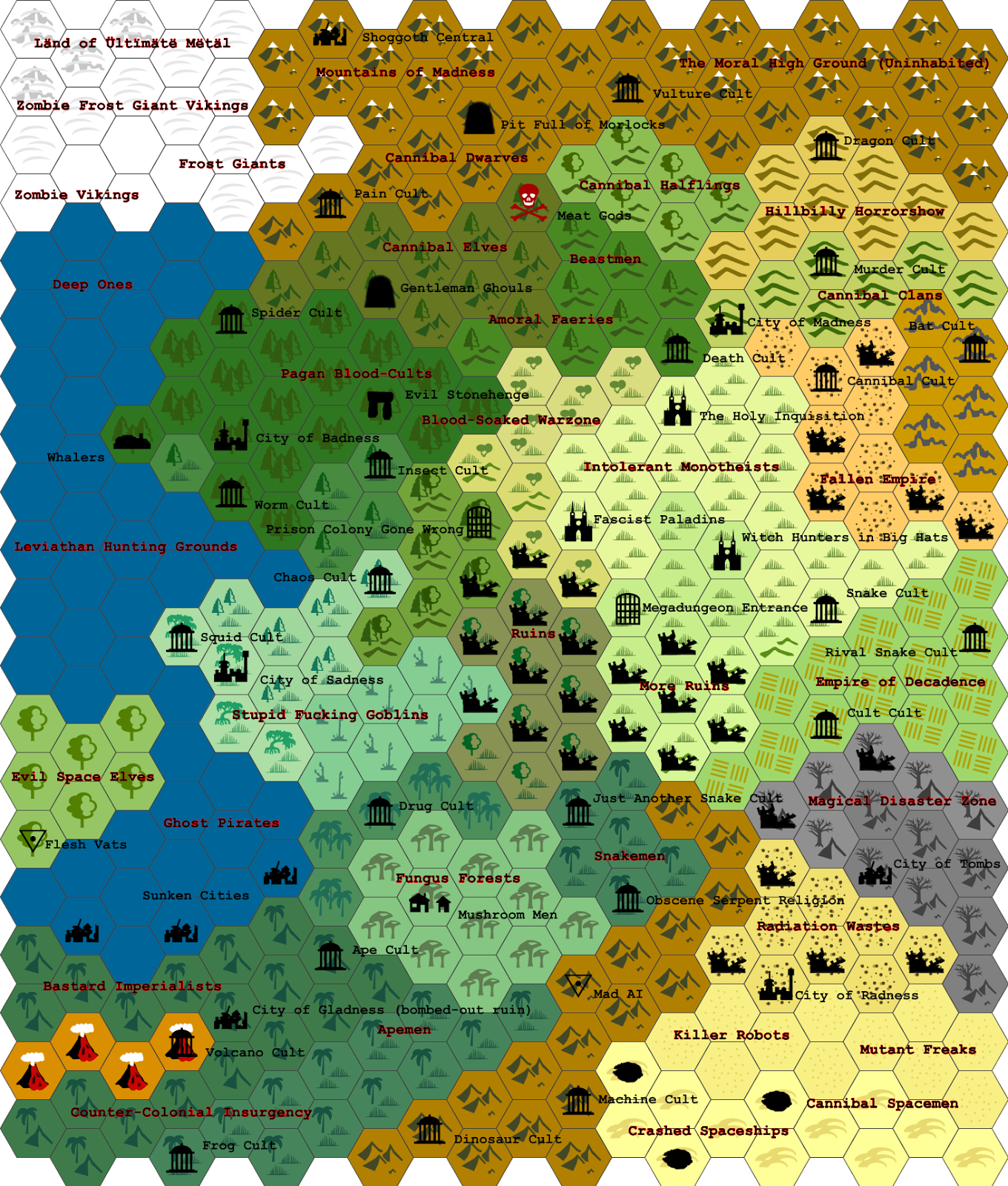
Initially I thought I'd use this beast as my map. This is because initially I hadn't run a hex-crawl before and had no idea how players would approach travel. I too read advice on the web for 'how many hexes should I have' and sanely downgraded the size to this, with points of interest generally being between 2 days to 2 weeks away from each other.
And we actually played for a while on this map. Now, I had the classic west marches rule going on where every session end meant a return to the home town, and every day+night of travel had 6 1/6 chances of a random encounter. This meant that inexperienced players couldn't get ANYWHERE without getting their ass kicked and going home. Early on, it was easier to just head into the Megadungeon below town, and day-long trips to nearby places of interest (usually the lumber camp which generally had some monster problem to solve) or following the coast south looking for things. There were about 7 minidungeons within a day or two of town, and by the end of the campaign, 5 had been found. One thing I wish I had done in retrospect was seed the map with a boatload of treasure maps.

Also, when faced with such a savage and dangerous wilderness, players tend to stick with known options. Castle Gondalo in the Norther Wastes became a popular destination, such that I eventually sickened of the long, perilous journey through the undead-infested desert and had an airship offer passage there and back. But even with the rideable floating jellyfish steeds purchased from the Gondalons, I had a strong suspicion that the players still had too much empty space to deal with. At this rate, I couldn't imagine the players ever getting to the beast-taming barbarians of the northeast deserts or the snakepeople of the far west or the fomorian giants of the unnaturally frozen southeast and I realized in trying to separate content between 'early' and 'lategame' content, I was wasting my time on making cool stuff that no one had a realistic chance of seeing because it was 'gated' behind potentially months of dangerous travel. So overall, I think you should start small, and you should put your prep where players can reach it, and definitely do not build content 'for when they're level 13' or 'for when they walk 200 miles due west.' Put Dark Castle Dumandred three days away and fill it with vampires and let the players go wild at level 1 if they want.
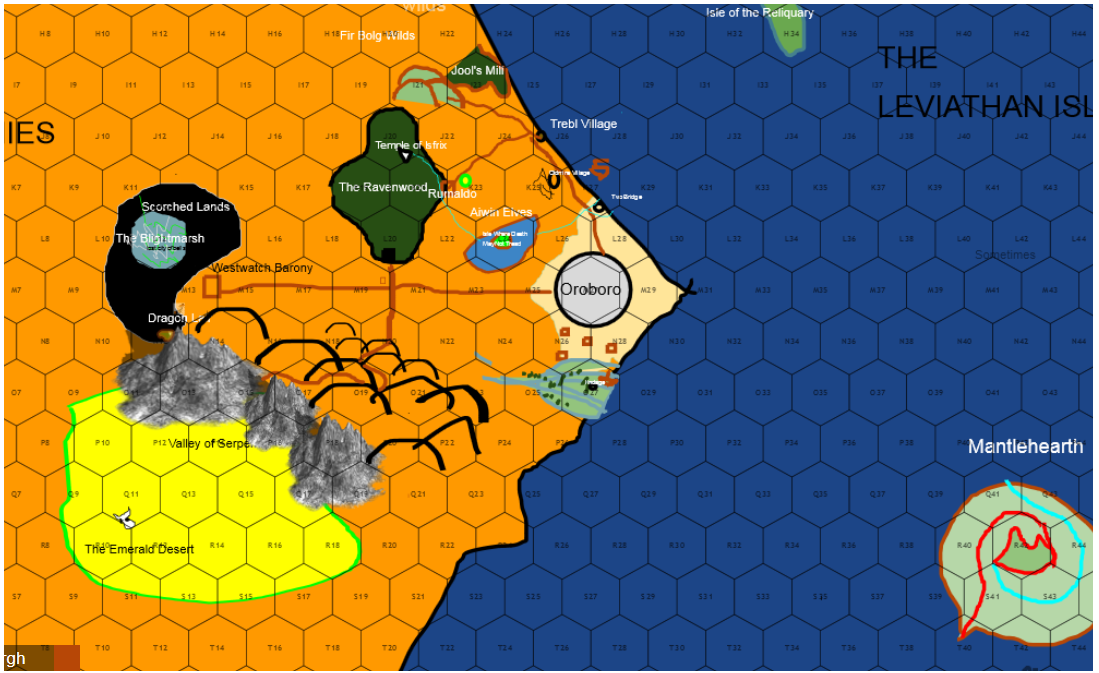
Ultimately I condensed the map to this, and honestly I could have shrunk it to 1/4th the size and I don't think it would have felt crowded. Empty hexes were deleted, consolidated into the same space, flooded by seas and lakes, and generally tossed into the bin. I didn't want the players to find everything because for sandbox exploration to be meaningful there must be the opportunity to NOT find things, but I think even now, it was a little oversized and definitely too empty. There were 1400 hexes, roughly, and about 80 had pre-planned(but not entirely finished or even begun) stuff in them. With that distribution of content, it was almost more of a pointcrawl than a hexcrawl. Travel as adventure gets old when travel is a required adventure between EVERY adventure.
The round black blotch happened post game after retrieving the Orb of Omnipotence and was the ascended player's way of showing how their land and faithful were hidden and protected.
 The vast majority of hexes had nothing cool in them, which left me room to suddenly plop things down, like the castle-engulfing Gelatinous Dome, or a random comment from a player turning an empty patch of coast into the Face Rocks/Benthic Chimerae Research Station, or them saying 'we track the axebeak(aka Chopcock) riding goblins back to their camp!' and then the camp being noted down after said tracking. But the thing is, a 6 mile hex is HUGE and can absolutely support multiple features, so even with the concept of 'leave empty space' I still had WAAAY too much empty space. 6 mile hexes really shouldn't be described as 'yah, nah, nuthin to see here'. They have room for hidden dungeons, villages, landmarks, lakes, all manner of things.

Now, you definitely don't need even close to that many hexes, and if you're just starting out you can get away with like, 4 starting locations and just build the world as the players branch out. The players probably found less than 1/4 of the keyed locations (but quite a few unkeyed impromptu locations were created) because often, a single location turned out to be good for more than one adventure. The common factor between these popular locations was almost invariably treasure, by the way. Treasure is the lowest common denominator of motivation, especially when treasure=XP, so if you're ever wondering how you can possibly convince the players that they want to go into a hideous deathtrap, just stuff it full of loot and they'll convince themselves. Ancient evil awakening, captured damsels, forget that. They'll brave ifrits with phenomenal cosmic power, minotaurs with ray guns, the T-1000, and 100 miles of ghoul-hyena infested desert just to obtain some unstable reactor cells so they can use their once per day spell of Heat Metal to blow up said reactor cells along with 80% of the party and an Ancient Black Dragon on the other side of the map just for one shot at that sweet, sweet type H treasure.

Anyway. Sarkomand's Fault was about the size of Florida, and most of it was never seen over the course of ~70 sessions and 8 months. The first big push to really travel came from a random dragon encounter in session 8, in which 10 level 1 and 2(maybe we had a 3) characters and hirelings just BARELY managed to slay a dragon, with about 50% losses(I think I changed my death and dismemberment tables to be harsher after that fight, or at least it sowed the seed for such changes), and the month it took to travel there and back again to the dragon's hoard was the first time the players really went away from civilization a single direction for more than a week. My players explored around the starting town for quite some time, then when they discovered castle Gondalo they used that as a forward base for explorations in that direction, and finally, when the high level priestess founded a religious village on the far side of the map near snakepeople villages, that became a common launching point for the furthest exploratory travels. If not for these forward bases the players found or established, I think what would have happened is that the players would have explored the coastlines north and south, perhaps even getting a boat and launching expeditions from that.

So how many hexes should you have? If you have lots of villages for the players to rest in and set out from, they will have a lot more mobility, and so you will need more initial prep. If you have a very hostile wilderness, you will have scads of time to prepare new locations as the players laboriously hack their way through the wilds. But either way, they can only do one thing at a time, so 5-20 starting keyed hexes is probably plenty, and if you make 1 new location between every game you'll probably far outrun what the players have time to ever explore. 'Empty' hexes between locations can quickly inflate your numbers and can be important if you're trying to convey a sense of 'this is unknown territory and you are far from home.' but I think they should not be the norm.

So, uh, in conclusion, have 100 hexes exactly. Yup.