Wednesday, February 3, 2021

Golems

 AD&D Golems

Golems come in 4 varieties, Flesh, Clay, Stone, and Iron. They are notable for being immune to many effects, much like slimes but at a higher difficulty level, but with less counterplay.
All come with a requirement of spells, level of magic user, and cost in GP per HP of the golem to create one, which is interesting and suggests creative use of spells and spell combos being something magic users can do to create thematically appropriate magical effects outside of the normally very rigid conception of what spells can do. All (Save for the clerical Clay variant) have a rather inexplicable blind spot in that they also require a Wish spell which is beyond what the required minimum level of spellcaster could actually cast.

Clay Golems- The clerical variant of golems, they are extra-immune to weapons, requiring blunt magical weapons to hurt them. They are immune to spells save for Move Earth, Disintegrate, and Earthquake, all of which briefly slow the golem and harm it decently. They can haste themselves after at least 1 round of combat for 3 rounds, attacking twice for 3d10. They also have a 1% cumulative chance per round of combat to be possessed by a chaotic evil spirit and going permanently berserk and murderous. They also have but 7 AC, which makes them pretty easy to hit, if not to harm. On a final mechanical note, the wounds they inflict are accursed and require basically the highest level of cleric to heal.

This is, of course, a reference to the Golem of Prague, though the mythical counterpart has a more solid reason for going berserk. It acted as a protector of the Jews, but one day, when the Rabbi forgot to deactivate it to allow it to rest on the Sabbath it went berserk and showed up on a rampage while he was reading the very Psalm denoting the Sabbath as a day of rest and praise to god (Clay golem more like Irony Golem amirite). In any case, this berserker state seemed to have been induced not by a random chaotic evil spirit being allowed to just yoink a 50,000gp gold investment from a mighty servant of a Deity, but as punishment for violating the laws of god, no doubt as a moral lesson of sorts.

The story also gives a good weakness to the Golem- removing the shem (a clay tablet bearing the name of god) from its mouth caused it to deactivate. Far more interesting than requiring some very specific earth-based spells or having the warriors dig out their less-favored Maces +1 that languish in their packs, spurned for fancier talking swords.

Flesh Golems-Vaguely Frankensteinesque, but only if you didn't actually read Frankenstein, but maybe saw like, Frankenstein vs Dracula at a 1970's drive in or something.

They are uninteresting monsters, immune to nonmagical weapons, with terrible AC, decent offense in 2 2d8 fists, an ability to break down doors and wooden structures, and a similar berserk chance, but with a 10% chance per round for its creator to regain control. Fire and ice slow them, electricity heals them, and other spells have no effect.

The role of such monsters, I would presume, would be not to defeat conan types, but a sort of mage-hunter monster, or perhaps a bodyguard against rival wizards.

Iron Golems- The most powerful golem, they have AC as plate, can destroy structures with time, breathe small clouds of poison gas once every 7 rounds (save or die, one assumes) can only be hit by +3 or better magical weapons similar to some of the spicier demon lords, and are very immune to magic, being slowed by lightning and healed by fire.
They are, however, 'subject to attack by rust monsters' which is a nice specific weakness to have.

I have no idea what the poison breath refers to, as only mythological 'metal golem' I can think of is Talos.

Stone Golems are basically just lesser iron golems, busting out a single-target Slow every other round, being affected by +2 weapons, and rock to mud which slows them, mud to rock which heals them, and stone to flesh making them vulnerable to normal weapons for 1 round.

3.5 Golems are basically true to their original counterparts, but Clay golems are given 'healed by acid' and all golems are given very good AC scores in comparison to their original pitiful AC.

BFRPG drops some of the esoteric abilities, increased the ACs, and added a bunch of esoteric lesser golem types like wood golems which are basically killer mannequins, amber golems that are lightning-shooting lions made of amber, 4 armed sword-wielding bone golems, and similar things that are more interesting than what they did with the default golem types for sure.

Golems, I believe, are intended to be a threat that forces a return to physical problem solving, as they are immune to spells, but are fairly slow and stupid. They are fairly killable if you have the appropriate magic weapons and strong fighters, but hit hard enough to make melee an unpleasant prospect. The clay golem is unquestionably my favorite, as its cursed wounds discourages casual engagement and its mythological roots are stronger and richer than the other variants which come across as a blander set of scaling 'powerlevel' threats more than beings with their own identities.

Sunset Realm Golems


Mokkhite Golems


Mokkhus, God of Death, adopted brother of Riikhus and the other face of the Stone Sun, the Counter of Bones! The faithful do not seek to cheat death, but sometimes, the Gatekeeper of the Dead used a loophole and allowed an ancestor spirit to return to the realm of the living with the following restrictions.
1- The animated vessel must be inanimate, not a corpse (Wood being an edge case that was allowed) and clearly resemble the animating soul so as to avoid deception.
2- The soul can only return for the completion of a task, then returns to the underworld
3- Tasks must be aligned with the holy interests of Mokkhus, not mortal whimsy

A simple wooden mannequin was the most affordable golem, with a hollow suit of bronze armor the next. After that, a statue was the next most common option- a statue of wet clay could be remodeled to suit multiple spirits, or a statue of fired pottery could be a more permanent option. Stone was the most desirable, but even with the power of the god assisting, a spirit would have  to be mighty indeed to move a stone statue, and so stone guardians only defended High Temples and other vital areas. The secrets of Golem-Crafting were guarded well by Mokkhite Priests even after the vanishing of their god and the obsolescence of their religion, and the process, while once almost standardized, is now ludicrously expensive, requiring ancient artifacts of the dead god to channel remnant power, and of course, a Golem Manual to describe these lost rituals and to find an appropriate spirit.

Elemental Golems-
Everything has a soul, so modern-minded sorcerers simply anthropomorphize the soul within the materials of a golem itself and bind it. As elementals are tremendously dangerous at even moderate sizes and typically utterly unconcerned with anything humans are interested in, these magics tend to be highly complex affairs requiring dozens of Spellwisps to wrangle an elemental and absurd amounts of pure gold for interior runic bindings, but the process is exponentially cheaper and easier with smaller golems, as errors are unlikely to have serious consequences. Though unfeasible for middleweight bouts for all but the mightiest magicians, there is a thriving market for golems built for the Featherweight division of Beast Battler circuits- golems made of pebbles, candles, butter, root vegetables, and so on.

Alvish Golems
Popular in the 3rd age, and perhaps the inspiration for later variants, golems created by the unparalleled magics of the Alves are controlled by custom-made spellwisps of ancient and terrible power, with wide-range counterspell suites to prevent rival fey from breaking their expensive toys. They are more akin to magical robots, with personalities pleasing to their creators, and a high degree of personalization, as each was essentially a vanity project. It would be futile to talk excessively of them as a group, for apart from the mastery with which they were created, each was unique. Many persist to this day, their masters long vanished into the dreams of trees, ice, and the Iron Moon, their forlorn creations still fulfilling ancient dictums in broken ruins. An intact Alvish Golem is usually less a threat and more an opportunity to adventurers and archaeologists- if the golem's rune-logic can be understood, it can be utilized for the benefit of those who discover it.

Necromantic Golems
When it comes to stitching together corpses before animating them, there's two main types of necromancers- the ones who want a giant unstoppable monster to rampage about with but all they have to work with is like, a local village graveyard, so they work with what they have, and the sort that are stitching together the dead to make a companion. Someone who has forsaken (or more likely been forsaken by) polite society to hang out with Corpse Dolls and Patchwork Girls of their own make.
Both these sorts of necromancers tend to blame each other for their own misunderstood unpopularity, while completely missing the point.

In any case, the only real difference between a 'zombie' and a 'Flesh Golem' is the amount of spellery put into one. A 'Zombie' is usually animated very simply by ravenous insect souls or fragments of nightmare, a 'Golem' is usually entirely spellwisp-motivated, and human-souled corporeal undead, regardless of the precise details, are usually called Revenants as a way to distinguish them from the 'nigh-mindless minion' variety. the more predatory human-derived entities like Wights, Mummies, Vampires, Ghouls, etc, and from the religious revenants of the goddess of undeath, the Children of M'shesh.

Clockwork Golems, or rather, rambling on the lack thereof in the sunlit world
Clockwork was well suited to dungeon machinery, the tech itself coming from a Stonefast 4, a now utterly-destroyed deep-delve fortress near the human city of Annu Nki that was known for its stone boats before clockwork was invented or unearthed by Svart 45045. By the late third age, dwarves were building their subterranean tricks and traps to both defend and increase the standard of living within their fortresses and outposts, and selling commissioned devices to those who could pay their prices, and so antique clockwork is a common enough discovery for tomb-robbers, especially in the north moonlands near Limedike and Annu Nki.

The idea of a clockwork golem complex enough to operate independently or even semi-independently was an amusing 'idea bounty' among dwarves for a time, though it never went anywhere. Amusing automata yes, wind-up toys and clocks, of course, but clockwork alone simply wasn't complex enough to operate reactively. This branch of research was further crushed by the geopolitics of  the third intersolar period and the 4th solar age. Wracked with magical catastrophe from the fallen Elf hegemony, neither the Witch-Queens of initial post-elf human rule nor the later conquest by theocratic Riikhites had much use for the idea of clockwork, being intensely magic or piety-focused, respectively. And so the field of clockwork became largely an abandoned one, eclipsed by runic magic developing first with the aid of the Witch-Queens, and Mokkhite golem-crafting later once dwarves once swore allegiance to the Stone Sun pantheon of Riikhus, Mokkhus, and the other enslaved deities.

During the 4th intersolar period, the majority Riikhite/Mokkhite population of dwarves, in a panic due to the death of their prime gods and dissolution of the Stone Sun pantheon, became fearful that their devices might be turned against them and used to oust them from their otherwise invulnerable stone fortresses by the human masses seeking refuge from the onslaught of Moons and Darkness outside. In exchange for granting refuge to the ruling nobility, clockwork and gunpowder not in dwarf-hands were outlawed by the Mercian Empire in perpetuity, and this law was retained among the splinter-states that formed as the Mercian Empire collapsed without its theocratic unity. The old law, devoid of context, nevertheless lined up with the desire for nobles to prevent guns from developing enough to challenge knights, and so despite the laws of Mercia no longer applying to places like the Fault or the Tripartite Realm, the clockwork/gunpowder ban remained almost worldwide for several hundred years, with Saresare and the Beast Islands being notable exceptions.

While by now dwarf society was well into its inevitable decline due to the gnawing darkness at the roots of their stonefast fortresses in the 5th age, the dwarf Thirbaek Merrymace(PC from the last 2.5 campaigns I ran), before he was father to the 6th sun Aurum or Underlord of Stonefast Two, brought back a titanic war machine from the Moonlands- the Keeper of Days- or rather, an unfinished replica of the Keeper, as the original was destroyed in the Oroboro Civil War by the Serpent Queen supporter Erhard De Vend- but I digress. It had no will of its own, requiring a pilot, but the dwindling population of the dwarves suddenly had incredible force multipliers in the form of these Keepers, where a lone pilot could become a 60-foot colossus of ticking steel. The Keepers spread throughout dwarf society and allowed them to reclaim land lost to the Moonlands and fortresses lost to chaos, and seem to be a herald of a new dawn for the dwarves- though if the temptation to use gunpowder proved too great for humans to keep to the pact, surely these metal titans will likewise lead to the loss of the old ban.

Friday, January 8, 2021

Gnoll, Gnome, Goblin, Giant Goat

AD&D GNOLL
Gnolls are the 2HD designated enemy humanoid monsters, and have a bit more effort put into differentiating them from other Evil Humanoids™ in that they are slavers (Having 1 slave per 10 gnolls at a minimum) and notably lazy in that they do not mine as the other subterranean humanoids are known to do. In contrast to many other humanoids, gnoll leader types have maxed (or near to it) HP scores, with HP ranging from 16-22 while HD remains in the 3-4 range. The rarer above-ground gnoll settlements have hyena and hyenadons, while subterranean gnoll lairs sometimes (30%) of the time collude with Trolls. Their treasure type is a bit better than, say, orcs and goblins, though gnolls are markedly more of a threat with 2HD than weaker humanoids who tend to have similar Numbers Appearing.

While loosely hyena themed, rather than focus on, say, the matriarchal spotted hyena pack structure, Gygax instead thought it best to describe how when committing war crimes against the gnolls there are females of 50% the male warrior population and children numbering 200% the male populace, from which I think it is only fair to conclude that Gygax kicked puppies at 200% the rate he kicked dogs.

Personally, I have great nostalgia for gnolls, for they were the designated evil humanoid of the best AD&D campaign I played in back when I was like 12(best because the GM pulled no punches and killed us many a time until we played more carefully), and my best AD&D character, Brother Phillip, LN Cleric of Undeath, got his start as a prisoner rescued from a gnoll camp and designated as replacement character, the characters before him having perished trying to go full Gygaxian murder on the gnolls and being stoned to death by a horde of 'noncombatant' gnolls alongside the other player who I believe was a ranger-type. A fitting end to such murderous hubris.

I believe the current editions of D&D, while attempting to humanize traditionally spurned beings such as orcs(with mixed results), have doubled down on having Gnolls be proper capital E evil villains, being unnatural extensions of the demon-god Yeenoghu spawned from regular hyena who ate so much battle-carrion they swelled up and exploded into gnolls. That's the sort of explanation for always evil humanoids you need.


AD&D GNOME

I've never been a fan of gnomes- they seemed redundant with halflings. Like, do we really need this subset of 'tiny dudes who are like halflings and/or dwarves but more fey/scientific?' Some people are the opposite way and would do away with the halfling and keep the gnome, but I think halflings are a nice standin for human children or just little people in terms of the 'small=sneaky' aspect. Whereas a gnome is like, 'oh no, halflings and dwarves are racially incapable of being an illusionist, we need to come up with a new 'race' to fill the vital niche of 'small but also illusions.'

Anyway, that's my take on gnomes as a player race. As monsters I have little to say about them- they are very similar to the Dwarf entry, and despite the prevalence of the idea of the 'gnome illusionist' they are instead all clerics or fighters, with magic-users being rumored but not proven. I have never heard of any campaigns with impassioned battles against gnomes, or modules with fiendish gnome lairs. Of course I don't really follow such things closely so I could be mistaken.

Also they have badgers for days to guard their burrows. Regular badgers, giant badgers, and wolverines which are pretty badgerlike if you squint. I dunno.


AD&D GOBLIN
The OG disposable humanoid monster. There is surprisingly little information given to these maligned sword-fodder, no doubt due to any GM being assumed to be familiar with Lord of the Rings (no doubt where the close association with giant wolves/wargs comes from as well.) They are said to be slave-takers and fond of torture, but I'm pretty sure the Gnolls stole all the depictions of slavery and then the Drow stole all the torture.

On a largely unrelated note, I find when consuming trashy japanese isekai manga, the depiction of goblins often is a useful 'canary in the coal mine.' If goblins are killed by adventurers without question and are depicted as inhuman subsentient monsters, the manga is likely to be extra trash, but if the goblins can be communicated with and are not portrayed as sacks of XP to be beaten like pinatas, there may be hope for the manga after all.

AD&D GIANT GOAT
Exactly what you'd expect, really. They have a menacing charge attack and occasionally serve as steeds, presumably for mountain-dwellers such as dwarves. They do not, however, have any special method of knocking people down or away, which is a missed opportunity.
Not satisfied with rules for slaughtering demihuman children, Gygax includes the percentile size of juvenile goats so that kids might be slaughtered as well. Shockingly, no rules for selling giant goats kids are mentioned. Pretty sus that Gygax outlines rules to sell sapient monster kids into slavery (see Giant Beavers) but doesn't give a single shred of attention to the market for 'literal domestic animals but big.'

SUNSET REALM GNOLL
In the realm of Saresare, there was an old, old god, Ibn Haur, who had no head. So he borrows heads from others, giving them his previously-borrowed head in exchange. As the swapping went on over the aeons, there came to be many such beast-headed people in Saresare, whose children are likewise beastly, and so on. Though they have some traits of their bestial heads and indeed, some have grown more beastly over the ages, they still count as 'human' for all intents and purposes. The only animal not included are dogs (more on that later) and snakes (Yg being behind all snakey things and typically focused on getting rid of legs before swapping heads)

There are Hyena in Saresare, and so inevitably there are some Hyena-headed people. Some are bandits of the desert, other judges of the court of law, and that's all there is to it- Ibn Haur did not seem to have any plan with all the head-swapping, and even if he did, the Law rules Saresare now, not the ancient edicts of nigh-forgotten gods.


No one can stop me from using goofy old 14th century art as reference


In Yuba, there are dog-headed people known as Cynocephali. They are typically sacred priests or temple-guards of Yuban ziggurats and are often two-souled, dog and human. Due to this shared experience, they are indeed more bestial in behavior than the Saresaren variety, but really, which is likelier to be wicked- a dog, or a man? The idea that someone would be worse for having doggish qualities is laughable in Yuba, as dog is basically synonymous with 'good' there.

Outside of their home realms, either may face prejudice due to beast-men implying something rather different in other places. In the Tripartite Realm of King's Point, Queen's Coast, and Prince's Spit, such hybridization is presumed to be the work of Murulu and as such has strong connotations with the ideological enemy of the realm, so suspicion of being a spy would be high. In Vint-Savoth, the accursed Blood Moon lies dead and bleeding, spreading the scourge of beasthood, and someone with animalistic features is assumed to be turning into a contagious alien werewolf monster, so panicked beast hunts could be called and explanations disregarded.

SUNSET REALM GNOME
I've never been a fan of gnomes- they seemed redundant with halflings. Like, do we really need this subset of 'tiny dudes who are like halflings and/or dwarves but more fey/scientific?' In any case, I think a gnome in the sunset realm is less of a thing and more just a catchier and more generic term for a half-fey, often the offspring of a little person and then some manner of pixie, fairy, or other smallish alfspawn. Etymology would then imply that Sylph and Undine are similar things, so the distinction is that Sylphs are half-fey with wings, Gnomes are land-walkers, and Undine are amphibious hybrids.


A shaved goblin, an unshaven goblin, and a goblin who has recently re-discovered cosmetology


SUNSET REALM GOBLINOIDS
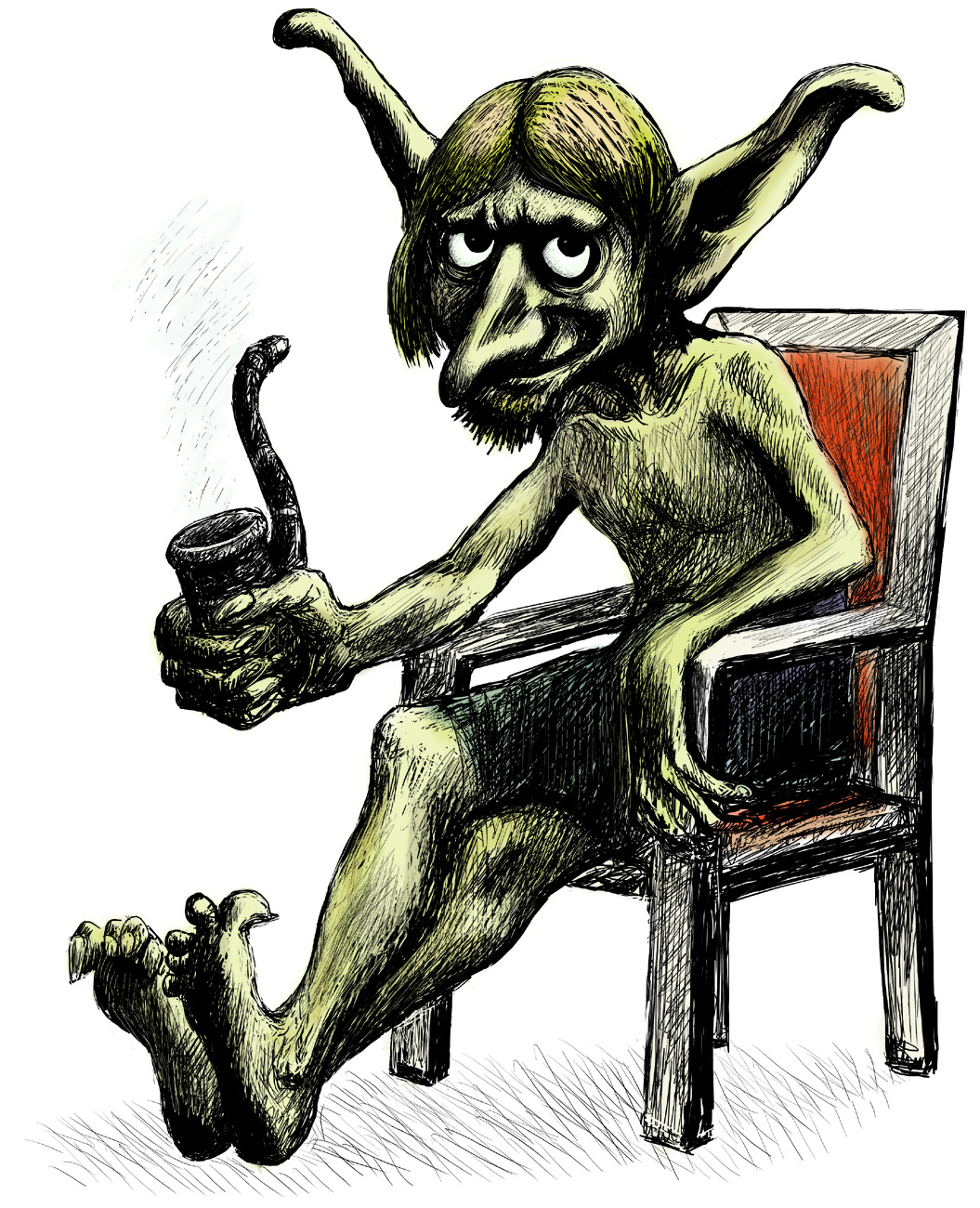
Goblins are the most common form of Alfspawn, and exist in a range of patterns known as 'Goblinoids.' 'Goblinoid' can be distinguished from 'humanoid' by virtue of green skin, short stature, bestial eyes, fur patterns, and teeth, and indeed, if you take certain humorous elvish lyrics at face value, humans may just be a round-eared, furless kind of goblin. To create a Goblin, the shadows of various animals, are melted together in a cauldron, and bound to serve the chef, typically an Alf Lord. They have no names or shadows, and are more akin to a golem or spellwisp than a biological creature- just made of shadows, magic and fey commandments rather than anything substantial. With no name or shadow, their identity and form are fluid but united in a general sort of idea as the animal shadows do their best to follow their anthropic programming. As for why goblins look the way they do- the answer is simple. To an Elf, a goblin is the same sort of ugly-cute as say, a pug-dog is to humans, and the classic green goblin was just the most popular model. Goblins that look more like elves or more like beasts were once quite common as well, and varied in size, shape, coloration, and everything else one might expect of a designer-being created by a race of bored aesthetes. None of them are ugly in the way a horrible burbling fungus-zombie from hell is ugly- goblin ugliness is more like comedic exaggeration for artistic effect.

However, their (admittedly weak) self-preservation rune-logic makes goblins rather keen on obtaining shadows and names and so becoming real, rather than a half-assed amalgamate of chipmunk shadows. A goblin with a name can have a individuated subjective experience of the world and true free will (this conscious thought replaces old rune-programming but will match overall motive at first), and a goblin with a shadow can have a proper biological form. Goblins with no shadows just burst into skittering animal-shadows when they are 'killed,' almost an exorcism. A goblin with both is a High Goblin, or Hob Goblin, or 'House Goblin.' Goblins either can be named in a ceremony that is a little dangerous to the goblin, or can steal a name by trickery, or can get a name naturally by picking up a nickname from their associates. Though goblins with no names can't name each other as they lack the consciousness to do so, the spontaneous organization of goblins comes about when even one gets a name, awakens to consciousness, and then ends up intentionally or otherwise naming others, who then name others, until the entire goblin gang has names and personalities. Shadows are a bit trickier, but can be stolen and traded similarly. Goblins with animal shadows end up extra-bestial, as the shadow informs the goblin's final body plan where before consistency was really more of a suggestion. Humans who lose their name, shadow, or both will become rather gobliny themselves, but have a sun-soul that keeps them more morphologically stable than a goblin is. While a goblin who is just a collection of animal shadows is more like a computer than a person, a goblin with either a name or a shadow is a living being of some kind, and Hobgoblins are basically just little green hairy people, having clawed their way up from a half-baked existence into genuine being. 

I got this from german wikipedia or something and it was titled 'kobold'


Goblins played various roles throughout the ages.
In the third age, when the spells for goblin-making were developed, they were essentially used as robots. They were servants and soldiers for those Elves did not trust humans for the role, the equivalent of using a Roomba instead of hiring a maid. Fairies, similarly created entities, were fragile and less flexible, being an anthropomorphized spell rather than an anthropomorphized collection of animal shadows, and so goblins were generalists compared to specialist Fairies.
They fought bloodless proxy wars, bursting into animal shadows when slain and causing many false superstitions to swell up among humans, as it was not clear that the shadowy hordes of goblins marching around were a symptom of elf conflict, not a separate people fighting elves, and this lingering idea of goblins being an independent force of chaos rather than the tools of elves stems from this misunderstanding. Naturally, elves can't be bothered to clear things up officially, because human societies, by their perspective, fall so rapidly and lose their libraries with such frequency that there's no point telling them anything- it would be like trying to educate fruit flies.

Confusion over goblins was therefore extremely common among humans in the 4th age, as knowledge from the 3rd age was lost in the intersolar darkness and replaced by half-remembered and entirely misunderstood tales of old, and conflict with remnant shadow-goblins protecting elven ruins, mines, forests, and with living hobgoblins who were just living their lives free of Alvish influence occurred frequently and tragically. The idea of goblins as monstrous 'sword-fodder' stems from this age, and lingering sentiment of that nature exists mainly to explain why new players drifting in to my campaign carrying expectations from other media might have those notions in-universe, so as to allow for diegetic explanation of the world rather than demanding they read oodles and oodles of deep lore.

In the 5th age, shadow-type goblins are extremely rare outside of Elfland or the Moonlands, their remnants falling to attrition from the uncounted horrors of the world or ascending to the state of true living beings. Living civilizations of goblins are mostly endemic to the Fault, where the survivors from the Riikhite crusades for the Orb in this land have prospered, reclaiming the ruins of their Alvish masters to create strongholds against the pressures of Undeath in that land once the jungles became choked with the dead. They also find work aboard the flying ships of the Gondazong, as the small frame of a goblin is good for tight engineering squeezes., alongside rat-folk hired for the same purpose, and are valued as Ratcatchers and discreet agents in other parts of the world.

Goblinoids that do not have shadows or names lean more muppet and less 'green elf' but are definitely more fairy tale and less Lord of the Rings movie depiction


Other Goblinoids
Bugbears- Just huge, hairy goblins.
Goblin King/Queens/Majesties- A term for long-lived, highly skilled goblins who typically come to rule younger, less experienced goblins.
Orcs- No longer exist, but if they did, they'd just be shaved bugbears-in-training.
Ogres- Shock/terror troop versions of goblins, with modified rune logic to avoid name-taking and instead prioritize shadow-stealing. They are the Alfspawn/Moonspawn of the Iron Moon and they are much, much closer to being true monsters than goblins.
Nilbogs- Created only during the downward spiral of the 3rd age, a Nilbog is a goblin created using the reflections of shadows, or perhaps shadows cast by darkness rather than light, or perhaps being an undead arisen from a shadow-goblin which was never truly alive, or the nightmare of a shadow-goblin which never truly had thoughts. In any case, Nilbogs are goblinoids who react oppositely to many stimuli, most notably being healed by being harmed, and vice-versa. Nilbogs are categorized as Monsters with a capital M, having no place in the waking world and bringing nothing but woe.
Humans- Though never proven, it would explain a lot
Elves- The obscure fairy tale 'Dancer in the Dark' or 'The 5th Traveler' provides an alternate origin for elves and goblins, suggesting elves are goblins who struck a deal with a thing from beyond reality to become fabulous immortal elves, in exchange for being tasked, with all of eternity as deadline, to render unto the thing the moon, the sun, and every star in the sky, and also too the black stars behind the bright stars.


SUNSET REALM GIANT GOAT
As with other giant things, anything can grow to outrageous size for a variety of whimsical reasons, so goats are no exception. Though dwarves are nearly extinct, their bred-to-be-giant goats probably outlived them to some degree, haunting the mountains of the Tripartite realm to provide Billy Goats Gruff references.


Friday, December 18, 2020

Giants (also Cyclops and Ettin)

 AD&D Giants
When it comes to the inspiration for AD&D's giants, some are obvious. Cloud Giants are of 'Jack and the Beanstalk' origin, Fire and Frost giants are from norse myth, stone giants are likely those mentioned briefly in 'The Hobbit.' Hill giants are more generic and honestly are a bit cruder and wilder than most giant myths but serve as a general sort of 'wild' giant. Storm Giants probably have the most confused origin- they seem to be a combination of the grecian Cyclops who forged thunderbolts for Zeus, and Zeus himself, with a curious underwater bent as well. This becomes doubly confusing when we consider the Titan entry, which is more akin to a grecian god with stated good relations with Storm Giants, so there's a sort of muddled sense of a grecian pantheon thing going on with echoes of gigantomachia and titanomachia bouncing every which way.

Either way, giants are notable in that they carry significant personal treasure in their giant bags in addition to their usually decent treasure types- around 1000-6000 gp, typically, making them a target on par with dragons in terms of 'where the good loot at.' Many modules dealing with giants take great glee in making lists of wacky giant bag contents, though I think players would often rather just have the coinage most the time, so better to use both if in doubt of how much high level treasure to dispense. Still, giants hit hard, have ranged attacks, and, while usually supposed to be rather stupid in a fairy-tale way, are intelligent enemies, and usually have assorted pet giant animals as well, so the reward must match the threat posed.

Great mathematical detail is given for the 'realistic' proportions of slaughtering of women and children giants because of course it is important to say 'if more than 4 hill giants are encountered in their lair numbers 5, 7, and 8 will be giantesses (6Hd, and treat as ogres for damage/attack) and 6, 8, and 10 will be young hill giants (roll percentile dice for size)' because clearly if you encounter a 1% grown giant the only sane action is to engage it in battle

 I will never not dunk on Gygax for this shit

Each giant has a minor quirk in addition to the gradually scaling power levels and various pets- Cloud giants are hard to surprise due to smell(obvious reference to 'fee fi fo fum I smell the blood of an englishman') and 10% can levitate stuff, and presumably it is this power that allows some cloud giants to live on magical cloud islands (the non-levitators just live on mountaintop castles).

Fire Giants and Frost Giants are immune to fire/cold respectively, and to my player who was disappointed that firegiant skin was not suitable for a grisly leather armor akin to red dragon hide, I believe this is because a red dragon has fire resistant hide, but fire/frost giants simply don't mind being hot/cold, so their parts are not going to shield a human from those effects.

Hill Giants don't have any thing unusual going for them besides being the weakest variety, and stone giants are just ranged rock-throwing specialists compared to other giants being better at melee, but Storm giants suddenly break away from the others with prophetic powers, lightning-throwing, weather control, and lightning immunity, not to mention a good alignment.

Other giant-types I include here are Ettins, which are basically just a hill giants with two heads and two weapons with no rock-throwing, fog giants and mountain giants which are superfluous variations of cloud and hill giants, fomorians who are a boring ugly giants (a poor adaptation of their irish origins to be sure) the Fir Bolg giants who have fey-type magic and are a better (if somewhat conflated with the fomorians) reference to the Book of Invasions, and the Verbeeg, who are a more grounded type of giant, more of a folk tale or Goliath figure that a true towering menace. Cyclops are not present save for the somewhat bizarre Cyclopskin, but are easily solved by giving any other giant one eye, poor depth perception, and references to the Odyssey.

Giants are typically too-high level to see much use in many campaigns, which is a shame, for like dragons, I think they're a good choice for players to learn to be sneaky and negotiate from positions of weakness. Better yet, it is more immediately clear to certain players that sassing a giant is a Bad Idea, while they may fail to demonstrate social graces in the presence of high-ranking humans, making a giant person an excellent symbolic demonstration of might. I did get to use giants once though, and rather than being mere blobs of danger-math to wade through as I feared, I found my limited run of Saga of the Giants (the BFRPG take on Against The Giants) to show that combat with seemingly unmanageable numbers of giants is not a hopeless affair after all, but instead took the players back to how they fought back when they were level 1 and feared errant forks thrown by goblins and what have you and they executed much scheming. Giant-sized scenery works well for creative problem solving in the moment too, allowing for giant sized dungeon delves to be pretty fun. I had never thought much of giants before, but now think they're pretty good monsters to introduce to players who are becoming confident in their powers.


Sunset Realm Giants


So in my setting, giants aren't exactly their own thing, but are human-derived. Halflings are just small humans, so giants are just big humans (though each considers themselves the norm and the others to be the deviation, naturally). The world runs on fantasy logic, not biology, so there are various ways to become giant beyond just 'tall people having even taller kids.' Suckling on the milk of a giant mammal can cause someone to become unusually giant, eating too much can cause you to swell into a giant instead of just getting fat, being stretched out can leave you permanently elongated, etc etc.

That said, there are some categories and sustainable populations that are not just fantasy-logic big humans instead largely being excuses to have some lore easily ready if someone else's module brings up giants in the more specific D&D variety rather than generically, and those are what are detailed following-

Emerald Desert Giants-
Though their origins are shrouded in mystery (it was mad alf science making giants from loamy soil), these giants were long-time bandits of the realm of Oroboro until they were defeated by a band of adventurers who claimed their mountain fortress and exiled them to the copper-and-salt chasm of the emerald desert. One such adventurer took the time to fund their settlement of the region(and install a more desirable leader) and help friendly trade routes be established. Smaller populations of these giants live among humans in Oroboro or the Emerald City, and even further north, there is a mendicant cult of Ebetheron-worshipper giants who tend an ancient magical Alf fields of wheat and are a vital non-wizard source of living Shrink effects.

These giants once subscribed strictly to the 'Heightarchy,' which is essentially, whoever is biggest is bestest, with triumphant smallfolk being assumed to be treacherous and dishonest. While one might expect this viewpoint to cause considerably conflict with nearby humans and halflings (and one would not be wrong), for the most part this viewpoint has been tempered by the proliferation of Grow/Shrink magic in the region, which has eroded the absolutist concept of height and allowed people of all sizes to see eye-to-eye, as well as the humbling experience of a 600 foot tall metal giant (an enlarged clockwork automata used by the aforementioned adventurers) sacking their bandit castle, which even for the heightarchy purists seemed to be a divine sign that dominating people just because they were smaller than you might not be the way to go.

Fire Giants- These gigantic, molten creatures are quite rare on the surface, mostly dwelling in the deeps along with other burning creatures drawn to the Undersun. Dwarves believe them to be a form of Svart, grown huge and fiery in the depths but maintaining their humanoid form rather than hatching into a dragon, but Heleognostics and Undersun cultists believe them to be the offspring of fire-saints who melted into the earth and found love in molten rock, meaning fire giants are the offspring of human and elemental earth, a fiery soul giving them anthropomorphism. The Skeleton War believes them to be just another attempt from the Undersun to break free and counts them among their enemies.

Either way, their lives and dramas are located deep in the earth, only occasionally surfacing via volcanos. In the current era, only one Fire Giant is available for comment- the Soul-Smith of the Fault, perhaps the greatest smith of magical arms and armor of all time, enslaved with his brethren in ancient times by Sarkomand the Omnipotent, left to battle dragons alone for centuries, and finally befriended by humans from the nameless Mercian penal colony that would eventually become Phillipston, AKA  City of the Rats. The Drachenjaegers, an Oroboro dragon-hunting company, would eventually come in contact with this giant centuries later and unite though love of megafauna-hunting, and so the Soul-Smith would become one of the highest ranking members of the Drachenjaegers until the end of his lengthy life.

Frost Giants- the Winter Moon is cold and merciless, but its chill light is not entirely a lifeless one. In the Auroral Reaches that tower over Wrecker's Bay, this frozen wasteland is home to many gigantic, white-furred beings that have adapted to a cold and frozen world, and among them are humans who have forsaken the warmth of the sun and given their all to the Winter Moon. Their hearts have frozen, out there, and are not really considered human any longer due to their alignment with a Moon rather than the Sun. Though occasionally prone to spasms of tyranny and empire directed towards humanity, most of their ire is directed at the Winter Court, those Alves and associated fey beings that hide in the reflections of ice and snow but consider themselves the masters of the winter season, a blasphemy the frost giants can ill-ignore if their own ideology of cold harshness and adaptation is to be seen as true. This ideology aside, there is history between frost giants and cold-dwelling elves(a bit of borrowing from themes of Dominions games by Illwinter)- the Fomorians, giants of the weather-machine ravaged Fault, warred with the Partholonians, the ancestors of the Winter Court of Alves, for centuries, and the giants of the Auroral Reaches trace lineage to this historic conflict and remember it through myth and elders alike. With neither side having much trace of warmth in their hearts, the conflict drags out without end.

Other frost giants can occasionally be found in the Moonlands, humans that forsook their humanity in order to survive in a frost-scourged moon cycle, and these roaming giants must pursue their frozen master lest they be left behind to melt. Those who survive the pilgrimage find their way to the Coast of Ice and Bone sooner or later, and must make one final push through the humans of Wrecker Bay to ascend the Auroral Reaches and join their giant brethren.

As for what the winter moon thinks of all this, or indeed if it thinks at all, none can say.

this would be typical fashion of late 4th age Wemezong & giant defender, with jungle-suited disposable fiber shawls, skirts, and hoods being worn over nigh-invulnerable polymer undershirts imported from the newly-allied Gondalons.


Stone Giants- The north deserts and jungles of the Fault have always been home to very large people- a gene-plague split the Gondalon star-people into mutant amazonians, ogres, and inbreds, burly pirates  attempted to invade the place a few hundred years later, Oza, Last Retainer of Sarkomand, birthed several children to the people there over the long eternity of true invulnerability, but tallest of all were the offspring of Yrn, who stole the secrets of golem-making from the accursed depths of Stonefast Two, carved herself a twenty-foot tall statue to defend her people from the dragons, and ended up making the golem her lover as well. The ensuing children were thankfully less rocky, but grew up no smaller than their larger parent, and so soon became a warrior-caste of the Wemezong people, the biggest of already big warriors, able to serve as siege weaponry against the draconic hordes that plague the Fault. As the world became more interconnected, Stone Giants found opportunities to do more besides throw rocks at dragons in exchange for wildly elevated social status for the survivors, and due to being raised among humans anyway, have only trouble fitting into human societies in the literal sense and now most cosmopolitan areas have at least one stone giant at any given time, whether tourist or citizen.


Cloud/Storm Giants-
In the fairy-tale realm of Queen's Coast, there are castles in the sky. Giant castles! Filled with Giants!

Why is anyone's guess. Some manner of interbreeding with cloud-nymphs? Ancient elf shenanigans? It is generally accepted these are the largest of giants, but the consistent inconsistency with which they are described, size wise (from 30 feet at the smallest, to being to humans as humans are to mice), and the psychedelic means of accessing their realm (rainbow bridges and the like), and most saliently of all, the complete lack of meaningful political impact on the lands below, has lead investigating scholars to theorize the sky giants may be some manner of dreamrealm incursion similar to Elfland, rather than being fully present in the waking world.

Apart from the usual bardic tales of adventurers retrieving giant-sized treasures from the sky and fooling giant caricatures of local political figures, more sober accounts of the sky obtained through Heleognostic research teams ascending to heights unheard of via Gondalon Float-Jelly Airships depict it as a strange land (or lack thereof) indeed, similar in tone to the deep caverns of the earth, simply with agoraphobia instead of claustrophobia as the theme between inexplicable ancient ruins and tremendous monstrosities. The sky is, after all, a borderland of sorts, floating between the daylit lands and the High Howling Darkness so a certain degree of chaos might need to be expected, and perhaps the sky giants are simply the chaos growing more anthropomorphized and familiar as it nears the lands of humanity.

Cyclops- thanks to my players to reminding me of their exploits and adventures with regards to these giants.

Cycladea is a strange land, once a peninsula that broke into flying winged mountains that flew across the sea and settled as a reef-rimmed archipelago (save for the flying mountain Aakasa Parvat, but I digress). Many thrilling tales of the 5th age come from these vaguely grecian (and entirely lungfungusian) islands, such as the ascendancy of the Golden Sun pantheon and Emperor Lychin over the other islands. Or the Burning of Bebrica, or the Shelling of Dolonia, or the Anarchy of Abystra, the Defiling of the Island of the Gods, the Exodus of the Fanged Plague, the chilling discovery of the Empty Thrones of Heaven, the inspiring tale of the rise of the New Sun Aurum, the Trials of the Drachenjaegers, the conversion of the Holy Beasts, etc etc.*
*This all is a warped historical viewpoint of what the players actually did

But, lets focus on the Cyclops now. Giants served the first gods of Cycladea you see, the mightiest of the mighty exalted to greater heights both literally and figuratively, heroes grown in stature to match their stories, and passing down their inherited larger-than-life size to their families. But some of the hero-giants saw the ascendency of the Three Goddesses not as glory and unity, but a witch-covens coup, and spurned the three goddesses. For their impertinence, they were half-blinded and cast into the depths of the earth to toil in cramped mines, forever scraping their shoulders and banging their heads. Their remaining eyes grew monstrous in the dark from all the straining to see in dim candle-light, though all there was to see was the earth's wealth which they had to turn over to cruel Mysian kings, and the terrible guardian beasts the gods set to torment them and keep them contained in the darkness. Still, they kept some things from the earth for themselves, and dreamed of a day when they would have justice against the goddesses.

And one day, they got their justice. Though at this point it is rather unclear whether the Cruel King was assassinated by the forces of Emperor Lychin, the Golden Sun liberators, or, ironically, the foreign Devils the Golden Sun came to Cycladea in pursuit of, the end result was that the giants were freed from the mines and sailed off to the nearby uninhabited island of Arborea to settle, with some joining the effort to unify the isles and cast down the goddesses. While the rest of Cycladea quickly adopted the new Imperially-sanctioned religion of the Golden Sun in the theological power vacuum, the giants once again refused to bow to any gods, having a great distrust of such entities. This time, however, they were not punished for their misotheism, and were simply left alone. Over the years, the island of the cyclops, Arborea, started to become overcrowded, so young cyclops with no place to inherit would leave the island to seek their fortune elsewhere, hiring on to Cycladean ships as living siege weapons to deter pirates and seamonsters. This was an idea that seemed reasonable in theory but in practice, due to poor depth perception, left much to be desired. However, the excellent low-light vision of a Cyclop's single large eye eventually led them to another, more suitable role- that of night lookouts. Nowadays, Cycladean galleys stick to ballista instead of cyclops-flung rocks, and give young cyclops their free boatrides to new lands in exchange for duty as spotters and lookouts. Besides the size and monocular vision, Cyclops origins are almost entirely of the 'heroically-scaled humans' sort of giant with a dash of ancient curse, and live comfortably enough among humans, even if they have to sleep with the entire length of the bedroom rather than just a bed. There is, however, one common form of cultural clash- Assuming they are raised on Arborea, it is likely they will inherit the traditional misotheism, so any cleric-types will be more of a 'miscellaneous spirit and demon wrangler' than devoted to the gods.


Thursday, December 10, 2020

Ghouls and Ghasts

This post was like really long and then some occult function deleted everything upon returning to the tab, the undo function didn't work to return my lost text, and all help/google searches on how to fix this returned only the wailing and gnashing of teeth of people who the same thing had happened to
😭

GHOULS
3 paralyzing attacks very dangerous

GHAST
stinky double ghoul

I suspect my shallow covering of the baseline monsters is the least interesting thing about these posts so I don't feel too bad about feeling too bad to rewrite this part from scratch


SUNSET REALM GHOULS
A Ghoul is a corpse or living being possessed by a Ghul, but more on that later. They are the second-most common form of undead in the Daylands, the most common being corpses that rise within their own tombs to speak with their descendants/drive off grave robbers. They are especially common in Saresare, as their undead-but-also-disease nature makes Vulch-lullabies unable to set them to rest.

Ghul, by contrast, is a term used to describe the spirits of obligate carnivore somethings from the second solar age. Their relation to the Serpent Empire is unclear, as those records must have burned in the descent of Yg-A the Undersun, as is what relation they have to humans. What is known, for elves alive then are alive now, is that whatever the Ghul were, they and the rising elf hegemony didn't get along and the ghul did not survive into the 3rd age.

However, they didn't stay extinct either. Through exploitation of the elemental covenant of life itself, the ghul persisted as a curse, a disease, a gestalt evil spirit of cannibalism. When certain entities (most notably humanoids such as elves and humans, but also, notably, dogs) eat human flesh (or are attacked by a ghoul), they become vulnerable to, as it is variably called, the Hunger (in Vint-Savoth), the Grinning Plague (Saresare), or most simply, Ghul Fever. It has been studied extensively due to being a potential undead-apocalypse agent rivaled in scope only by the Skull Moon, and so all civilizations that have survived more than a few generations are aware of the signs, symptoms, treatment, and control of this plague.

Stage 0- Exposure
The saliva of a ghoul is, in fact, ectoplasm, liquid ghul-spirit colonies, produced in endless quantity regardless of hydration. Ectoplasm evaporates quickly away from the source, making it unsuitable for use on ranged weaponry or for poisoning food or drink. It causes paralysis by engaging the soul in a battle for the body, and a single bite, lick, or saliva-stained claw or melee weapon causes paralysis for about an hour (2d4 turns) on a failed save to dogs and most hominids, elves excluded. Either way, a burst of healing energy from basically any source of magical healing, or exposure to sunlight will drive the ghul-spirits away, curing the paralysis and the chance of deeper infection alike. Blessings from the gods will prevent the infection from setting in as well.

However, if someone does not receive such a cure before sunrise/sundown, they must save vs paralysis again to see if the spirits have only been fought to a standstill rather than fully expelled. Washing the wound with holy water, breathing in blessed incense smoke, and sleeping in a circle of salt are all measures that allow for an additional save, each, and if any save is successful, the disease does not set in.

The other method of exposure is cannibalism, more specifically, being an elf, human, dog, or nearabouts, and eating elf or human flesh. A decent amount must be eaten- an entire meal of the stuff, basically. Certain cannibalistic cults can reduce or remove the infection rate with certain rituals, but otherwise, a save to see if the disease sets in must be made, and the paralysis will correspond with sleep and troubling dreams and often goes unnoticed.
Knowingly and willingly engaging in cannibalism for non-survival reasons sends the infected straight to Stage 2, no save.


Stage 1- The Hunger
At this point, the infected is moderately possessed by a ghul spirit, and craves flesh. Holy water is uncomfortable and will cause superficial burns, allowing for detection of latent infections, as will most other anti-undead measures. Upon smelling dead human flesh, the infected must save or try to consume it, or save it for later consumption, an irrational compulsion and madness. Though otherwise still in control and sane, the infected cannot be trusted on such matters, and while they will not kill or harm others to obtain flesh, they may trick and lie to those to hide flesh obtained through other means.

Eating human flesh at this point will mark an irreversible progression, so it must be avoided at all costs until a year and a day has passed, at which point the incredibly tenacious ghul are forced out of the waking world once more. Only powerful, esoteric means can cure the disease directly at this stage, (cure disease will not work) and so this period must be endured without any accidental exposure to corpses. For those of means, house arrest is a common option. For the poor, curse-asylums or other prisons may be their best bet, to be locked up with lycanthropes and other menaces to society, until they are cured. For those who must, for whatever reason, continue traveling, mouth-blocking iron-and-leather masks, locked such in the back that 3 arms are required to open them, are worn, and typically a strictly vegetarian diet is adopted by all as a precautionary measure. Properly functioning masks are expensive and well-crafted, but most temples will have at least one in their cupboards for such an occurrence and are handed out freely.

Stage 2- Ghouls
Those who have succumbed to the Hunger are no longer in control of their bodies, the ghul-spirit having taken over. Most souls leave at this point rather than carry on as a helpless spectator, causing the body to die and begin rotting, making ghouls appear similar to drooling, but intelligent and nimble zombies. Those who consumed flesh willingly may collude with the parasitic ghul though, their souls mingling and becoming one, their bodies remaining alive.

Either way, ghouls at this stage should no longer be considered infected people, but undead monsters, and indeed, anti-undead measures have full effect against them. Empathy is lost, as is a great deal of impulse control, and the personality of the ghul-spirit will be a confused, fragmentary vision of the person the body used to belong to, as the ghul has fragmented memories of ancient ages mixed with the recent shared subjectivity of their host's life since infection. The hunger for flesh overrides all else though, especially that of humans and elves.

The reason for this maddening flesh-hunger is that something is growing inside them. Though ghouls can 'starve,' they will instead go into hibernation if flesh is not to be found, later bursting out of shallow self-dug graves or tunnels or tombs to menace the living. If a ghoul manages to get about double their bodyweight in human flesh in one sitting (a rare event given they hunt in packs and have to share) they will advance to the next stage, but otherwise will remain as they are until destroyed, perhaps showing signs of the coming transformation if they are well fed, but not quite well-fed enough for the final metamorphosis.

Various attempts at training/weaponizing ghouls by humans have invariably ended in disaster due to quarantine breaches, and even Necromancers want little to nothing to do with them, as ghouls will absolutely (preferentially over live humans, even) eat other undead. A minor exception to 'nobody works well with ghouls' is ghoul/vampire relations- Vampires suck the blood, ghouls eat the rest, and this benefits both in remaining undiscovered in urban areas as neither accidentally creates more spawn.

don't sue me Jim Davis

 Stage 3- True Ghul
If enough meat can be had, the True Ghul emerges from the husk of rotten flesh like a moth from a cocoon. Though technically living once more, their physiology is so alien that they still enjoy typical undead immunities, and their profane rebirth does little to alleviate the wrath of gods and elements behind most anti-undead countermeasures, and as such are still treated as undead. They have managed to spoof the elemental covenant, however, and so long as they continue to eat dead flesh (including that of other undead) they will be spared the minor elemental wrath of aging and decay and so will live forever... but if they cannot eat flesh, they will slowly rot away and be forced into hibernation lest they crumble to dust.

Ghuls are rubbery, grey-skinned creatures with cartilage for bones, allowing all manner of grotesque contortions and tight squeezes. Most are hairless, while others (ghasts, typically) may have greasy black or white hair with mostly humanish patterning, just in excess hirsuteness. Their eyes do not have pupils and are in sunken sockets, in a bestial head reminiscent of hyena, baboon, and crocodile. Their tongues at this point are a meter long and prehensile, and their feet and hands are large, sharp-clawed, and spadelike, and are used for digging tunnels and scraping flesh from bone. They are as fast on all fours as bipedally, and dog-derived ghuls are identical save for being quadrupeds worse at climbing but faster runners.

They organize in loosely hierarchical packs, age determining position. In this mature phase, they are less of a slave to the desire for meat and will prioritize self-preservation over a good meal. They are sexless, though not necessarily genderless, for they inherit culture from their host species. As such they refer to each other as elder/younger brother/sister/sibling, though they reproduce only via infection. This is not prioritized, as ghuls value larger shares of meat over expanded social opportunities. Indeed, accidentally infected ghouls are rarely welcomed into existing ghul packs unless losses have occurred and more strength is required to hunt prey/dig into catacombs.


Ghasts
Those who willingly seek to become a ghoul via cannibalism have a different transition to stage 3, transforming their semi-living body and keeping their soul, rather than having a ghul grown to replace it. The most notable differences from a normal ghoul are that the normal pheromones of a living(ish) body are turned to a sickening corpse-odor that, while utterly overwhelming to living beings, is a fine perfume to other ghouls and ensures popularity among them. Physically, ghasts turn grey and rubbery but are otherwise recognizable as their original selves. This willing transformation is the only method by which an Elf interacts with the ghoulification process, as they have been engineered to be immune to incidental exposure. In ancient times, this was a way for elves to infiltrate ghul society as double agents, but with ghuls being a scattered and disorganized threat in modern times, the only elves who do such a thing are probably shunned for all manner of equally nasty reasons. These elves would rather reign in hell than serve in heaven, so to speak, and so seek out existing (or create their own) ghul packs to lord over and engage in, well, ghoulish behaviors, the less said of the better.

Referring to elf-ghasts as 'stink twinks' is, I think, only fair

Ghasts have two souls (the original conspirator and the ghul) that are largely indistinguishable, but still, the joint effort makes ghasts stronger than one would expect. Furthermore, with their memories intact, they have considerably more experience than other ghuls and ghouls alike, and so the presence of a ghast typically increases the menace posed by ghouls by virtue of being able to plan and scheme and increase their numbers via intentional infection. However, elves (who don't want the humans to find out that a good many ghasts are decadent elves) and human clergy (who don't want organized ghouls eating all the corpses and causing a riot in the afterlives, let alone an undead outbreak) will almost invariably put together ghoul-busting teams to put an end to any ghast-led ghoul group before it can grow into a problem. However, sometimes the ghast wins against all comers, which can lead to a Dracula type situation, or a 'Night of the Living Dead' scenario, in which case any competent nearby civilization will quickly call their neighbors to arms against the ghouls lest the problem swell to apocalyptic proportions.

Sunday, December 6, 2020

Gelatinous Cube, Ghost

AD&D Gelatinous Cube
These monsters are hilarious. Rather than a blob of killer goo, they're a cube! A cube! Amazing. So amazing that it is often forgotten, especially in art, that they're supposed to be nigh-invisible, which would definitely detract from all the art of adventurers battling a jello cube, so I can hardly complain. Unlike most oozes, they are not particularly difficult to kill, as normal weapons can chop them up without issue, as can fire (though personally I find it unlikely that a flask of burning oil could meaningfully affect that much protoplasm without simply being extinguished as the ooze advanced).  Cold halves their damage and move but does not kill them, so they could probably survive being frozen solid.

They paralyze for 5d4 rounds upon hit, and deal a respectable 2d4 damage, but with a low AC, movespeed, and 4HD, they just aren't a big threat to an actual party of adventurers, but with the paralysis and surprise chance of 1-3, they have decent odds of picking off scouting thieves, wizards hanging in the back unaware that a Cube is after the party, and people the dice hates. As such I think they are most effective as complications to other encounters than encounters in their own right, and could be re-imagined, statistics wise, to be more of a 'crushing wall' to avoid being trapped by and escape, than a soft jello blob to chop up.

The most amusing feature of the cube is the treasure suspended in them- this can be used to occasional puzzling effect when you describe a suit of armor suspended within a cube floating statically forward in dim dungeon lighting, or a sword, or assorted jewels. I think the minor treasures found within cubes can be more interesting if the players must come up with a plan to fish them out without being eaten, rather than simply as the reward for beating these relatively feeble monsters like a pinata.


AD&D Ghost
I think it is interesting that ghosts are not simply any old spirit, but specifically people who were so evil they were cursed (or rewarded) with their undead status. So the statblock is not for the common concept of 'ghost as soul that has not moved on' with tragic overtones or unfinished business, no, it's just some asshole hanging around long past their expiration date.

They cause fear and aging on sight, with clerics of level 6+ being immune, and are not merely protected by 'can only be hit by magic weapons' but are actually properly on the ethereal plane, just also happening to be coterminously visible. They can possess people who get too close, and if this fails, they can semi-materialize to strike for 10-40 years of aging in melee, at which point they can be smote with silver for half damage or magic weapons for full, though with 10HD and AC0 (or 20 for ascending AC) this seems likely to be a pyrrhic victory at best thanks to the aging.  Most perilously of all, perhaps, they cannot be struck by spells unless the caster has entered the ethereal plane along with the ghost (if those wishing to battle the ghost venture there, they will find its AC is 8 points worse). Any of the original player races except half-orcs slain by a ghost is forever dead, though half-orc immunity might be an oversight rather than deep lore.

Unlike some other undead, they have no particular weaknesses (even outwitting-wise they are said to be of 'high' intelligence), though it may be worth mentioning there is no mention of flight or swimming capabilities, so deep water or flight might be a way to escape from them. They also are 'Lawful Evil' which might indicate some possibility that they are bound by certain rules, or authority from whoever or whatever cursed/blessed them to their unholy might in the first place.

Finally, they have treasure type E and S, which has pretty good odds of potions and probably one decent score of treasure (with low odds of getting absolute heaps of loot). This is probably a mix of their own grave goods and that of their victims.

Sunset Realm Gelatinous Cube
Considerably more solid than other oozes, they mostly devour algae and mold from dungeon walls, and as such take on the general shape of hallways, and so come in alternate shapes such as gelatinous domes (for arched ceilings) and other such things. Their paralysis is not chemical, but physical- those who are "paralyzed" are just sucked into the body of the creature and held immobile and helpless by hundreds of pounds of stiff, corrosive gelatin until they suffocate or are reduced to a skeleton.

They are among the most 'domestic' of oozes, though they are far from tame. However, dungeon dwellers, most notably deep-dwelling fortress dwarves, sometimes use them as cleaners/pest control/garbage collection, for they are harmless to inorganic materials and as such good for cleaning places composed entirely of stone and metal. When such 'Cleaner' slime are used in inhabited areas rather than unstaffed areas, they are typically pruned to be gelatinous rectangular prisms, as this does not affect their cleaning abilities, but prevents them from engulfing and suffocating people if they are only a foot thick.

As a minor aside, the gambling god of chaos T'liki inscribes runes on the sides of these creatures so that they may roll about like dice and cause magical mayhem, and T'liki may set these creatures on those he is wrothful with (or happy with, T'liki is not very consistent), with the most terrible manifestation being the 20HD, 20-sided Gelatinous Icosahedron...

I didn't draw this specifically for this post but I haven't posted in like a month, corners must be cut


Sunset Realm Ghost

Life is sometimes described as 'A ghost riding a skeleton wearing a meat suit' but this is not quite true.
A ghost is a particular manifestation of a spirit or soul, affecting the physical world by virtue of possessing base elements that are human enough to be valid possession targets without requiring massive spiritual strength to dominate the elemental souls within all things. The dust of flaky skin, the moisture of sweat, exhaled breaths- it is these fragile, scavenged pieces of humanity a ghost uses to cross over from powerless soul in the afterlives/dream realm to manifested ghost in the waking world. It is easiest to do this with scraps of one's own decaying body or the detritus of a relative (indeed, most ghosts are simply those lurking around their own unburied corpse, unable to bear the pain of reanimating it themselves, but wanting to get others attention so that they may be properly buried), but with enough determination, a ghost can manifest with even the dust of old trees and spiderwebs.

Ghosts are essentially as they were in life, for good or ill, and cannot be permanently exorcised by merely scattering their incorporeal bodies- so long as their will to remain remains, they can construct a new body without much issue- magical weapons drive them off in the dream realm as well as the waking world (usually until next nightfall) and are useful for buying time, but are not permanent solutions. As such, exorcisms are more akin to therapy and crime investigation than ghostbusting. One must determine why a ghost is lingering about, which is often difficult due to language issues, physical communication issues from less-physically-coherent ghosts, and of course, any danger posed by a wrathful or frustrated spirit which can call down all manner of tricks from when it was alive. Furthermore, by default, elemental wrath in the form of aging is a threat from frustrated ghosts, as ghosts may, intentionally or otherwise, rouse the minor elementals within things to try to destroy a perceived unlife violation of the elemental covenant which allows souls to inhabit matter, and get the living caught up in it due to collateral damage expected of elementals that are literally dumb as rocks, airheads, or... wet behind the ears? (If anyone has a better water-based phrase implying bad judgement/low braininess do tell me)
The other prime threat of a ghost is possession- compared to microscopic particles, an entire body is MUCH easier to take control of and has many benefits. Those who are body-snatched may stay in their body and try to wrest control back for brief moments, or they may wander as ghosts themselves, typically with a bit of a learning period. While charms to prevent this are not entirely uncommon (any priest or witch worth their salt should be able to make one, the level 1 spell Protection from Evil will do), vigilance with regards to constantly checking that the charm is not lost or damaged must be kept!

Some ghosts trauma is so great that they are semi-or-entirely trapped in a Nightmare Realm, unable to perceive reality as it truly is and reliving the horror of their death (or life) and dragging others into it. This can manifest as full entry into an alternate reality, or aspects of the trauma manifesting into reality (ie, a ghost who burned to death might be a pyrokinetic). These ghosts are the ones that blur the line between 'person who happens to be noncorporeal' and 'monster,' but 9/10 exorcists agree that a ghost that still has its original form is still a person who can be helped- if the psyche collapses and the soul flees not only the waking world, but the dream world/afterlives, the remaining thing is a Wraith, an anthropomorphized Nightmare Realm, and no longer the original person.


Ghost-On-The Go
So you rolled 'Ghost' on someone elses encounter table and feel a 10HD AD&D murder-happy ghost just isn't quite what you want to spring on the party.

Ghost Motives (d6)
1-2- Improper Burial. The ghost's body or grave is desecrated, or they need to be buried in a proper graveyard with their ancestors/friends, something like that. These ghosts are the most common as while the details of how they ended up like this can be wildly variable, their basic desire is the same.
3-Escapism- The ghost has grown tired of afterlife shenanigans and wants a vacation in the waking world. They will prioritize possession, hedonism, and spectacle. Typically, psychopomp spirits/exorcists will arrive to put a stop to these shenanigans sooner or later, preventing long-term bodysnatching, but if not, the best course of action is to find out what the ghost is really trying to distract itself from in its afterlife, and find a way to address that, rather than simply guiding it on the least-destructive bender and hoping for the best.
4- Injustice- The ghost was wronged in life- murdered, abused, betrayed, and so on, and can't move on until they are satisfied wrongs have been righted. The less justice-motivated ghosts are just in it for vengeance, morality be damned, but cannot rise as corporeal revenants and do it themselves for some reason. Either way, these ghosts tend to be emotionally driven and prone to excess, but can oft be sated by symbolic satisfaction in the event the injustice cannot be properly solved due to the march of years.
5- Unfinished Business- The ghost needs to do something not for itself, but for someone yet living- confess love to an old friend so they can move on, find the True Heir to the throne, save their family farm from tax collectors, etc etc. As this ghost requires material results rather than emotional satisfaction, they tend to be more grounded but also more picky.
6- Madness- This ghost suffered so intensely or for so long that direct contact is too dangerous to allow for proper communication.  Reroll a d4+1 to determine motive, but this motive cannot be learned from the incoherent, inconsolable ghost itself and requires serious, in-depth sleuthing to figure out how to perform an exorcism.

Ghost Powers
1- Poltergeist- The ghost has trained itself to be able to move objects, usually violently, but more subtle behaviors like untying ropes or locking/unlocking doors is possible too.
2- Thematic Powers- Based on their life or death, the ghost might be able to manifest either real or ectoplasmic events that mimic their own experiences- ie, a ghost who was a dog trainer/eaten by wolves might be able to summon wolf packs, or drive dogs mad, or just summon ectoplasmic canines to chase the players with.
3-Cold Spots- Light and heat are coveted by the dream realm, and the bridge between it and the waking world allows for the leeching of energy. The ghost can freeze liquids, bring rooms to freezing temperatures, and cause touched things to frost over.
4-Omnipresence- The ghost haunts an entire thematically appropriate area, and can dimly sense all that occurs within the haunted area, as well as teleport about with ease.
5-Nightmarish- The ghost has become twisted from trauma and isolation, and corrupts the surroundings with a Nightmare Realm (see The Nightmares Underneath, free edition. Or expensive edition if you have it, I suppose)
6-Wizard!- Becoming a spirit did not break the connection this wizard had to their spellwisps, and indeed, being on the same plane as their strange spellwisps, demons, and so on may have even strengthened their connection. Spellcasting Wizard-Ghosts who intentionally achieved this state of being are typically referred to as 'Spectres,' and are perhaps even more annoying than their corporeal counterpart of the Lich.

Rewards of Exorcism
1- The appropriate god or necropolis the ghost should've been resting peacefully within is grateful, gain +1 favor (or clear Wrath) with the appropriate spiritual entity, or increase your Luck score by 1, DCC style.
2- Ghost decides to hang around a little longer and can be learned as a spell by players if the appropriate gold-prices are paid (A lumberjack ghost being a spell to 'Fell Tree,' for instance).
3-Ghost answers questions the players might have about local events, rumors, etc, paying them with information it gained while it was dead.
4-Ghost owes them a favor, can return once to do ghosty things in the future to aid them (and will do so to rescue them if they are in peril and forget their ghost favor).
5- Word of party's ghostbusting spreads, giving them +1 to local reaction rolls from townsfolk and so on, and perhaps eventually leading some manner of exorcist to get in contact with them about thrilling multiclass opportunities.
6-Ghost reveals locale of treasure hoard (as treasure map), understanding that the players, as material beings, could probably use material compensation.

Thursday, October 29, 2020

1d20 Unrealistic but Gameable Insanities

There are occasional 'insanity' effects in D&D, but as one of my players has said, trying to model actual mental illnesses in a roleplaying game mechanically can come off as all manner of insulting, ignorant, insensitive, and so on (as one example of many, the AD&D tables use such outdated terminology that the name of the condition and what is actually described do not even match).

My approach to the matter is to have insanities be gonzo mental mutations/curses that are primarily focused on making the game more interesting rather than modeling anything from real life. The most common means of obtaining an insanity is from learning forbidden knowledge where the insanity is the price you pay for the knowledge/abilities gleaned, and if the insanity is removed, so too is the knowledge lost. This allows for roleplaying the insanity to the specifics- one example would be from my own campaign, where players had access to a scroll that showed those who read it flashes of futures, one of which was the fall of the human world to brain wasps in a distant future if their current sorceress-princess was driven out of the society. Upon rolling 'Homicidal Mania,' Ser Arsem became convinced he needed to murder certain people to prevent this terrible future from occurring, and it was a pretty useful plot point that led to a lot of interesting misadventures. It was up for debate if he was acting on prophecy or insanity. I think leaving the precise details to the players is the best thing to do, so it becomes an aspect of the character rather than random 'ok you are NPC now and don't get to play' thing.

  1. Chaotic- You cannot take the same action twice in a row, be it during combat or downtime. At the GM's option, repeating plan may be impossible as well if any pattern of behavior is being established. Any attempt to predict your actions (such as reading your mind to see what you are thinking of doing next, or time-travel) will be bamboozled.
  2. Elvishness- Due to ruinous nostalgia of past lives, excessive interest in the aesthetics of a scenario, a sudden desire to recite philosophical poetry or create art, or talking to spell-wisps, ghosts, bugs, etc, you have a 1/20 chance of losing touch with the urgency of any crisis situation and instead focusing on something whimsical instead. If you create something artistic to share with the group from this whimsy, you are eligible for a small bonus of XP, along the lines of an X from Die Trying at GM discretion.
  3. Hypersanity- What if it's not you, but everyone else? Once per session, upon encountering some common mundanity, like 'sitting in chairs to eat' or 'shaking hands,' declare that an act of insanity and refuse to partake in it henceforth, regardless of social consequences. If your list becomes unmanageably long do not fret about what you forget now and then, just try to make up for it upon remembering (like throwing away all the chairs to prevent a similar slip-up).
  4. Parallaxis- Your mind, attuned to realities congruent and less so, cannot help but provide you with extra information about these parallel worlds. You do not believe yourself to be lying, but everything you say is embellished with things that you forget are not locally true, which makes it difficult for people to believe even the true parts when you mention a town that was never founded being vital for this month's crop supply. These false ideas are not entirely useless- to use the prior example, the unfounded crop-town may be a valley of rich soil unclaimed by anyone else.
  5. True Love- Pick a character, or perhaps even an idea (It need not be romantic love). You would do anything for them, and if they perish, it might as well be the end of the world for you. You are immune to any effect that would turn you against them. 
  6. Jekyllism- You have an alternate self, the shadow, the id, maybe a cannibalized twin, whatever you call it, and you can call it forth, and it you, at will, though altered mental states sometimes cause an involuntary swap (such as a Fear effect causing one personality to retreat, calling forth the other). It is your opposite, or near to it, and your stats are reversed and even your class is different (Fighter-MU and Cleric-Thief being the default 'swaps').

    The other personality will seek to avoid this 'insanity' being removed, or even seek to remove you and become the only self, but is not unreasonable and acts in their own best interests and will cooperate on important matters.

    Depending on context, the other self may not be a facet of yourself, but a dream, or a fictional character, or a ghost or something, in which case they are not so much 'opposite' as 'just another person' and may have knowledge completely unknown to you.
  7. Homicidal Mania- Upon meeting new people (having them talk to you in enough depth to learn each others names is the rough trigger here) you have a 1-in-20 chance to decide they need to die. You may scheme for subtle assassination plans rather than defaulting to instant stabbing, but if delayed for too long you will lose the ability to gain XP, and eventually the ability to sleep.
  8. Nightmare Host- Whenever you sleep, you become a Nightmare Incursion, a dungeon of sorts that can be entered and altered from within, and is host to monsters symbolic of yourself. This effect occurs and is permanent upon death, and those slain within/killed by the monsters of your nightmares become nightmare incursions themselves. The wandering encounter rates are such that if you are asleep, no one near you will be for long.

    As it may soon be relevant, sleepless nights reduce all stats by 1 and prevent any healing, recovery of spells and abilities, and so on.
  9. Determined- Pick a goal you have- you are obsessed with its completion and cannot take downtime activities in the service of anything else, and should justify most actions within this context, or grumble mightily when doing unrelated things. If you are slain before it is completed, you immediately become undead and continue trying to accomplish this goal devoid of the weaknesses of the living (as a PC or NPC depending on preferences). You gain bonus XP for following your goal, however, and pick a new goal if you complete one.
  10. MegaMasochism- You register pain as pleasure, and gain 1d6 temporary HP whenever struck for damage. This temporary HP is lost at the end of a combat or otherwise defined scene, as it is a brief high and your wounds are still wounds. You also lose any dodge-based AC bonuses, and show up with 1d6 less HP after any instance of downtime due to self (or otherwise) flagellation.
    Previously pleasurable activities lose their luster and so things like food, drugs, soft beds, and even healing effects (unless the healing process is painful/does not numb pain) provide only half their previous benefits, rounding down.

    Naturally, any pain-based attempts at coercion are entirely ineffective.
  11. Awakened Sleeper- While asleep, you function as though mostly awake, though your speech is unintelligible and you must simultaneously contend with the dream realm as well as the waking world, (assuming the GM is too busy to run both realms at once, apply a 50% chance to act as Confused each action taken). While useful for night-time ambushes, sleep spells, and so on, this is largely an annoyance and it may be easiest to bind yourself upon rest so you do not wander.
  12. Darktongue- You constantly mutter and babble, though less so if you occupy your mouth with a pipe, or food, or a hand over it. Fragments of out-of-character chatter make their way into diegetic conversation, impairing auditory stealth and conversation, and your muttering may disturb others- if something especially odd is said, it may reroll reaction or morale of friends and enemies alike. Spellcasting is most direly affected- when you cast a spell, it is subject to wild magic, temporary spell mutations, etc etc
  13. P-Zombie- You lose your soul and your mind, have no internal experience of being, and are immune to any such effects reliant on you being more than a chemo-electrical meat-puppet. However, the empty thing that I will refer to as 'you' for sake of conversation behaves as though 'you' still had consciousness, and acts as though 'you' were affected by such effects. Mind-reading or 'detect' spells targeting you will yield no results, however, as there is 'nothing there.' Philosophers must save vs nervous sweat in your presence.
  14. Fight/Flight- When put into crisis situations/threatened with physical harm, you must make a Will save (or whatever save is most appropriate) or you must either enter a berserker rage in which you deal and take maximum melee damage and must attack(or at least take violent offensive action like throwing Fireballs or chasing your foes bellowing) until all threats are eliminated, or you may flee as fast as possible until you have evaded, hidden from, and otherwise lost all pursuing threats and given yourself a good 10 minutes/1 dungeon turn to calm down.
  15. Amnesia- You forget the specifics of your past- you know what a human is, but you don't know WHO a human is. You know what spaghetti is, but not if you like it. All that remains is a dim recollection of 'ah yes, I was a human*, I did, human things.' The memories are retained within the soul or the brain (depending on lore) but cannot be accessed until the seal upon them is removed. Some abilities and skills may be lost, others may remain via muscle memory and unconscious influence.

    *Obviously replace human with dog if you are a dog or something 
  16. Hyperbolic Optimism/Pessimism- Upon waking, you have a 50% chance to be either rabidly optimistic or nihilistically pessimistic for the rest of the day. While initially amusing it soon begins to wear on those exposed, and each subsequent day of the same ludicrous cheer or crushing gloom reduces the morale of retainers by 1 until the swap is made back for a change of pace.

    For downtime, you may take two downtime actions, but each has double chance of mishaps occurring due to hasty decisions and self-sabotage.
  17. Blabbering Honesty- You cannot lie, and if someone is lying and you think you know the truth, save or blurt it out.
    If you are an Elf or similar fey critter, you instead lose all your magic powers if you lie overtly (though lies by omission are fine).
  18. Nightmare Curse- You are not quite possessed, but infested by a nightmare creature that manifests as aberrant behavior. Roll your random curse on page 236
  19. Contrarianism- When told to do something, save or attempt to do the opposite, or in the case of an exact opposite being untenable, something counterproductive to the intended order. Your own intended actions can trigger this (ie, jumping into a pit instead of over it), but only if you have gone a session without causing some zany misadventure and are now jonesing for contrarian wackiness.
  20. Darkmind- Exposure to forbidden elements has altered your mind-concept in alien ways incomprehensible to mere diegetic beings. Your character is now the character of at least one other player in addition to yourself, providing them with a wealth of new ideas and behaviors.

Sunday, October 18, 2020

Giant Gar, Goyle Gar, and Gas Spore

 AD&D Giant Gar
This is just a big 8HD, AC as plate, danger fish that swallows you whole on 20's and has a 5d4 bite.
There are also giant Pike later in the book, but honestly I feel like those entries (and any other oddly specific giant fish) entries could probably have been condensed to a single 'Giant Fish' section, or even been a footnote in the 'Shark' section mentioning 'the shark statblock can also serve for various predatory fish.

AD&D Gargoyles
Gargoyles in AD&D are pretty nasty sorts, being immune to nonmagical weaponry (though their AC is merely as Chain), boasting numerous but weak attacks via claw/claw/bite/horn gore attack routine, and of course flight. They are 'predators of a magical nature' that are 90% likely to attack anything they detect, and are said to enjoy torturing prey to death on account of them being evil monsters. It is not at all clear if they are evilly animated statues intentionally created or some manner of naturally occurring stony monster, but their presence in underground caverns as well as ruins points to the latter, while later modules depicted gargoyles that seem directly inspired by stonework.

They also have, bizarrely, an aquatic variant known as the kopoacinth, which swim with their wings and are found in shallow waters with sea-caves.

Though I prefer a friendlier take on these creatures, I think they are pretty good monsters to serve as minions for larger villains (as the book mentions.) They are immune to normal weaponry, making them good at terrorizing townsfolk, flying away with hostages, and providing a demon-like threat without the grab-bag of magical powers actual demons have.
BFRPG Gargoyles
Largely identical to their origin, this interpretation leans more on them being 'evil rocks' giving them better camouflage/surprise chance when they stand motionless and pretend to be statues, and their predations are confirmed to be cruel in nature, as they need neither food, air, water, or sleep.

DCC Gargoyles
While similar to the BFRPG variant, they have AC as Plate+Shield+3 but only 2HD, and normal weapons still inflict damage, but shatter upon striking the gargoyle 50% of the time. This makes them more prone to being 'seemingly invincible, then suddenly shattered' and a drain on weaponry that better represents them being made of stone but not magically resilient, and all in all I think is a better take than the 4HD gargoyles which are a bit of a slog to get rid of if you actually have the capacity to do so.

AD&D Gas Spore- A nasty sort of 'trick' monster which resembles a beholder, but is in fact a sort of lethal exploding fungus balloon. Killing one causes it to explode in a 6d6 blast in a 20' radius, which even with a save for half is pretty rude as a gotcha moment.

Interestingly, despite being an order of magnitude or three weaker than a beholder, I feel like they can only be used properly AFTER the party has encountered a beholder, for that gives the party a chance to realize something is off (primarily the fact that the main eye of a beholder should be cancelling magic as it gazes upon the party, while a gas spore's 'Eye' is just fungal texture.)

Once the functioning of gas spores has been realized, they could become interesting encounter complications akin to an exploding barrel in DOOM, or terrain hazards in rooms with high bridges, narrow walkways, tight halls, and so on.

One thing I had quite forgotten until rereading the entry is that letting them bob balloon-like up to someone, apparently harmless now you haven't detonated it, is in fact another 'gotcha' moment, where the gas spore will 'shoot tiny rhizomes' into someone, die on the spot (without exploding), and infect the target such that they will die in 24 hours and sprout into 2d4 more gas spores. While a fascinating fungal life-cycle, there's no reason to expect an exploding ball to suddenly function as a hypodermic needle injecting its fungal contents upon touch (or so I imagine the process) and so I'm not too fond of the double trickery of this creature, neither of which is something you would expect.


Sunset Realm Giant Fish
Fish can grow giant just like everything else, but I have no special attachment to Gar, and honestly have plenty of other sea-beasts I'd rather use.

It is a common belief that the uglier a gargoyle is, the more fearsome a guardian it will be


Sunset Realm Gargoyle
Gargoyles come in two varieties- church-defenders carved from the hallowed stone of a temple, their elemental souls given humanoid egos by their new shadows. This is a High Alvish technique adopted first by the 3rd solar age sorcerer-king Sarkomand the Omnipotent, then by the 4th age Church of the Stone Sun. In the absence of either, remaining gargoyles tend to be ancient and somewhat battered, lurking in old ruins and defending them for no good reason anymore, making it not at all impossible to negotiate with them if the appropriate ancient language can be utilized and at least some moral similarities to their fallen cult demonstrated (destroying undead is usually a safe bet, as watching over church graveyards to keep the dead under control was a common task, and recovering lost relics, stained glass windows, and so on that the gargoyles liked to gaze upon is another good bribe.)

The other, more sinister origin of a gargoyle is one who is carved from a (preferably extremely obese) humanoid petrified by the knowledge of Yg transmitted via Basilisk or Medusa, reshaped into an entirely new being by the snakey folk responisble. The original soul is usually cast from the body in this process (unless it hangs on out of consent or stubborn determination), the new soul of a gargoyle being an artificial shadow-soul tweaked to the specifications of the creator. Medusa like gargoyle servants, for they are immune to petrification, and they featured predominantly as soldiers in the Oroboron Civil War in which the Serpent Queen Tinnea (Herself a descendant of Vala) tried to take the city from King Samuel Goffnagoff, only to be ousted in open revolt from basically all the human nobles of the land and replaced by Queen Evalyn Goffnagoff, daughter of the king. This event marked the addition of the goddesses Yg and Lumar to the list of unsanctioned cults of the realm, which stands to this day.

That aside, gargoyles are decidedly an urban creature, (either inhabited or ruined) and the church-defending sort tend to know quite a lot about the goings on of priests, for they have nothing to do but gaze stoically from their perches and gossip as they wait for their time to act. As such, investigations of corruptions sometimes bear unexpected fruits when the ancient gargoyles of an abbey are consulted, and truly unforgivable goings on may even bring down the gargoyles of a building to depose of problems. This is not exclusively limited to religious buildings- some gargoyles were built for military defense and surveillance and do away with spies, thieves, and saboteurs, and the religious leanings of gargoyles is a matter of the secret techniques being passed down among the gods enslaved by the Stone Sun pantheon and therefore used in religious projects far more often than anything else.

Sunset Realm Gas Spore- Fungus is poorly understood by scholars, but it is generally agreed that it is the 'plant life' of darkness, in contrast to sun-loving trees and herbs. And while monstrous plants are not unheard of (the twin moons Spring and Autumn producing such vicious shrubbery without fail), it is no surprise that dark-thriving fungus grows into monstrous forms in the dark.

Gas spores are a form of fungus that grows on rotting flesh and other organic matter not defended by the light of life, and they tend to resemble what they grow from, leading to spores that look like human heads, skulls, bloated roadkill balloons, other mushrooms and so on. The similarity to beholders is more a matter of them being 'a spherical floating something' than true mimicry, but the dim lighting and twitchy reactions of dungeoneering typically works in their favor. They are attracted to air currents and slowly fly about by ejecting spores as propulsion, and they explode when violently struck, or when they touch something that registers as 'alive' or at least 'organic' to their mysterious fungal senses. The concussive burst is sometimes lethal due to throwing those caught in the blast to crack their skulls on rocks and so on, but mostly just knocks people prone with some blood coming from the ears and nose, perhaps attracting nearby monsters (1d6 damage, save vs dragon breath for half, per 1' diameter of the spore, the damage dropping off by 1d6 every 5 feet of distance from ground zero. Spores grow to a maximum diameter of 6' before exploding themselves). Anything spore-covered will infect any dead organic matter it touches until either they clean off the spores, or the spores perish in sunlight.

Infested organic matter (such as the rations of a spore-covered adventurer) will look and taste moldy at first, and over the course of the next 1d6 hours will collapse into rot and sprout into a new gas spore. Corpses will provide enough energy to produce 2d4 gas spores. Infested wood will sprout gas spores as well, but at a slower rate, until burnt. Rotten dungeon timber tends to serve as a sort of 'spawner' of gas spores, ensuring a dungeon will have wandering gas spores until all the infestation points have been destroyed.

The idea behind this variant of gas spore, from GMing perspective, is to have them serve as an explosive menace that also serves as ration and corpse depletion, and built in dungeon re-stocking. The players might turn the gas spore life cycle to their advantage, or fail to take appropriate measures and find themselves drowning in the things as everything in the dungeon falls.

Explodestools- Exploding land-mine toadstools were a favorite of mine, depicted in a dragon magazine article I forget the name/issue of. I think a variant gas spore that grows as a bloated mushroom rather than a floating balloon makes for a good potential change, with the major difference being that Explodestools can thrive aboveground, and of course are stationary hazards.